undefined
Posts
undefined
Followers
‘Those days are done:’ New rules proposed for pulp mills after deadly Longview implosion
By Brandon Thompson,
18 hours ago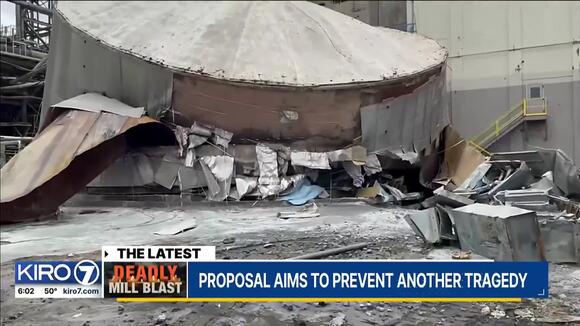
New rules are being proposed for paper and pulp mills following an investigation by the Washington Department of Labor and Industries (L&I) that detailed the lead-up to the tank failure in Longview that killed 11 workers and injured 12 others at Nippon Dynawave.
“The best tribute we can offer to those who died is to renew our commitment to industrial safety and to make sure workers go home safe at the end of every shift,” said State Senator Jeff Wilson, who represents Legislative District 19, which covers Longview and other communities in southwest Washington.
KIRO 7 and Wilson first discussed the gaps in oversight in June, about a week after the failure happened.
He has been working with union leaders, pulp and mill experts, and community members to develop a framework since then.
On Friday, L&I detailed its nearly six-month investigation, finding that the operator, Nippon Dynawave, failed to maintain a safe environment for its workers by not following industry recommendations on how corroding tanks should operate.
Marty Cohen, a Professor Emeritus at the University of Washington’s Department of Occupational and Environmental Health Sciences (DEOHS), says it’s workplace safety that fell under L&I’s jurisdiction.
“There wasn’t a very specific L&I regulation dealing with how those tanks should be maintained and replaced if need be, but they used the API, or the American Petroleum Institute, standards as a reference standard,” Cohen said.
KIRO 7 first reported in June that neither L&I nor the Department of Ecology has an inspection authority over plans.
Marissa Baker, a UW associate professor with the DEOHS, says responsibility rests only with the company itself.
“There were a host of violations at this company. There was a history of disregard for a third party coming in and telling them they needed to maintain and/or repair, replace, or shut down their tanks. And so it really pointed to kind of several broken systems on this site,” Baker said of the L&I investigation.
That investigation found that the walls on the lower section of the tank that failed, called G Tank, had eroded under the caustic chemicals it stored.
In July 2025, an outside contractor reported the walls were thinner than the recognized industry standard for safe minimum thickness.
The inspector noted the tank was not fit for continued service. L&I found that the tank walls continued to erode until failure.
Sections of the tank that failed were found to be half an inch thinner than the minimum safe thickness, at .07 of an inch, thinner than a quarter.
Industry recommendations from the American Petroleum Institute (API) lay out what an operator should do in that situation. API says an operator should reduce the tank’s capacity, repair the issue, or remove it from use.
L&I found none of those steps were followed, and the tank operated at or above 60% of capacity from August until the May rupture.
Wilson’s bill would put those recommendations into law, add requirements for leak monitoring, task L&I with mandatory inspections, and register each pulping mill tank in the state. A $5,000 fine would be levied for each week a facility is out of compliance.
“We know for a fact that the self-certification portion of industry regulated themselves. It didn’t work. The price that was paid for those 11 souls that were lost is way too much,” Wilson said. “This is a direct change in what has been done for the standard for years. Those days are done. Simply, they’re done. We’re moving forward.”
Cohen believes L&I’s team that enforces process safety management laws would be a natural fit. Those laws oversee “highly hazardous” materials in industries that use facilities like oil refineries.
He also said L&I staff would need extensive training to take on inspecting an entirely new industry.
“It’s very specialized. So, you have to have a lot of experience before you even do those types of inspections. So, you can’t just get someone coming out of school,” Cohen said.
Baker worries that new regulations could overburden an already busy L&I, though Wilson says his legislation would pay for enforcement through the fines or registration, but is still working on those details. She hopes that any regulatory role by L&I or Ecology doesn’t supercede who is responsible for the keeping a safe workplace.
“It was a workplace that had the information that there was a hazard present and actively chose to take steps to not control that hazard. That has always been the responsibility of the workplace and the employer,” Baker said.
Wilson agrees, saying he thinks this will change industry oversight completely in Washington.
“I hope it sets an attitude, an attitude that, listen, you’re open for business. No, you are open for the protection of fellow workers and the environment and your community around. I think this is a lesson for everybody that those 11 lives weren’t lost in vain and we will never forget them and their families,” Wilson said.
 Add to Preferred Sources
