undefined
Posts
undefined
Followers
Experts provide tips to prepare for future tech outages
By Jake Chapman,
17 hours ago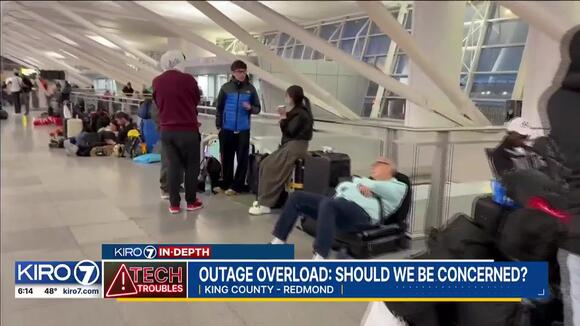
A series of technology outages affecting major companies and services is raising concerns among cybersecurity experts about the infrastructure millions of people rely on every day.
The disruptions have affected everything from travel and communication to financial services and workplaces. Two cybersecurity experts interviewed for this story said the number of outages occurring in a short period is unusual and concerning.
The problems come after Microsoft Outlook experienced a prolonged outage last week, leaving some users unable to access the email service for more than a day. Other outages have affected major companies and services.
“I mean, Marriott is on there. Apple is on there. Apple Store,” Datec’s Mike Hamilton said.
For people caught in the disruptions, the consequences can be immediate.
“I’m not able to print out my documents, because the UPS Store wasn’t able to accept any Outlook emails,” Chris Baker, who was impacted by an outage, said.
Baker said the repeated disruptions have also made him question society’s growing dependence on technology.
“I’m concerned about mine and the whole infrastructure’s reliance on tech,” Baker said.
Cybersecurity experts said the disruptions highlight the degree to which companies and consumers depend on interconnected systems and shared infrastructure.
While individual outages can have different causes, reliance on common systems can amplify the effects when something goes wrong.
“They’re using a common infrastructure, a common system, right?” Hamilton said.
Erik Moore, with Seattle University’s cybersecurity leadership program, said infrastructure also must keep pace as new technologies develop.
“As these new technologies come out, it’s accelerated,” Moore said. “So how much will we work on our infrastructure? Which is kind of what we are seeing in some of these outages.”
For consumers, Moore recommends preparing for the possibility that a service or system they depend on will temporarily become unavailable.
That can include keeping multiple backups of important information.
“Making sure that you download things and you save it on two USB drives, so that if one goes out, you still have the other one,” Moore said.
He compared digital preparedness to keeping emergency supplies in a vehicle.
“It’s the same way we think about our car,” Moore said. “You want to maintain your car. You like to drive carefully, but you also want to have the jack in the back or a first aid kit and something to inflate your tires.”
Hamilton said companies also bear responsibility for building resilient systems and having plans to restore services when failures occur.
“Hopefully, the companies that you use are mature enough on how to put these things back together,” Hamilton said.
For Baker, the recent disruptions have been a reminder that relying entirely on technology comes with risks.
“I think we need to get back to living like we used to,” Baker said. “Without it.”
 Add to Preferred Sources