undefined
Posts
undefined
Followers
Swept Before the Storm on Skid Row
By Stephen Oduntan,
5 days ago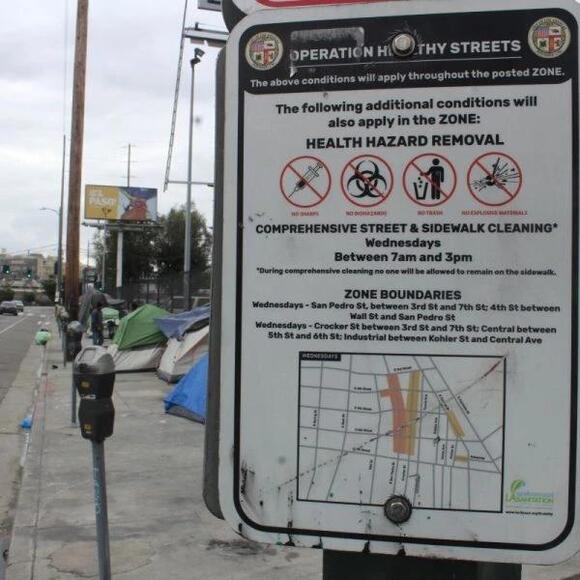
Days After Meteorologists Briefed Los Angeles Agencies on Incoming Rain, Crews Cleared Tents Along Central Avenue
The trucks announced themselves with a persistent beeping.
On the morning of October 21, a 65-year-old man living in a tent along Central Avenue in Los Angeles’ Skid Row had gone back to sleep. Sanitation crews usually arrived around 8 a.m., he said. When they failed to appear, he assumed they were not coming.
About 10 minutes later, he heard them.
“I came out,” he recalled. “The trucks were all lined up.”
Workers told him he had 15 minutes to gather his belongings and leave.
The man, who requested anonymity, has been homeless for more than a year. When interviewed on Central Avenue, he leaned on a walking stick, his dark hair streaked with gray. An oversized jersey hung loosely from his slender frame.
Chronic pain and limited mobility made the sudden demand to pack up particularly difficult.
He managed to gather clothing, tools, a sleeping bag and a laptop. A large tent he had erected just two weeks earlier was among the possessions he could not save.
“You guys gotta go,” he recalled a worker announcing as police officers stood nearby. “Come on. Let’s go, let’s go, let’s go.”
Still trying to collect his belongings, he protested.
“He just told us 15 minutes,” he recalled saying. “It only been about 10 minutes.”
The worker disputed that he had been promised so much time, the man said.
By then, workers had cordoned off the area with tape, preventing him from returning to his belongings, according to his account.
“Can I come back and get my bed?” he recalled asking.
“Nope, you can’t do that, either,” he said he was told.
He also asked workers to spare his tent. According to his account, they refused, citing rat contamination.
But losing his belongings was not his only grievance. He alleged that police officers and sanitation workers laughed as possessions were thrown into a truck.
“It’s like they get a kick out of it,” he said.
Asked whether he had been treated with dignity, he chuckled.
“Not at all. Not at all.”
About an hour after the crews departed, according to his recollection, rain began falling.
“Fortunately, for me, I got housed in a shelter till the rain stopped,” he said.
Some neighbors remained outside.
“They were stuck out here.”
A Cleanup Schedule Without Certainty
For people living on Skid Row, the uncertainty extends beyond how much time they have to collect their belongings.
During a neighborhood walk, John Raphling of the Los Angeles Community Action Network (LA CAN) pointed to Operation Healthy Streets notices designating Wednesdays for sidewalk cleaning across multiple street segments, without specifying when crews would reach individual blocks.
“It makes it very unpredictable,” Raphling said. “People have no idea.”
The homeless man described repeatedly dismantling his shelter in anticipation of cleanups that sometimes never occurred.
“There’s times where I’ve taken everything down,” he said. “Everything’s all packed up. And they don’t show up.”
Raphling described similar complaints about the time residents are given to collect their belongings.
“Often, they’ll give you four minutes, five minutes, eight minutes,” he said.
Launched in 2012 amid public health concerns, Operation Healthy Streets has faced scrutiny over the seizure and destruction of homeless residents’ belongings.
That same year, a federal appeals court upheld restrictions on Los Angeles officials seizing and immediately destroying property that homeless residents had not abandoned.
A 2024 Human Rights Watch investigation documented concerns about imprecise cleanup notices, limited time to gather belongings, and contamination classifications used to justify property disposal. Its findings predate the October 21 operation.
Similar concerns have surfaced in earlier reporting. Invisible People has previously reported on a homeless Los Angeles resident with impaired vision who was given 15 minutes to move his belongings during a cleanup.
Raphling said there was a better way to maintain clean streets without repeatedly displacing homeless residents.
“What it should be is regular trash pickup,” he said. “Let everyone know, let people put all their trash out.”
Advocates have also organized community-led cleanups as alternatives to city sweeps.
Police at the Cleanup
The Los Angeles Police Department confirmed that Central Area officers were present during the operation.
LAPD said officers were assigned to public safety and medical response, not property removal. The department reported no arrests, citations, or uses of force.
Raphling questioned whether those figures captured the pressure homeless residents experienced.
“That’s what they’ll always say, right?” he said. “They stand there, and if you don’t obey the sanitation workers, then they’ll make an arrest.”
LAPD Lt. Elpidio Orozco said officers were expected to treat everyone with dignity and respect.
“When they see someone in distress, including people who are elderly or have limited mobility, they can request medical help and connect them with outreach resources on site,” Orozco wrote.
The department did not provide specific examples of assistance during the cleanup.
Addressing the man’s allegation that officers laughed as belongings were discarded, Orozco said, “The Department takes any allegation of officer misconduct seriously.”
He said complaints could be filed anonymously and investigated, including through review of available body-worn camera footage. LAPD could not evaluate the individual allegation without additional information, he added.
The Rain Was Already in the Forecast
For the homeless man on Central Avenue, the danger was not necessarily the intensity of the storm but the loss of shelter before it arrived.
Raphling said he witnessed sanitation equipment crushing tents and belongings during the cleanup. LA CAN recorded video, he added.
In a subsequent statement, nine advocacy organizations alleged that nearly 20 homeless residents were affected and only one hotel room, accommodating two people, was made available.
The coalition called for emergency shelter, rain protection supplies, and suspension of enforcement operations when storms are imminent.
Those accounts raised a question: With rain approaching, what precautions had city agencies taken before an operation that residents and advocates said left people without their shelters?
The rain was already in the forecast.
Days before sanitation trucks arrived on Central Avenue, the National Weather Service had predicted rainfall. Meteorologists briefed city agencies twice, including two days before the cleanup.
“An additional webinar was given to city agencies on Monday, October 19, to provide the latest forecasts indicating rain was imminent,” said Todd Hall, warning coordination meteorologist at the National Weather Service’s Oxnard office.
The downtown Los Angeles weather station recorded 0.19 inches of rain on October 21. Hall described the rainfall as typical for the season, although heavier showers may have occurred in some areas.
The weather service did not establish precisely when rain began falling on Central Avenue or whether LA Sanitation received the briefings.
In a statement to Invisible People, the Los Angeles Department of Public Works said sanitation crews can postpone or modify operations because of weather conditions.
“LASAN crews do postpone or reschedule operations when environmental conditions make it difficult to conduct health hazard determinations,” the department said. “Especially during rainfall or when temperatures drop below 50 degrees Fahrenheit, services are downgraded to spot cleaning.”
It also did not directly address questions about advance notice, the time homeless people were given to gather belongings, contamination determinations, or property disposal.
The department said LA Sanitation was working with elected officials and community stakeholders to evaluate how resources are deployed in Skid Row.
Invisible People also sought comment from the Los Angeles Homeless Services Authority about emergency shelter availability, weather-response procedures and whether outreach teams offered accommodations to homeless people affected by the cleanup. LAHSA had not responded by the reporting deadline.
Mayor Karen Bass’ office also did not respond to questions about requests to suspend sanitation operations ahead of rainfall and measures to protect homeless people.
For the homeless man on Central Avenue, the dispute came down to something more immediate than sanitation schedules or weather forecasts: whether he could retrieve the belongings he needed to survive.
“I don’t understand why they can’t let us get what they know we need,” he said.
He imagined a worker offering a small concession.
“I’ll let you come back and get one more thing, and then you can go.”
 Add to Preferred Sources