undefined
Posts
undefined
Followers
Why airplanes stay safe even during violent airflow changes
By Georgina Jedikovska,
2026-03-31
Anyone who has boarded a plane has most likely experienced sudden bumps and shaking mid-air. Known as turbulence, this in-flight physical phenomenon can feel quite unsettling. As a matter of fact, it’s one of the main reasons up to 40 percent of US citizens struggle with aviophobia, an intense, irrational fear of air travel.
But the reality is that despite how terrifying it may feel, turbulence is just a routine part of flying. And it’s far less dangerous than it appears at first glance.
Turbulence is a sudden, often unpredictable disturbance in airflow. Characterized by rapid shifts in wind speed and direction, it generates rising and descending air currents caused by irregular atmospheric motion. This causes the aircraft to move with the surrounding air.
In short, turbulence occurs when an aircraft moves through irregular or unstable airflows. But why doesn’t it have a greater impact on aircraft, and how do planes stay in the sky? The answer lies in how they’re engineered.
Types of turbulence
Turbulence can be triggered by a number of environmental factors. Atmospheric changes are, however, its primary driver. Convective turbulence, caused by uneven heating of the Earth’s surface, is one of the most common types. It happens when warm air rises and cool air sinks. Consequently, strong vertical currents create updrafts and downdrafts during flight.
Mechanical turbulence is another frequent form. It happens when the airflow is disrupted by terrain or man-made structures, such as mountains, buildings, and even rows of trees. These break up the smooth wind patterns and produce irregular air movements, especially at low altitudes.
Clear-air turbulence (CAT), an often invisible turbulence form, happens at higher altitudes. It develops when fast-moving air, like jet streams, interacts with slower surrounding air. It forms in cloudless regions and cannot be easily detected by onboard radar.
Turbulence can also intensify near weather systems. Frontal turbulence develops when warm and cold air masses collide. Thunderstorm turbulence can be highly severe due to powerful updrafts and downdrafts within storm systems. It is the reason pilots avoid flying through or near thunderstorms.
Wind shear happens closer to the ground. It is an abrupt change in wind speed or direction over a short distance. It can rapidly alter a plane’s lift and performance, which is why it’s particularly critical during takeoff and landing.
Designed to adapt
Commercial airplanes cruise at speeds of up to 600 miles per hour (521 knots) at altitudes between 30,000 and 42,000 feet, levels which are specifically selected to reduce disturbances. However, shifting wind patterns and atmospheric conditions mean turbulence can still occur at virtually any altitude.
This is why modern aircraft are engineered not to withstand, but rather to absorb and adapt to turbulence. In line with certification standards set by the Federal Aviation Administration (FAA) and the European Union Aviation Safety Agency (EASA), every aircraft must withstand forces exceeding those of routine flights.
For this reason, engineers define a so-called limit load. This is the highest load an aircraft is expected to encounter during its operating life. Aircraft are required to withstand 1.5 times that level without failure.
A plane’s wings play a crucial role in its resilience because they are built to flex under stress and sometimes bend upward by a few feet. This absorbs turbulent loads and reduces structural fatigue, much like a shock absorber.
Modern carbon-fiber composite wings are made to bend rather than break. They outperform materials like aluminum and titanium in strength-to-weight ratio and can handle roughly 150 percent of expected loads. The Boeing 787 Dreamliner and Airbus A350 use carbon-fiber composites in both the wings and stabilizing tails.
Moreover, fly-by-wire systems adjust control surfaces in real time. These semi-automatic, computer-regulated flight systems replace mechanical flight controls with an electronic interface. They smooth out disturbances and reduce loads in the airframe.
Turbulence on the rise
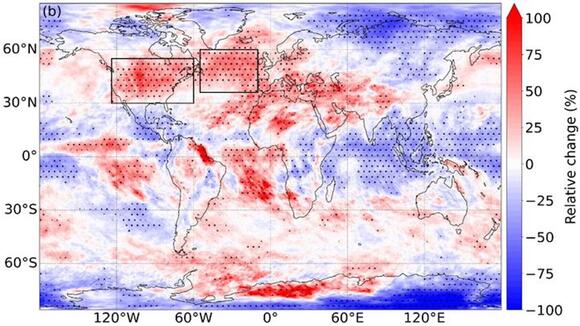
On a less optimistic note, turbulence seems to be increasing. A 2023 study by the University of Reading, UK, found that severe turbulence has surged by as much as 55 percent since 1979. The rise is most notable in clear-air turbulence, which is difficult to detect.
The researchers pointed to climate change as a possible factor. An earlier paper conducted by the same university found that climate change could make severe aircraft turbulence up to three times more common.
Credit: Mark Prosser et al.
The team used supercomputer simulations of the atmosphere and found that the rise is driven by stronger wind shear in the jet stream. Even moderate turbulence is expected to rise sharply.
“Even the most seasoned frequent fliers may be alarmed at the prospect of a 149 percent increase in severe turbulence, which frequently hospitalizes air travelers and flight attendants around the world,” Paul Williams, an atmospheric science professor at the university, said.
Predicting air turbulences
Now the good news. Planes don’t crash during turbulence because their wings continuously generate lift and the surrounding air remains intact, similarly to a boat riding waves. It comes from irregular airflow, not empty pockets, which is why even in severe cases, the plane will move with the air rather than dropping.
Nevertheless, while turbulence is unlikely to destroy an aircraft, it can still lead to structural damage. Turbulence forecasting improves cabin crew and passenger safety, reduces injuries, and boosts fuel efficiency.
However, the process still remains the critical weak point of modern-day aviation, as predictions rely heavily on subjective and often inaccurate pilot reports. This is why improving forecasting methods remains a priority for researchers.
Credit: FUW, jch
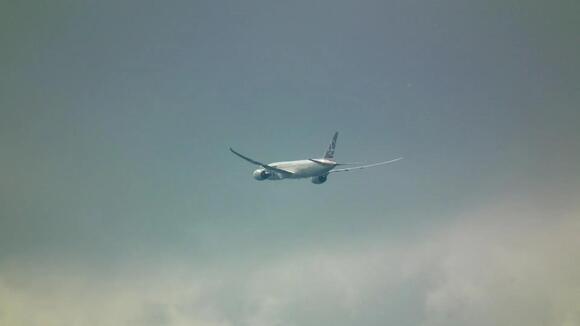
For example, scientists from Poland’s University of Warsaw found that turbulence can be detected faster and more accurately by analyzing flight parameters from data broadcast by commercial aircraft. As per the study, planes themselves can act as airborne sensors and help identify turbulent zones in near real time.
A different study from the KTH Royal Institute of Technology and the Barcelona Supercomputing Center revealed that AI could prevent sudden mid-air altitude drops. The team tested a machine learning system that improves airflow control over the wings. The system reduces stall risk while improving stability.
Another AI method from the Universitat Politècnica de València utilizes neural networks to analyze complex fluid behavior and therefore explain turbulence, rather than just simulating it.
Using modern technologies to predict turbulence, rather than simply reacting to it, can significantly enhance flight safety.
 Add to Preferred Sources
