undefined
Posts
undefined
Followers
Guest Column: Forgotten grave, fresh history
By David Duncan,
1 days ago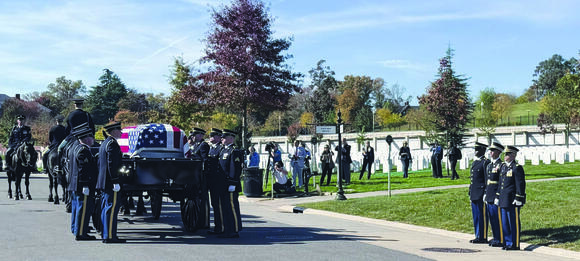
Guest Column: Forgotten grave, fresh history
The small, white clapboard house at the corner of Featherbed Lane and Lee Highway in Manassas where Lucinda Dogan, a widow, raised her eight children was at the center of the storm during the Battle of Second Manassas on Aug. 29 and 30, 1862.
Union batteries lined up outside and, after the battle, surgeons took over the dwelling as a makeshift field hospital. Amputated legs and arms were buried in a nearby pit.
Today, most of the 50,000 motorists who drive by the Dogan House each day are unaware of this layered history written there 160 years ago in the blood of American soldiers. That history continues to unfold today.
On Nov. 4, an unknown Union soldier whose remains were discovered in a battlefield grave near the Dogan House 2½ years earlier was reinterred with full military honors at Arlington National Cemetery.
The soldier was just a teenager, and one of some 3,300 who died in the three-day battle. His bones were found with six New York State Excelsior coat buttons, indicating he served in a New York infantry unit. In the grave, archaeologists also found his rubber pocket comb and, more tellingly, a lead artillery case-shot ball near his neck – quite possibly the wound that killed him.
I am humbled when I think of the courage and sacrifice of this young soldier. In my mind’s eye, I can see him enlisting in the Union Army with a heart full of resolve to fight for his country, only to become an unknown soldier in an unmarked grave hundreds of miles from home. The presence and discovery of his remains are a powerful reminder of how significant these battlefields remain.
In 2014, routine maintenance on an underground water pipe near the house uncovered a human bone. By 2015, National Park Service archaeologists had discovered the remains of two soldiers and seven or possibly eight amputated limbs. These two unknown soldiers were given a final resting place at Arlington National Cemetery in 2018. Further excavations in 2024 found the New York soldier’s body, along with several more amputated limbs.
These discoveries underscore the undeniable truth that graves of soldiers killed in battle remain, unmarked and unknown, scattered across the nation. Just a few years ago, 14 Revolutionary War soldiers were discovered in Camden, S.C., and I have no doubt that other soldiers killed at Second Manassas are still in their unmarked, unknown battlefield graves. These discoveries are among the most important reasons why I seek to protect these historic landscapes. “Hallowed ground” is more than a pretty turn of phrase.
Because this particular soldier’s first resting place was on ground that was ultimately protected within Manassas National Battlefield Park, it was not marred by the rampant development that has overrun the region and threatens unpreserved parts of the Manassas battlefield. His former comrades who still rest elsewhere in the fields of Prince William County and countless other battlefields may not be so lucky. Their rest might be disturbed at any time by the construction of a highway, a subdivision or a warehouse complex.
As president of the American Battlefield Trust, the nation’s premier historic land preservation organization, I am honored to represent some 500,000 members and supporters as we work with the park service’s American Battlefield Protection Program and numerous local organizations to save the places where our forefathers fought and died for the freedom we have today.
Since 1987, the trust has saved more than 63,000 acres across 160-plus battlefields in 25 states, representing engagements from the outset of the American Revolution to the end of the Civil War. At the Second Manassas battlefield alone, we have saved more than 387 acres by buying land at market prices from willing sellers. And the trust helped lead the fight that stopped the development of a massive complex of data centers next to the battlefield park.
The discovery of the remains of yet another unknown soldier on an American battlefield is a sobering reminder that our past is very much a living history that must be honored and protected.
David Duncan is president of the American Battlefield Trust, a nonpartisan nonprofit organization.
 Add to Preferred Sources
