undefined
Posts
undefined
Followers
Startup Tests Offshore Geothermal Power
By Julia Tilton,
2026-09-24Geothermal startup Endurance Energy began drilling a well last week into the seafloor in an attempt to harness energy from an underwater volcano. The well, located 1,500 meters below the surface of the Pacific Ocean off the Oregon coast, will give the company access to hot fluid from Earth’s crust, which will spin the turbine of an underwater power generator.
The project takes an elaborate approach to tapping geothermal energy that’s far more accessible elsewhere. Nearly every other geothermal company is operating on dry land while Endurance is adding a host of engineering challenges by doing it in deep water. But the company is betting that the approach will prove valuable for small islands needing an alternative source of energy as they try to wean off expensive, imported diesel.
Subsea geothermal is “a slightly dingbat idea, at least for grid generation,” but it has potential in certain use cases such as generating power for islands, says Roland Horne, director of Stanford’s geothermal program. But he remains skeptical. Companies have long tried and failed to make offshore geothermal work at scale, and questions remain about logistics and performance in the harsh conditions of the deep ocean.
Endurance, based in Seattle, acknowledges the ambitiousness of the plan. “There’s very, very little precedent” for successfully generating power with subsea geothermal technology, says Endurance CEO Andrew Redd. The Oregon project “really serves as a learning pilot for us,” he says.
How to Drill for Offshore Geothermal Energy
Over the past several weeks, Endurance has been using remote sensing to survey the Pacific Ocean’s seismic and volcanically active Juan de Fuca Ridge in search of a few target locations to install its system. From the command center aboard the Ocean Guardian, a Stabbert Maritime vessel, the company’s team identified a few flat areas on the seafloor near the Axial Seamount, the region’s largest and most active volcano, about 500 kilometers from the Oregon coast.
Last week, the company chose a spot and drilled a shallow, 60-meter well to gain access to hydrothermal fluid, or briny water, at around 250 °C. That temperature is within the 250–350 °C “sweet spot” that will allow the team to “still use a lot of pretty normal terrestrial materials,” Redd says. The well’s bore hole, at 5 centimeters in diameter, is considerably narrower than those of land-based geothermal systems, which draw from wells that are about 20–30 cm in diameter.
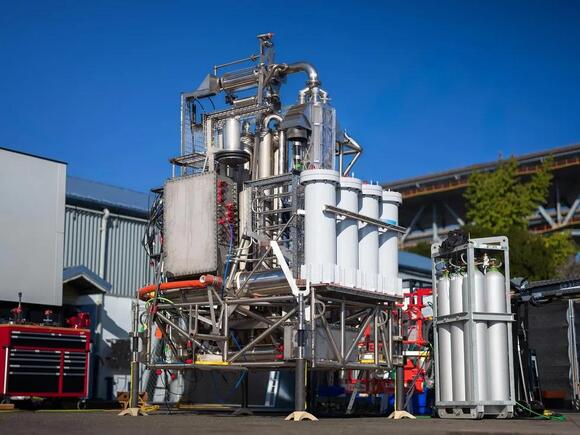
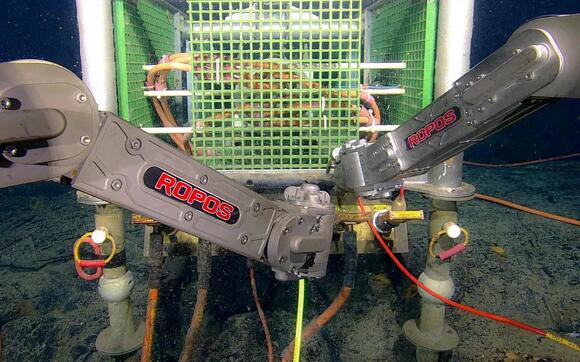
Next week the team plans to submerge its 100-kilowatt power system, dubbed Adélie, and place it on the seafloor about 20 meters away from the well. A submarine robot will then unspool flexible piping to connect the well to the generator and turn on the flow of hydrothermal fluid.
The power system’s organic rankine cycle technology uses a closed-loop heat-transfer process to generate electricity by spinning a turbine. This kind of generator has not been hooked up to a well on the seafloor before, so the team selectively chose materials that can withstand the undersea environment, Redd says.
Once fluid from the well is connected to the power system, electricity production will begin. But for this deployment, the company will be focused more on data collection than power. A fraction of Adélie’s electricity capacity will be used to power sensors, and the rest will be released back into the water as heat. Temperature and flow-rate data from Adélie will travel back to shore in real time via an existing fiber-optic cable network operated by the National Science Foundation’s Ocean Observatories Initiative–part of the reason Endurance chose the site.
The Juan de Fuca Ridge “is an extremely well-researched, well-studied, and well-surveyed part of the ocean floor,” Redd says. “So we’re really focusing on how much can we learn from this process while being very good stewards of the vent systems.” Before the deployment, Endurance took baseline temperature and environmental measurements so that it can later evaluate the technology’s impact on the surrounding ecosystem.
Redd says the company has already learned a lot through the system’s design and coordination with existing offshore resources, like the array of research cables lining the ocean floor between the Axial Seamount and the coast of Oregon.
Tonga Turns to Subsea Geothermal
Endurance Energy aims to operate on the Axial Seamount for a year, Redd says. By the end of 2027, the company plans to deploy a 2-megawatt unit off the coast of the Kingdom of Tonga. Like many island nations, Tonga faces high prices for diesel, which has to be shipped from abroad at the whims of geopolitics. The country’s partnership with Endurance is part of a strategy to build the island’s energy independence.
Unlike the pilot near Oregon, the Tonga system will generatepower for the island, and won’t be installed quite so close to active volcanoes, where seismic activity is a risk.
Endurance will have to lay submarine cables to transfer the power to shore which will add to the overall cost, the exact details of which Redd says are still being determined. He says Endurance’s system will be competitive with the cost of the diesel upon which many Pacific Island nations like Tonga currently rely.
Endurance will surely face doubts about the viability of subsea geothermal for large-scale generation, especially when there are plenty of terrestrial geothermal resources waiting to be tapped. “It’s not like oil and gas; that we ran out and had to look somewhere else,” Horne says.
But Endurance’s team is steadfast in its belief that its technology will be cost-competitive at scale. And as for building out all of those underwater cables–Endurance sees that as an opportunity. Offshore, there’s more flexibility with the transmission corridor than onshore, where existing transmission lines bring limitations, says Jennifer Kenyon, Endurance’s director of policy and external affairs.
“If offshore wind figured it out…and they’ve managed to be cost-competitive in parts of the world, I think there’s [a] ‘there’ there,” Kenyon says. “We just need to build to get to it.”
This article was updated on 25 September 2026. It was corrected to reflect the accurate owner of the Ocean Guardian vessel and the manner in which excess heat is released into the water.
 Add to Preferred Sources

