undefined
Posts
undefined
Followers
Idaho officials say wildfire resources are under pressure
By ROYCE MCCANDLESS,
2026-08-11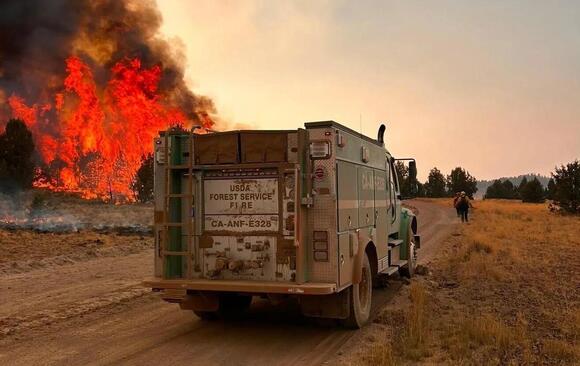
COEUR D’ALENE — State and federal officials gathered Friday at Coeur d’Alene’s Interagency Fire Cache for an appraisal of fire season in Idaho and the broader region.
The joint press conference arrived as the Pacific Northwest, and the states of Oregon and Washington specifically, have been the hardest hit by wildfire to this point in the year, with 3 million acres burned and counting across the two states.
“Hot temperatures, dry fuels, low humidity, changing winds are creating conditions where wildfires can spread rapidly and unpredictably,” Gov. Brad Little said. “These conditions are placing tremendous demands on the firefighters and the firefighting resources throughout the region, and for that matter, throughout the country.”
U.S. Forest Service Chief Tom Schultz said this year’s fire season was uniquely challenging.
The 10-year average for wildfires nationally to this point in the season is 35,000 fires and 4 million acres burned. This year fire numbers are 127% of the 10-year average and acres burned is at 144% of the 10-year average.
Schultz said that the conditions observed in Idaho — of statewide drought and historically low snowpack — are not unique, with similar circumstances observed in Washington, Oregon, California, Utah, New Mexico and other Western states.
“Many of those states have had somewhere between zero and 15 percent of snowpack that they would traditionally get,” Schultz said, “so we knew these conditions are going to be difficult.”
Schultz described the ongoing fires around Spokane — those being the Autumn Lane, Old Trails and Fairview fires — as being the “No. 1” priority in the nation. As of Friday, Schultz said over 850 structures were burned by the fires and 1,500 personnel had been assigned to the area, including 242 from the U.S. Forest Service.
Emphasizing the interconnectedness of firefighting operations, Schultz said Coeur d’Alene’s tanker base has facilitated 740,000 gallons of fire retardant this year, more than half of which have been delivered to Washington state in the last month.
Idaho Department of Lands Fire Management Bureau Chief Josh Harvey highlighted the recent emergency declaration from Little authorizing Idaho National Guard deployments to assist with large wildfires.
The declaration signed by Little on July 28 has since allowed IDL access to personnel and aviation resources within the Idaho National Guard through the Office of Emergency Management that have since been dedicated to the Big Grass fire, Harvey said. The fire originating near the Idaho-Oregon border has since burned more than 550,000 acres across both states and extended into Owyhee County.
According to a statewide report issued Friday, 485,550 acres have burned across all jurisdictions this fire season. Looking specifically at areas protected by IDL, there have been 4,480 acres burned across 149 fires, 81 of which have been determined to be human-caused, 29 of which are natural and 39 of undetermined cause.
IDL fire suppression expenses have totaled approximately $23.3 million, approximately $6.5 million of which is reimbursable due to certain costs stemming from IDL assisting agencies with fires outside of IDL’s jurisdiction. This leaves a net general fund obligation of $16.8 million to this point in the fire season, the report said.
At the national level, Harvey said more than 31,000 personnel have been assigned to fires that are largely concentrated in Western states. This includes 625 hand crews, 1,897 engines and 186 helicopters committed to active incidents.
“Those numbers demonstrate the level of competition any fire is going to be competing for resources across the country,” Harvey said. “Idaho is prepared and continues to coordinate available resources, but crews, engines, aircraft, and incident management personnel are in very high demand.”
Beyond interstate allocations, fire demands are also bringing firefighters from outside the county. Up to 250 additional fire management specialists from Australia and New Zealand are scheduled to arrive in the United States on Tuesday and Wednesday to provide added support.
The incoming personnel will receive an orientation and briefing at the Boise-based National Interagency Fire Center on Thursday and Friday before being assigned to incidents across the country, according to a release from the National Multi-Agency Coordinating Group.
Speaking to his long-term funding aims for IDL, Little said he wanted the agency to receive an annual appropriation for wildfire suppression aligning with the five-year average in firefighting costs, equivalent to about $47.2 million, as was previously reported by the Idaho Press.
Little has consistently urged the Idaho Legislature to provide a pre-payment for fire suppression costs ahead of fire season. Though this fund repeatedly saw balances of around $70 million during years with budget surpluses in the hundreds of millions of dollars, it dipped to around $3 million after last year’s $76.2 million fire season, before hitting a cash balance below zero in June.
“It makes you a wiser purchaser if you’re not saying, ‘Well, we got to go ask the legislature about it,’” Little said, referring to the mechanism when unmet fire season expenditures are covered in the next legislative session. “If we got money in the bank, we can go out and be more efficient in our contract(s).”
 Add to Preferred Sources