undefined
Posts
undefined
Followers
The Twilight Years of Kauffman Stadium
By Kevin O’Brien
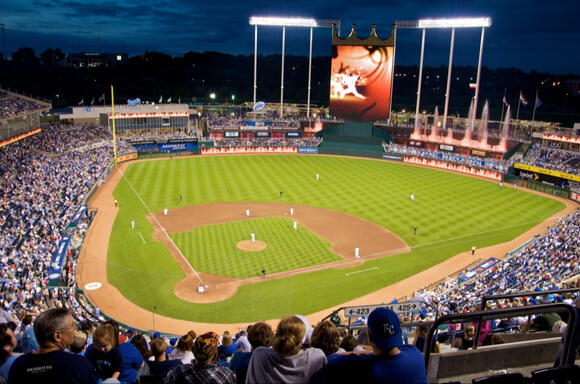
The Royals plan to move from photogenic but inconvenient Kauffman Stadium.
In April 2026, the Kansas City Royals partnered with Hallmark Cards to announce a new downtown ballpark in Crown Center, replacing Hallmark Cards’ former headquarters. The stadium announcement ended years of uncertainty regarding the future of Kauffman Stadium and the Truman Sports Complex.
In December of 2025, the Kansas City Chiefs shocked fans by announcing that they were moving across the state line and into Wyandotte County, which is also where the Kansas Speedway and Children’s Mercy Park, the home of the MLS’ Sporting KC, is located. Talk of moves for the Chiefs and Royals began in April 2024 after Jackson County voters rejected a stadium sales tax extension that would’ve kept both teams in Kansas City, Missouri. After the Chiefs announced their intentions to move to Kansas, Kansas City and Missouri made a strong effort to keep the Royals.
The Royals’ announcement and planned move have sparked controversy.
While owner John Sherman and the Royals’ ownership group will provide some private investment, the city and the state’s Show-Me-Sports Investment Act will provide $600 million. Using public funds, especially when many people in Kansas City and across the country are struggling financially, seems like poor timing and an insult to working-class folks. Second, because of the public-private design plan, the new stadium will not go to a public vote. That has angered local Kansas City folks, especially in Jackson County, since they rejected the 2024 measure.
Regardless of the feelings and finances of this new project, one thing is clear: Kauffman Stadium is on a short leash.
The plan seems to be for the Royals to begin breaking ground in the next couple of months or at the start of 2027 so that the new downtown ballpark is ready by Opening Day 2030. While that would mean a penalty for the Royals for breaking their lease (they’re technically under contract until 2031), it’s likely Jackson County, Kansas City, and the Royals will reach an agreement, especially since the Royals will be staying in the city and county.
Thus, Royals fans will be entering the twilight years of Kauffman Stadium, which is sad given the ballpark’s rich history since it opened in 1973.
After playing four years at Municipal Stadium in the heart of the Jazz District from 1969-1973, the Royals moved to the Truman Sports Complex to prove that big-time baseball belonged in Kansas City (the Athletics moved after the 1967 season). While the A’s were a joke, the Royals became competitive almost immediately, capturing the attention of not just Kansas City baseball fans, but baseball eyes across the nation.
From 1976 to 1981, they made the post-season in five of six seasons, including an AL pennant in 1980 (they lost to the Phillies in the World Series). They captured their first World Series title in 1985, beating I-70 rival St. Louis in seven games. During this period, the Royals were one of baseball’s best small-market teams.
Unfortunately, after 1985, success waned, especially after owner Ewing Kauffman’s death in 1993. Despite those on-field issues, Kauffman Stadium remained one of baseball’s most iconic parks, even though it sat in the middle of nowhere on the outskirts of Kansas City.
Kauffman (named for the owner after his death) helped pioneer a movement away from the “multi-sports” complexes built in the '60s and '70s. Unlike Oakland, which opted for a multi-sports complex for the A’s and Raiders in the Coliseum, the Chiefs and Royals had separate stadiums, located right next to each other. With a single-sport focus, the clubs could design stadiums that were not only aesthetically pleasing but also ideal for fans’ sight-lines and game-watching experience.
The Royals’ home yard remains an immaculate palace for those who truly enjoy baseball. The fountains are unique in baseball and quintessentially KC (the city has more fountains than any other in America). The stadium is incredibly easy to navigate, making it a breeze for tourists who want to explore everything the K has to offer. The Royals Hall of Fame is expansive, constantly updated, and most importantly, free. Lastly, there isn’t a bad seat in the house, and sections cater to all kinds of baseball fans.
The stadium has undergone a few renovations, including Astroturf replacement in 1995 and a major renovation in 2009 after the 2006 stadium sales tax, which allowed the new Crown Vision scoreboard and the outfield experience area. Despite those changes, the soul of Kauffman Stadium never changed, and it became a bucket-list destination for visiting fans who wanted to watch a ballgame in the fifth-oldest active stadium in Major League Baseball.
Kauffman isn’t without its flaws. If it was a perfect situation, they would have stayed in the Truman Sports Complex, especially with the Chiefs deciding to move to Kansas.
The area around the complex is sparse with no attractions (well…unless you consider Taco Bell an attraction), and a big reason why they’re moving downtown. Attendance has also struggled, though part of that is due to the team’s competitiveness. Since 1991, the Royals have hit the 2+ million attendance mark only three times (2016, 2017, and 2018) after the 2015 World Series title. Sure, the baseball product wasn’t good, but Kauffman’s remote location and lack of amenities around the complex certainly didn’t help the attendance endeavor. A new ballpark with a Ballpark Village and proximity to downtown attractions — much in the mold of St. Louis, Denver, and the North Side of Chicago — seems to be one way the Royals will improve attendance and better engage the Blue and White faithful.
With three years left, Kauffman will be an experience worth appreciating for baseball fans, especially those who live in the area. It’s not the fanciest ballpark, but it’s certainly one of the friendliest. Whether it’s chatting it up in the parking lot with tailgaters or season ticket holders or being welcomed by ushers and laid-back Royals fans, Kauffman Stadium is an experience where fans of all ages and teams can feel welcome. There’s certainly a classic flair to the park that makes it special: Sluggerr the mascot, the hot dog races, the kiss cam, $5 Miller Lites, the blazing heat of a mid-summer day game and the numerous water coolers to help fans avoid heat stroke in an August game against the Tigers.
A new ballpark will bring excitement. It will bring new fans. It will revitalize the city, especially among tourists who don’t want to rent a car and travel all over the city to watch a ball game and take in the city’s sights on the same day. This move to downtown was probably a long time coming, and it will be interesting to see Major League Baseball played in somewhere else in Kansas City than Kauffman Stadium in 2030.
For now, however, Royals fans need to enjoy and savor the next three years (well, two if baseball doesn’t happen in 2027). The tailgating, the seats, the baseball, the vibes, and the Royals experience just won’t be the same outside of the K.
It never is with teams when they move stadiums, even if it is within the same metro and city.
Kevin O’Brien is an educator and the editor of Royals Keep, a Kansas City Royals-centered web site that is part of the Diamondcentric network. He is also a contributor to Pitcher List, a co-host of the Royals Pipeline podcast, part of the KC Sports Network. He is based in Kansas City, Kansas.
 Add to Preferred Sources
