undefined
Posts
undefined
Followers
Museum curator asks, “What happened to the Ioway?”
By Winona Whitaker,
2026-09-01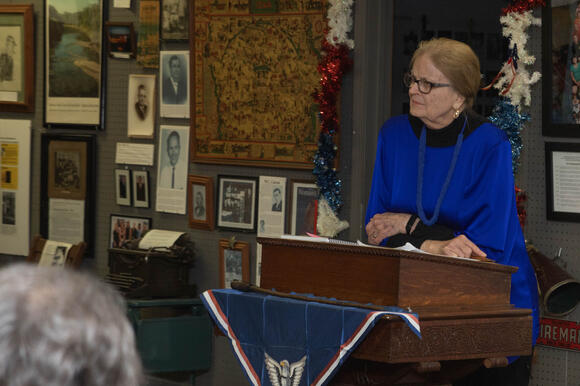
NORTH ENGLISH — Sandra Kessler Host, Curator of the Iowa Rural Schools Museum in Odebolt, was raised on a farm in Sac County and, after leaving for college and work, returned to the state — Council Bluffs — almost 20 years ago.
Like many Iowans’, Host knew very little about the Indian tribe from which the state took it’s name, the Ioway.
While researching the history of farming in Iowa, Host learned the history of the natives who lived in the state and left the state as Europeans pushed their way across the continent.
It all began with the French Fur Trade in Canada, Host told a crowd of more than 50 listeners during a presentation at the English Valleys History Center in North English. Sunday, Aug. 30.
In 1530-1540 in Canada, French fur trader Jacques Cartier traded metal objects, such as knives and pots, to tribes along the Canadian waterways, said Host. The French set up trading posts in the Great Lakes region and along the Mississippi river during the next 100 years.
From 1629-1701 the French fought the Iroquois, winning the war for the fur trade known as The Beaver Wars, said Host. The French pushed the Iroquois, south of the great lakes into western Illinois. After a 50 year struggle, the Iroquois defeated the Illini Confederation, pushing them west across the Illinois River.
The French defeated the Sauk in the Great Lakes region and pushed them west from Michigan and then south into western Illinois where they decimated the rest of the Illini by 1667 and created a settlement called Saukenuk near Rock Island, Host said.
Many historians believe fur traders reached the Ioway in 1669 at the Des Moines Rapids near Keokuk. The rapids, which were negated with the building of the lock and dam in 1913, were a major impediment to steamboat traffic. This helped isolate the Ioway, said Host.
The Ioway were a nomadic plains tribe which spoke a language with Siouan roots. They used teepees and rode horses left by the Spanish.
The territory that is now Iowa was also protected by prairie grasses, big blue stem which grew six feet tall above seven-foot roots. Travel through the grass was difficult, said Host. Even a man on horseback could get lost.
Explorers stayed near rivers and forests, said Host. Wagon trains traveled around Iowa.
The Ioway controlled most of Iowa, southeast Minnesota and Northeast Missouri when Europeans came, said Host. They were known for trading salt in Missouri and pipestone from southern Minnesota.
Louis Joliet is said to be the first European to set foot in what is now Iowa. He came to Iowa to trade in 1673. Julian Dubuque set up the first trading post in 1788 in Iowa at what is now Dubuque, became friends with the Meskwaki there and made an agreement with them to mine lead.
The Fox Wars, from 1712-1733, ended with the French taking the control of the Fox River from the Fox, or Meskwaki Indians, and giving them control of waterways from Green Bay to Prairie du Chien and access to the Mississippi.
Much diminished, the Meskwaki tribes joined the Sauk in Illinois, said Host.
The movement of tribes into the hunting grounds of other tribes caused additional conflicts.
Following the French Indian War, the British took control of the region previously held by the French as Louisiana.
In 1800, the Sauk and Meskwaki made an alliance and defeated the Osage in Missouri for control of their hunting grounds, which they shared with the Ioway. They betrayed the Ioway and sold the land to the U.S.
The land in southeast Iowa was used as a half-breed settlement because intermarrying was not allowed in Illinois.
In 1803, a small pox outbreak killed about 25% of the Ioway, which was already a small tribe, said Host. Estimates put their population at less than 1,000 following the small pox deaths.
Settlement in Iowa began about 1833 following the Black Hawk purchase.
The Ioway consisted of seven major clan groups which acted as a family with different duties. Leadership was alternated between clans. But in 1801, the tribe had to name a chief because the U.S. government needed to negotiate treaties with a single leader
After the war of 1812, tribes that supported Great Britain, such as the Ioway, had a hard time, said Host.
In 1823, that Sauk attacked unarmed Ioway warriors near their main settlement Iowaville while the Ioway were taking part in competitions, said Host.
Some historians don’t believe the attack occurred because no artifacts have been found.
In 1842 the last of the Ioway moved to a reservation in Kansas. Later some moved on to Oklahoma. “Some Ioway felt they could live their culture” and not have to assimilate if they lived there, Host said.
The Ioway Nation is currently settled on the Iowa Tribe of Kansas and Nebraska reservation and at The Iowa Tribe of Oklahoma reservation.
“I wish more history was being taught in Iowa schools,” said Host. Iowa children don’t understand how Iowa became a state.
 Add to Preferred Sources
