undefined
Posts
undefined
Followers
Brooklyn environmentalists sue to block Greenpoint waterfront development
By Willow Higgins,
18 hours ago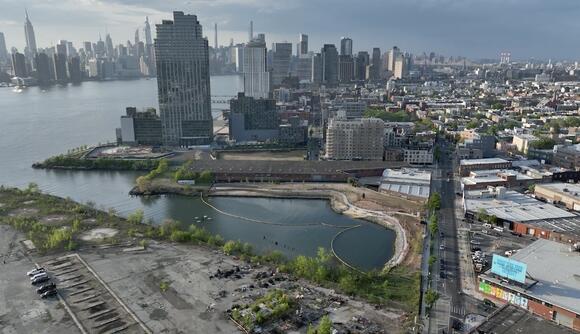
Environmental activists are suing New York City to stop plans for a waterfront residential complex of more than 1,300 units in Greenpoint that they say sits in a floodplain and will endanger residents.
Friends of Bushwick Inlet Park, a nonprofit that advocates for a public park on the North Brooklyn waterfront, and local environmental activists say in court papers that the city’s environmental review of the Monitor Point project relies on outdated climate projections.
The lawsuit is the latest chapter in a decadeslong disagreement over how the land near the East River’s Bushwick Inlet should be used. A sweeping zoning change in 2005 made way for skyscrapers across swaths of Williamsburg and Greenpoint, but also promised public parkland on the nearly 30 acres surrounding the inlet — heavily polluted land that was historically home to fossil fuel companies. More than 20 years later, according to Friends of Bushwick Inlet Park, only a third of the promised parkland is open.
“Using public land and funding to put people in harm’s way without a thorough, science-based environmental review is just reckless,” said Ari Feldman, a spokesperson for Legal Services NYC, which filed the lawsuit, in a statement. “This project would place hundreds of affordable housing residents, including seniors, in a high-risk floodplain without adequate protections.”
The City’s legal department has yet to file a response to the petition, but told Gothamist it stands by its decision to approve the project.
“We are reviewing the suit and are confident in the integrity of the City's environmental review,” said Nicholas Paolucci, the director of public affairs in the city’s law department, in a statement. “We will be responding further in the litigation.”
Monitor Point, set to be built right next to a narrow edge of the parkland, includes two predominantly market-rate residential towers up to 640 feet tall and a third building intended to be entirely income-restricted. Part of the project will be built on land owned by the MTA, which has agreed to lease its property to the real estate developer Gotham Organization.
The Article 78 petition — a legal filing that challenges the decisions of government agencies — which was filed against New York City, the Department of City Planning, the City Council, the MTA, Gotham Organization and other city agencies, argues that the proposal should not have been approved.
The review process “downplayed and ignored the true costs and climate risks of a project that will deepen the climate dangers for the surrounding community and endanger the fragile Inlet ecosystem, the neighborhood, the Project’s own residents, and people who already reside, work or recreate nearby,” the lawsuit states.
The properties at 40 and 56 Quay Street were rezoned again this summer to make way for the development. In doing so, the environmental review process, according to the lawsuit, relied on outdated climate and flood projections from 2015 that do not include what’s called “compound flooding,” the combination of heavy rainfall with other flood sources like rising groundwater runoff, river levels and storm surges. Doing so “severely underestimated flood risk,” according to the lawsuit.
The New York Panel on Climate Change released new metrics in 2024 that do consider the risks of compound flooding, and, according to the lawsuit, those updated metrics should be incorporated into the city’s environmental review process.
Opponents of the project said that the area where Monitor Point is planned has flooded before. Hurricane Sandy left it 12 feet underwater, according to the lawsuit, noting that risks from climate change have since increased.
Katherine Conkling Thompson, president of Friends of Bushwick Inlet Park and one of the Article 78 petitioners, told Gothamist she is particularly concerned about flooding risks because the Monitor Point proposal touts 662 affordable units, including more than 160 deeply affordable units for seniors and 110 for formerly homeless New Yorkers.
“The city would be investing… hundreds of millions of dollars in housing for particularly at-risk people,” Thompson said. “These are formerly unhoused people and elderly… in a very flood-prone location. We think that’s unwise and needs more scrutiny.”
Ron Shiffman, a city planner and professor emeritus at the Pratt Institute, filed an affidavit supporting the lawsuit against the city agencies. More affordable housing in New York is paramount, he argued to the court, but it should also be done right.
“New York urgently needs more housing, and especially more housing affordable to very low, low- and moderate-income households,” Shiffman stated in the legal filing. “But affordable housing production cannot be treated as a substitute for planning and community development.”
 Add to Preferred Sources
