undefined
Posts
undefined
Followers
Ohio State's club team might be the Buckeyes' most dominant program
By Eli Lederman,
8 hours ago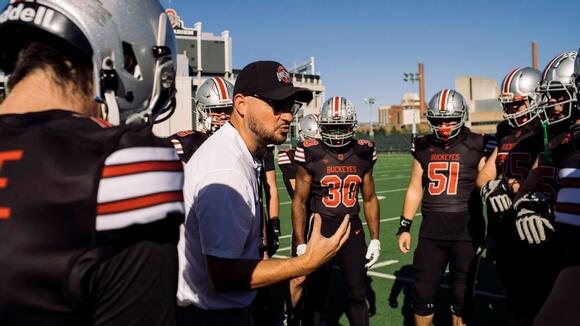
COLUMBUS, Ohio -- The second floor of the historic Ohio State Women's Field House isn't really a locker room. But with folding chairs, cubbies and a remix of Lil Uzi Vert's "Money Longer" bouncing off its walls, the century-old Tudor Revivalist-style barn looks, smells and sounds like one 24 minutes before the Buckeyes' Oct. 24 visit from Wright State. When James Grega swaggers into the room, the music stops and the makeshift space falls silent.
Grega, 33, is miffed. Specifically, the coach behind the preeminent dynasty of the National Club Football Association doesn't like how Wright State just warmed up after its 62-mile drive from Dayton. Even Ohio State Club Football -- with six Great Lakes Conference titles, four NCFA national championships and a 63-7 record since 2018 -- needs to feel like an underdog sometimes.
"I take the fact that they didn't warm up in pads extremely disrespectful," Grega tells his players. "The first thing they hit tonight is going to be you guys. The lack of respect for a program with as much success as we have pisses me off. It should piss you off, too. Is that understood?"
The top-ranked Buckeyes respond as one: "Yes, sir." Three hours later, the back-to-back national champion Buckeyes hold a new NCFA single-game scoring record and their 17th straight victory.
Final: Ohio State 105, Wright State 0.
The most dominant football program on Ohio State's campus resides on a turf field next to Ohio Stadium. Spend a few days around these Buckeyes, as ESPN did last month, and you quickly understand that more than talent or the natural resources of the second-largest flagship university in the United States, the story of Ohio State's club football ascent is defined by an absurd, unreasonable and extraordinary commitment.
It helps explain how Grega, a former sportswriter from the Cleveland suburbs took a teetering program and transformed it into a national powerhouse. And it helps explain why a roster of 50 players featuring engineers, bartenders, finance MBAs, at least one father -- all of them Ohio State students -- pays to play, how a team of 16 unpaid coaches and support staffers tackles every granular detail and the gravitational pull of a football fraternity whose alumni includes doctors, pilots, physical therapists, financial analysts, pro football players, a scout for the Buffalo Bills and four walk-ons on Ohio State coach Ryan Day's varsity roster this fall.
While Day and the No. 14 Buckeyes' visit Nebraska this weekend clinging to their College Football Playoff aspirations, Grega & Co. are banging on the door again. With a win over Toledo in Saturday's Great Lakes Conference Championship, Ohio State will advance to its seventh consecutive NCFA national title game appearance. "We might not have all the glitz or glamor, but this is real college football," said film and data analyst Dylan Barron. "We probably seem like we're in a cult or something. But we're all just so invested. Every single game is the biggest game ever."
Across three days embedded with Grega and the dedicated operation behind Ohio State Club Football, it certainly feels that way.
"Outside of paying the bills with my day job, my family and my wife, it's the most important thing I do." Grega told ESPN. "There's a lot of people who love football. There's not a lot of people who love football the way you have to love it to play for this program."
An objectively irrational undertaking
Steps from the banks of the Olentangy River, Lincoln Tower Park exists in the literal shadow of "The Shoe", the 102,780-seat coliseum that has been home to the varsity Buckeyes since 1922.
Forty-eight hours before Wright State arrives, the Buckeyes' third practice session of the week begins a little after 8 p.m. The program typically prefers to practice in the early evening. Tonight, however, the club frisbee team and a cluster of 7-on-7 soccer matches have priority, so No. 1 Ohio State won't finish its pregame walk-through until nearly 10:30 p.m.
Afterward, Matt Humphreys hits the road and drives 75 miles home to Jackson, Ohio.
Humphreys, 25, is one of the NCFA's most-feared pass rushers. His wife, Haley, is a medical student at Ohio University, and the couple recently relocated from Columbus to Jackson, a midway point between their respective campuses. By day, Humphreys juggles Masters-level courses and a job as an estate specialist at Morgan Stanley in Columbus. At night, he throws on pads and prepares scouting reports for the Buckeyes' defense before heading southbound on U.S. Route 23. "I usually leave around 7 a.m.," said Humphreys, who commutes to Columbus four days a week. "After a walk-through, I might not get home until midnight."
For players, coaches and staffers alike, club football is an objectively irrational undertaking. It features none of the material payoffs -- scholarships or revenue-share dollars, for example -- of major FBS football. It doesn't include any of the trappings or resources available at the FCS, Division II or Division III levels, either. This is college football stripped down to the very core.
Spread across 11 states, the NCFA's 14 member programs operate on shoestring budgets, hand-me-down equipment and a general tolerance for the physical risks inherent to full-contact tackle football. From Ohio State (student population: 68,183) to Clarkson University (3,348), basic program survival, let alone on-field success, is a year-to-year concern at this level.
At its peak in 2018, Grega's first season as head coach, the NCFA had 30 club teams, including programs on five Power 4 football campuses: North Carolina, Michigan State, Pitt, South Carolina and the Buckeyes. Since then, "our numbers have dwindled," NCFA president Sandy Sanderson told ESPN. Sanderson cited financial constraints, safety concerns and declining levels of national football participation -- down 7.4% from 2008 to 2024, per the National Federation of State High School Associations -- among the obstacles facing club programs in 2026. The COVID-19 pandemic didn't help, either. "Some programs just vanished," Sanderson said.
Over the same period, Grega has not only delivered stability, but forged a perennial NCFA power. The Buckeyes' eight victories this fall have come by an average margin of 49.1 points per game. They enter Saturday's conference title game on a run of 20 consecutive victories, one shy of matching Oakland University (2015-17) for the longest win streak in NCFA history.
"They're something closer to a Division III program on a Division I campus," said Michigan State club football coach Mark Beach. "We have not not modeled ourselves after them to try and get into the same ballpark."
Ohio State was hardly a model program when Grega, a former high school quarterback at the Cleveland suburbs joined the team in 2012, the Buckeyes' debut season in the NCFA.
At the time, Ohio State had fewer than two dozen players on the roster and was coached by a former player who had graduated a year earlier. The Buckeyes operated on loosely planned practices, simple schemes and a thin playbook. "There was no organization or supervision," Grega said. In six seasons from 2012-17, the program went 26-20 with a single postseason win.
All of that irritated Grega.
"It was just like, 'If we're going to play college football, let's really play college football," he said. "I knew plenty of people who were interested in putting the pads back on. But the problem was they'd come out and see how disorganized we were and they'd say, 'I'm not wasting my time.'"
In college, Grega had split his time between the club team and reporting on Ohio State football for The Lantern, Ohio State's student newspaper. When he graduated in 2015, he did the same thing, working the football beat for ElevenWarriors.com and another local outlet while serving as the Buckeyes club team's' offensive coordinator in 2015 and 2017.
Grega wasn't planning to return to the program in 2018 until he got a call from Connor Slade, the team's student president. Grega explained that he made the decision to step away from the team after the 2017 season due to philosophical differences with former head coach Darryl Payne, who led the Buckeyes from 2014-17. Two weeks before the season, Slade reached out with a list of concerns and an appeal for Grega to rejoin the coaching staff. Still, the answer was no. A few hours later, Slade called back with a different question: Would you be willing to be our head coach? With approval from his editor at Buckeye Sports Bulletin, Grega took the job.
Ohio State had only 13 players available for Grega's first game against Southern Illinois University Edwardsville. "I told them we were only playing this game if all 13 guys, to a man, say they're comfortable playing because I have two subs for a 60-minute game and 85-degree weather," Grega recalled. The short-handed Buckeyes chose to play and rolled to a 24-4 win behind three touchdowns from a transfer receiver from FCS Dayton. A year later, Chris Booker joined Ohio State's varsity team as a walk-on, appearing in 19 games from 2019-21.
Grega closed his debut season with a 4-1 record and a division title. Shortly after, he turned his attention to building the infrastructure of the type of program he wished he'd gotten to play for.
"I look at everything through the lens of what would a Division III program do?" Grega said."That's how I still operate. Not a day goes any time of year where I'm not trying to do something to make this program better. I want to be the coach I wanted 15 years ago."
'We are the Yankees of club football'
Paul Allmon gets to work around 10 a.m., seven hours before kickoff with Wright State.
His plastic crates, containing various ointments, adhesive tape, power tools and every other conceivable sideline necessity, are labeled by number. Each sideline cooler is filled with 20 pounds of ice; the referee's cooler gets exactly 14. By the time he starts unloading title banners, plastic crates and a set of Gatorade jugs he got on Facebook Marketplace from his GMC Sierra, Allmon is already navigating the morning's logistical hurdles.
"The marching band has people out here practicing all the time," he explains. "And then you have your rogue soccer players who get in the way. I came to an understanding with them a few years ago where at a certain time they move their stuff off. We get along better now."
A retired Army logistician who served in Bosnia, Germany, Iraq and Japan, Allmon, 56, executes his field setup operation with military precision. Officially, he's in charge of Ohio State's game-day operations. In practice, Allmon wears a truly remarkable number of hats.
Over the course of a frantic two hours, Allmon hangs title banners, moves benches, fills coolers, installs goalpost bases in each end zone and more. He also mentions the dance team he booked as halftime entertainment, a team photoshoot he has organized in collaboration with a local fashion boutique and the TikTok clip he made to promote Saturday night's game; it has generated more than 39K likes. During warmups, Allmon tapes ankles and wrists. A "fledgling DJ," by his own description, he handles in-stadium music and public announcing duties, too.
"We are the Yankees of club football -- the gold standard," Allmon says. "My goal is that the players walk into the best environment possible and don't have to do anything but play."
Ohio State's club program undoubtedly benefits from certain competitive advantages over its NCFA counterparts. Among them: a 68,000-plus student recruiting base, location in a major metro area and proximity to others, the biggest staff in club football, the academic and social diversity of a flagship state university and one of the best brands in all of college athletics.
But perhaps the most significant edge Grega and the Buckeyes have working for them is the titanic collection of zealously committed volunteer coaches and support staffers who help make the program Grega once envisioned a reality every day; a cast of unpaid energizers who donate time, effort and immeasurable bits of crucial ingenuity at least five days a week each season.
"Even our trainers think this a bit intense," Allmon, stirring powdered Gatorade with a paint mixer fastened to the end of a Ryobi power drill, explains. "But we have not had a guy go down with cramps for two seasons."
There are nine on-field assistants on the Buckeyes' 2026 coaching staff. Together, they help run three practices, a film session and a game each week. In the winter, they oversee the program's offseason at a local indoor soccer facility before a formal spring camp.
Many of them, including Christian Allen, Sam Garber, Raheem Massenburg and Alex Strohm, are former players. Running backs coach Nick Untch won a national title with the Buckeyes in 2019 and now works as a traveling physical therapist. He schedules his assignments around the team's schedule. Defensive coordinator Brendan McNeill stumbled upon the program.
"I only decided I wanted to start coaching in 2019," he said. "I came here with my son and saw them playing one day and I said, 'I wonder how I can get there?' Eventually, I got here."
Co-special teams coach Chauncey Moore's commute from Cincinnati takes about 90 minutes. Yet it's not even close to the most extreme example of commitment on Grega's staff.
In 2022, Barron, a former Buckeyes linebacker, settled back home in Miami with a job as a financial analyst in Hard Rock International's corporate office and left football behind with just one exception. For four months each year between 2023-25, Barron returned to Columbus, moved into a long-term Airbnb and worked remotely, sacrificing time, money and even his health for a dream job with his former team: defensive coordinator for Ohio State Club Football.
"Each year I'd budget 20 pounds [of weight gain] and $20,000," he said. "Financially, it wasn't a very smart decision. That's time I'll never get back. But I just couldn't stay away, man."
Allmon's counterpart is equipment director Todd Thiele. His son John played under Grega from 2021 to 2024. Even more dearly than his NCFA championship rings, Thiele cherishes a video from a few seasons ago. In it, John follows a touchdown run by tracking down his dad for a hug.
"This program," Thiele said. "It's been life-changing stuff for me and my son."
Thiele jumped from the cheering section to Grega's staff as a part-time assistant in 2022 and slowly carved out his current role as managing the team's equipment. The club maintains a good relationship with varsity equipment directors Kevin Ries and Kevin Nerl and nearly every inch of surface area in the club program's equipment cage inside the Women's Field House is covered with hand-me-down shoulder pads, practice jerseys, chin straps, cones, blocking pads, yard markers and pylons. Helmets and Guardian caps hang from a wooden beam along the ceiling.
A helmet is often the one big-ticket item an Ohio State Club Football player is personally responsible for. Earlier in Grega's tenure, players took their old high school helmets to a local body shop to be repainted."What I found was kids were putting them back together half-assed," Thiele recalled. "We needed a little bit more regimentation." His solution: shuttling those helmets to a friend's sporting goods store in Oxford, Ohio, 2½ hours away. Thiele routinely makes the five-hour round trip for fresh paint jobs and helmet recertification. "He doesn't ask for gas money," Grega said. "Doesn't ask for anything other than to keep him around."
Like Thiele, Allmon has proved willing to go the distance. As he constructs Wright State's visiting locker room -- a pair of tailgate tents behind the south end zone -- he tells a story.
In December 2024, the Buckeyes traveled to Waynesburg, Pennsylvania, to play Clayton State for the NCFA title in freezing conditions. Allmon purchased chicken broth and hot chocolate for warming beverages on the sideline, but wasn't sure how he'd be able to heat the liquids. That was until he looked at a map and found out there was a Bob Evans next to the team hotel. By the next morning, Allmon had talked his way into the restaurant's kitchen. The Buckeyes celebrated a 20-13 win and the program's third national title with warm drinks in their bellies. "I don't know where this program would be if it wasn't for Paul and Todd," said Grega. "They have elevated this to take it to another level that I don't know that I thought we would get to."
25 hours a week and an itch to keep playing
There's a little under three hours until kickoff and the fifth-floor hallway of Morrill Tower, a 23-story dorm hall mere steps from Lincoln Tower Park, is buzzing with residents glued to Saturday's college football slate and others headed for the dining hall downstairs.
As Evan Riggs leads visitors into his combination dorm room/locker room, the freshman linebacker points to an adjacent doorway.
"That's Room 542," he explains "Apparently Jeffrey Dahmer used to live next door in the '70s."
Beneath Riggs' lofted bed, there's shoulder pads, a helmet, cleats and a team-issued Ohio State duffel bag gifted to him by his older brother, Eli, a third-year linebacker who walked-on to Ohio State's varsity in 2024 without ever playing for the club program. In his room, Riggs sleeps a minute's walk from the gate at Ohio Stadium where players meet their families after games. In a year or two, Riggs hopes to walk through those gates as his brother's teammate.
"That's been my goal since I got here," he said.
Ohio State Club Football is a haven for former high school stars, Division III football burnouts and any soul with 25 free hours a week and a lingering itch to keep playing the game.
Like many of his club teammates, Riggs considered a handful of Division III offers and a preferred walk-on opportunity at Chattanooga out of Cincinnati's Indian Hill High School. And, like many of them, he also passed on those offers, opting for the state school experience rather than paying to play football on a smaller campus. With a team-high 44 tackles this fall and multiple years of eligibility, Riggs is viewed as a legitimate candidate to be the team's next varsity call-up.
Since Grega took over, the program has developed six players who later played for the Buckeyes' varsity team. Between rules capping the roster at 105 players in recent years paired with the elimination of the spring transfer portal window, FBS programs are having to get increasingly creative to fill late-emerging roster holes. It's no coincidence that of the six club-to-varsity call-ups since Grega took over in 2018, four -- Glorien Gough and Zach Hayes in 2023, Ian Gecse in 2024 and Jackson Gula in July -- have come over the past three offseasons.
"We've been able to get a couple of guys on the team, which has been great," Day said last month. "I can't sit here and say it's been the lifeblood of the program. But it is an opportunity for some guys to get in the program and be part of what we do here."
The reality, however, is that the majority of the 50 players on Grega's roster won't get a varsity call-up, and most don't fork over their $375 annual fee with that ambition in mind, either.
Reagan Little is 5-foot-8, 150-pound defensive back from Danvers, Massachusetts, a fourth-year captain and the current student president of Ohio State Club Football. When he isn't prowling the Buckeyes' secondary -- Little's seven interceptions rank second in program history -- he's overseeing day-to-day operations of the program alongside Grega, student vice president Tommy Delaney and treasurer Elijah Lowden. Together, they manage administrative duties including club sports forms, travel booking and the management of a $15,000 annual budget. Funded primarily through players' fees, it covers uniforms, road travel, referees and trainers fees and other regular expenses. Responsibility, Grega believes, breeds accountability and buy-in.
In the offseason, the Buckeyes acquired a team set of lightly used Nike game pants from the Ohio State varsity team. Once they had the scarlet and black pants in hand, there was a natural follow-up: "Do we want to order black jerseys this year? Grega asked his student leaders. "If we do, we're going to need to raise the annual fee. That's a decision you guys have to make. They're invested because they have real ownership of this program."
It was an easy call. The players agreed to raise their annual dues between $75 and $100 for matching scarlet-and-black tops. The Buckeyes are debuting the all-black uniform set against Wright State tonight.
"First night game since I've been on the team," Little says. "I can't wait."
Well before Humphreys began shuttling back and forth to Columbus, he began his career at Robert Morris in 2019. Within two years, and after a pair of abdominal tears, team doctors suggest that he should medically retire. With his education suddenly in jeopardy, Humphreys transferred to Ohio State with plans to pursue a degree in finance and a bad taste in his mouth from the way his football career ended. Four years and 21.5 sacks later, that has changed.
"Everybody has their reasons for playing on the club team," Humphreys said. "I had to reconfigure my entire relationship with football. It feels like I've gotten that closure I've been looking for."
By and large, there are far more Reagan Littles and Matt Humphreys on Ohio State's roster than there are Jackson Gulas and Glorien Goughs. Some players do leverage club football into offers elsewhere at the Division II or Division III level. But for the most, simply strapping on the pads, getting to suit up every weekend and being on a team for another season is the point.
The program Grega believed Ohio State could become and ultimately built it to be is for them.
"Being part of a football program is a one-of-one experience in life, and it's not something you get to do forever," said Little. "Maybe it's just me wanting to play as long as my body says I can. But I love the process, the brotherhood and the experience of that."
Title hunt stays alive
Wright State is overmatched. That much is clear as Ohio State return man Milan Jackson, who began his career at Division II Lake Erie College, takes the opening kick back for a touchdown.
The Raiders follow by committing turnovers on their first five offensive possessions. With 51 seconds left in the first quarter, they trail 56-0. Several voices among the 300 or so spectators who showed up for the top-ranked Buckeyes' first night game at Lincoln Tower Park since 2019 are very suddenly curious about the possibility of a running clock for the final three quarters.
Not every game the Buckeyes play is like this one. Michigan State took them to the brink in September; Ohio State escaped with a 17-16 win on a 37-yard field goal from kicker Raj Venkatesh with 34 seconds remaining. Along with the Spartans, Columbus State, Coppin State and Toledo -- the Buckeyes' fellow conference finalists this weekend -- make up the next tier of competition within the NCFA hierarchy. Since 2018, Grega is 17-0 against those four programs.
"I think a lot of the smaller schools look at Ohio State as the bully program," said Beach, Michigan State's head coach. "But there's not a single team that wouldn't take the success that James has created and take it to their program if given the opportunity."
Grega harbors ambitions of more challenging nonconference schedules and someday hopes to land a paid full-time coaching job. Last month, Ohio State traveled an hour to face the junior varsity team at Division III Wilmington College. The Buckeyes won 47-13, posting their highest-ever point total against an NCAA opponent. This past summer, he turned down a role with a private coaching facility that trains quarterbacks in the Columbus metro area.
Those are questions for the future. Jogging back up the steps to the makeshift locker room in the Women's Field House with a 98-0 halftime lead, Grega has a more pressing problem to solve. His face is as red now as it was during his pregame talk. But this time, Grega is speechless.
"I'm really blown away right now," he tells a group of assistants. "I don't know if I'm going to have much of a halftime speech."
ESPN's Jake Trotter contributed to the reporting of this story.
 Add to Preferred Sources
