undefined
Posts
undefined
Followers
Exploding stars carved a giant hole that is now making new stars
By Chrissy Sexton,
2026-09-05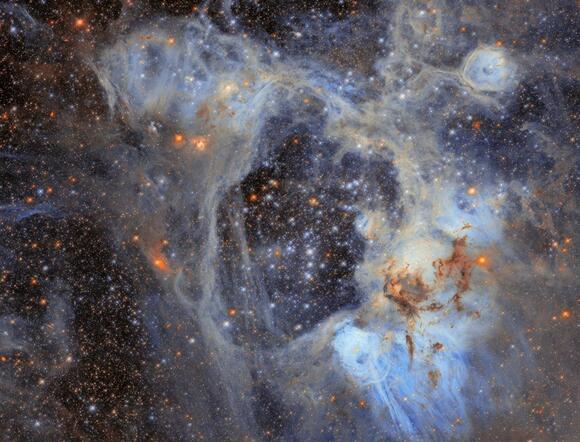
Today’s Image of the Day from the European Space Agency reveals a huge stellar nursery where generations of stars are changing the landscape around them.
Bright young stars, dark clouds of dust, and glowing gas fill the scene. Near the middle lies an enormous empty-looking cavity.
Far from being quiet, this hollow region records some of the most violent events in the lives of massive stars.
The view from the Hubble Space Telescope features LHA 120-N44, also known as N44.
The nebula sits in the Large Magellanic Cloud, a small neighboring galaxy about 160,000 light-years from Earth.
A nearby galaxy full of young stars
The Large Magellanic Cloud is the largest of the small galaxies orbiting the Milky Way.
Its relative closeness gives astronomers an unusually detailed view of places where stars are being born.
N44 lies within the constellation Dorado and contains a mix of young stars, thick gas, and dust.
Its most striking feature is a vast central cavity measuring roughly 210 by 140 light-years. Astronomers call this kind of structure a superbubble.
Stars carved out a giant cavity
The stars inside the cavity helped create it. Massive young stars throw material into space through powerful stellar winds.
Some eventually explode as supernovae, releasing enormous amounts of energy and pushing surrounding gas outward.
Over time, those forces cleared much of the material from the central region of N44.
Instead of simply disappearing, the displaced gas accumulated around the edges. It formed the dense, dusty shell visible around the superbubble today.
Destruction creates another nursery
That shell has become a birthplace for another generation of stars.
Gas squeezed together along the bubble’s boundary can become dense enough for gravity to take over, eventually collapsing into new stellar objects.
N44 therefore gives astronomers a chance to study several stages of star formation within the same complex.
Researchers want to measure how long the process takes, beginning when cold clouds of gas collapse into dense knots and ending when nuclear fusion starts inside a newborn star.
Hubble counts half a million stars
Researchers used Hubble to conduct a remarkably large census of N44.
The telescope catalogued nearly half a million stars, including stars belonging to the complex and unrelated objects lying along the same line of sight.
Nearly 30,000 of the objects are pre-main-sequence stars. These are young stars that have not yet reached the long, relatively stable stage of life in which hydrogen fusion powers their cores.
Finding so many of them gives researchers a large population for studying the earliest phases of stellar development.
Catching faint stars in a crowded region
Young, low-mass stars can be difficult to detect, especially when they sit among brighter objects and glowing clouds of gas.
Hubble’s sensitivity and sharp spatial resolution allow astronomers to separate many of these faint points of light even in densely packed stellar neighborhoods.
The observations also help scientists investigate the masses of newborn stars.
That matters because the amount of mass a star acquires during formation largely determines what happens during the rest of its life, from how brightly it shines to how long it survives.
Massive stars light up the gas
Ultraviolet radiation pouring from massive stars energizes the gas surrounding N44’s superbubble.
That radiation helps produce the nebula’s bright glow and reveals smaller structures scattered throughout the larger complex.
Astronomer Karl Henize catalogued these individual features during the 1950s. One of them, N44F, appears near the upper-right portion of the Hubble view.
Unlike the enormous central superbubble, N44F was shaped largely by the fierce wind of a single hot, massive star.
One star shapes its surroundings
Radiation and stellar winds from that star have pushed against nearby material, producing a smaller interstellar bubble.
Hubble observations have also revealed pillars of dusty gas shaped by the intense activity.
Such structures show how strongly stars can alter the clouds that produced them.
A young massive star does not remain a passive resident of its birthplace. Its radiation and outflowing material immediately begin reshaping the surrounding environment.
Star formation under different conditions
The Hubble observations came from observing program 14689, led by Dimitrios Gouliermis. The project focused on stars in N44 that have not yet begun sustained hydrogen fusion.
N44 is especially useful because the Large Magellanic Cloud contains fewer elements heavier than helium than the environment around the Sun.
Astronomers call these heavier elements metals, even though many would not normally be considered metals on Earth.
Studying low-mass stars in this setting can help researchers understand how stars form when fewer heavy elements are available.
Similar chemical conditions were more common in galaxies much earlier in cosmic history.
N44 therefore offers more than a striking photograph. Its hollow center, compressed shell, and thousands of unfinished stars preserve different chapters of the same process, giving astronomers a nearby laboratory for tracing how new suns take shape.
Image Credit: ESA/Hubble & NASA, D. Gouliermis
—–
Like what you read? Subscribe to our newsletter for engaging articles, exclusive content, and the latest updates.
Check us out on EarthSnap, a free app brought to you by Eric Ralls and Earth.com.
—–
 Add to Preferred Sources


