undefined
Posts
undefined
Followers
The Moon’s surface is covered by much more rubble and dirt than previously known
By Jordan Joseph,
2026-07-27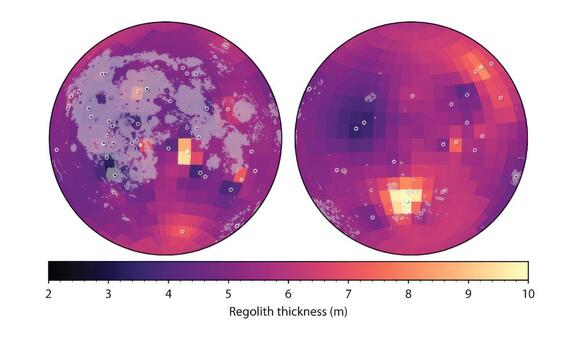
The Moon is covered by a thick layer of crushed rock and dust known as regolith, the material that blankets its entire surface.
A new study has mapped that layer in detail, revealing that it averages about 20 feet (six meters) deep in the ancient highlands and 13 feet (four meters) deep across the dark volcanic plains.
The map gives mission planners a publicly available estimate of how far the rubble extends before reaching solid rock across the Moon.
Depending on the task, that layer can be either an obstacle to construction or a valuable resource.
Reading fresh craters
The Moon has no atmosphere to burn up incoming debris, so meteorites of every size strike it constantly.
Over billions of years, that steady bombardment has ground the outer crust into rubble and powder. The same impacts that built the layer also give scientists a way to measure it.
A small impact digs only into loose material, while a bigger one can punch through to bedrock and throw out boulders that settle around the new crater.
Andrea Rajšić, a research scientist at Brown University, led the study. She leads a lunar research group funded by the National Aeronautics and Space Administration (NASA).
Her team examined 346 fresh craters scattered across the Moon, each between about 35 feet (eleven meters) and 800 feet (244 meters) wide.
Craters tell the story
Each crater then fell into one of two groups. Boulders in the surrounding debris meant the impact had most likely reached solid rock.
Debris with nothing larger than fine rubble suggested the crater formed entirely within the loose layer, meaning the regolith extends deeper than the impact reached.
From there, well-tested relationships between a crater’s width and the depth it digs let the team estimate regolith thickness region by region.
A statistical model pinned down the crater size at which boulders start appearing, plus the uncertainty around each estimate.
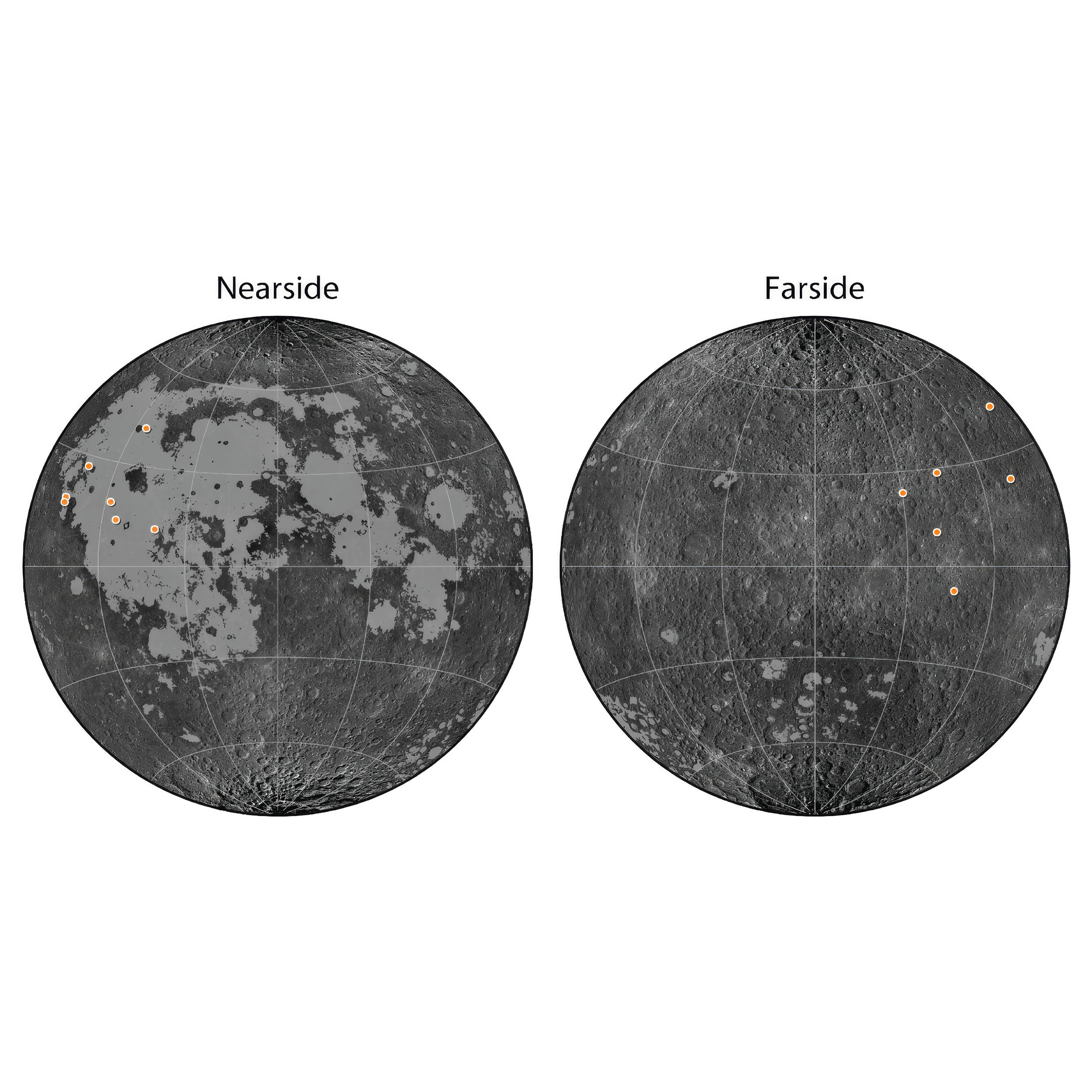 Points marked in orange are 13 different areas where we mapped 346 fresh-looking craters in lunar maria (shaded) and highlands. Mare boundaries are from D. Nelson et al. Credit: Brown University / IOP. Click image to enlarge.
Highlands run deeper
The numbers land on the side of an idea planetary scientists have carried for decades.
Regolith averages about 20 feet (six meters) thick in the highlands, the bright, rugged terrain that covers most of the Moon.
In the maria, the dark plains of long-hardened lava that mark the near side, the average is closer to 13 feet (four meters). That difference fits the history of the two terrains.
The highlands have been absorbing impacts for more than four billion years. The maria formed later, when lava flooded enormous basins and buried the older, battered ground under fresh rock.
A Moon-wide map
To build a Moon-wide view, the researchers folded in direct measurements from 68 spots on the surface. Some date back decades.
Vibration recorders left by the Apollo missions in the 1970s contributed, along with radar carried by China’s recent robotic landers and radar bounced off the Moon from Earth.
Filling the space between those points produced an approximate map of the whole lunar surface.
“Understanding the Moon’s surface is important because we’re landing there, we’re going to be walking and driving there, and we’re going to be mining there,” said Rajšić.
Testing an old idea
Planetary scientists call the expectation behind these numbers the depth-age hypothesis.
The longer a stretch of ground sits exposed to space, the more impacts it absorbs, so older surfaces should carry a thicker layer of rubble. Recent work had put that idea under real strain.
One analysis found regolith depths between roughly ten and 30 feet (three to nine meters), with no clear sign that older plains held more of it than younger ones.
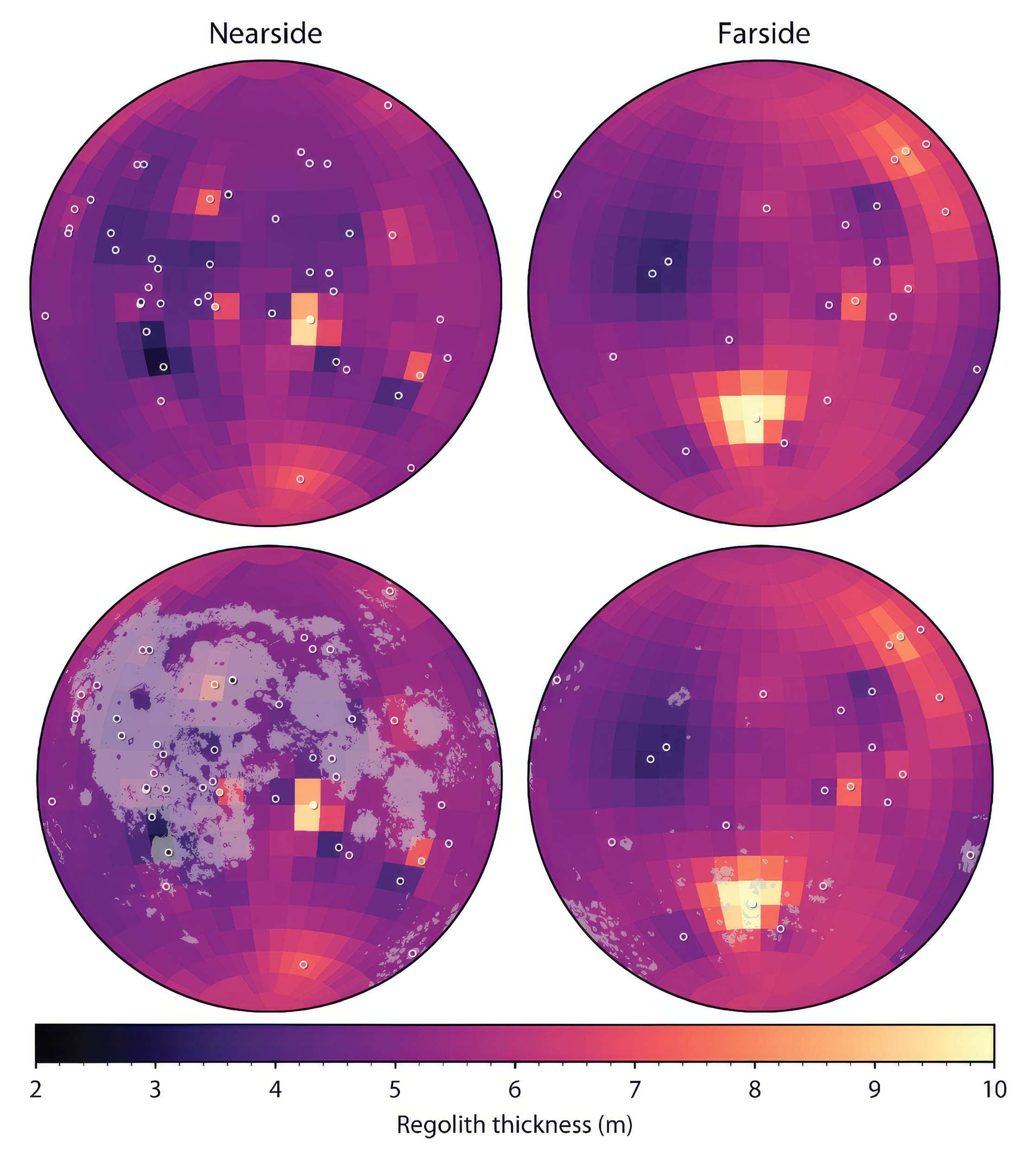 Brown University researchers have mapped the thickness of the Moon’s regolith, the layer of loose dirt and rock that drapes the Moon’s surface. Darker colors indicate thinner regolith, while lighter colors indicate more thickness. Credit: Andrea Rajsic. Click image to enlarge.
Regolith grows over time
Combined with earlier ground measurements, the new crater survey suggests the broad pattern is real. On average, older ground carries more regolith.
Any one location can still stray far from that trend, but across hundreds of craters on both terrain types, the signal comes through. Local exceptions are not hard to find.
A recent survey of four candidate landing sites for a small lunar rover found the oldest site had the thinnest regolith of the group, the reverse of what the hypothesis predicts.
Impacts pile regolith up everywhere over time, but buried lava flows, local geology, and the individual strikes likely decide how deep the layer runs at any one spot.
Built for explorers
For Rajšić, the map serves as a planning tool. A crew planning a Moon base, for instance, would want thin regolith underfoot, because solid ground for foundations would sit within reach.
“For example, in a situation where you want to build a Moon base, thinner regolith could make it easier to reach more competent material for foundations, depending on the construction method.”
Miners would want the opposite. Thick regolith provides more material to work with.
She noted it may hold resources such as water ice, a source of drinking water and rocket fuel, and helium-3, a rare gas often discussed as fuel for future fusion power plants.
The estimates still cover the Moon unevenly, with wide gaps between measured points.
So the team published its crater catalog and mapping tools in a public repository, letting other researchers rerun the analysis and fold in observations of their own.
A tool for future missions
Scientists now have a working estimate of the Moon’s surface rubble, gathered with one consistent method and tied to ground measurements.
It measures about 20 feet (six meters) across the old highlands and about 13 feet (four meters) across the younger plains.
Mission planners can weigh those depths when comparing one landing site against another. Coverage should improve as new missions land and new craters get mapped.
“We’re hoping that people will use it more and add observations so that we eventually have a global coverage of the Moon.”
The study is published in The Planetary Science Journal.
—–
Like what you read? Subscribe to our newsletter for engaging articles, exclusive content, and the latest updates.
Check us out on EarthSnap, a free app brought to you by Eric Ralls and Earth.com.
—–
 Add to Preferred Sources

