undefined
Posts
undefined
Followers
Sheriff’s department overtime reflects a wide budget balancing act
By JIM PAUL EagleHerald,
12 days ago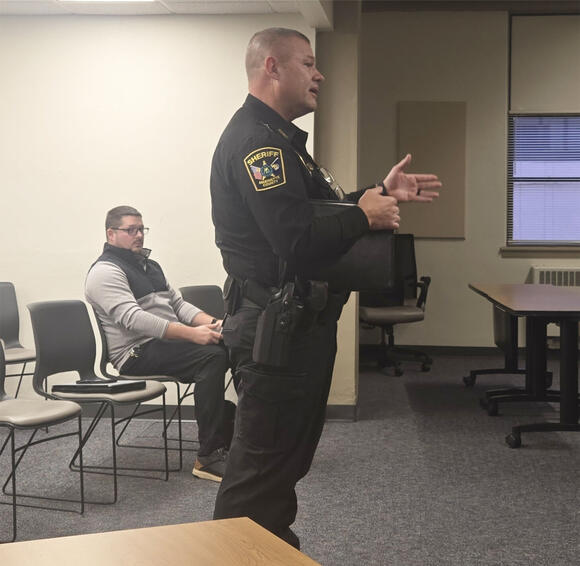
MARINETTE — The Marinette County Administrative Committee Thursday discussed the sheriff’s department’s overtime costs and how to control them without undermining public safety.
The discussion exposed a difficult trade-off: staffing shortages and unpredictable calls can drive overtime, while county budget limits put pressure on departments to contain spending.
Sheriff Randy Miller attributed much of the correctional center overtime to vacancies in the 40-hour fill positions — staff who can cover shifts when employees take leave. Miller said the department had reduced those positions over time and had recently begun rebuilding coverage.
“For the first time this year, we have one 40-hour fill that actually is slated in that spot,” Miller said.
He added that another employee was in training and a third had returned from military deployment. A fourth candidate left during training, requiring the department to restart the hiring process.
Miller said staffing shortages are especially challenging because the jail must maintain minimum coverage, including male and female staff. When employees are unavailable, overtime pay may be needed to fill required shifts.
Miller expected that filling open positions could reduce this kind of overtime, but cautioned that other demands would remain.
“There should be very little to no overtime to fill positions when people want off,” Miller said.
Miller noted that emergency incidents and hospital guards are difficult to predict.
Some overtime, he explained, comes from extraordinary situations rather than routine scheduling. Guarding a person in custody in a Milwaukee hospital on a high bond has cost the department $18,000 in one week, Miller explained.
Miller also described investigative work, fatal crashes and missing persons cases as sources of overtime that the department cannot readily schedule around.
Patrol staffing adds another constraint. Miller said the department will not go below three deputies on the road for a county covering more than 1,400 square miles.
When staff are absent, officers may be pulled from patrol to cover court or other duties, leaving fewer people available to respond.
“More often than not we are down to minimum staffing,” Miller said, describing a shift toward responding to calls rather than conducting proactive patrols.
The financial figures prompted questions about how much room the department has to absorb costs. Finance Director Hollie Viestenz reported that overtime was at $253,000 for the year, with a projection of $300,000, while next year’s jail overtime budget was just over $70,000.
Viestenz cautioned that the lower figure depended on the 40-hour fill positions staying staffed. Committee members also emphasized that the department’s overall budget had increased; Bonnie Popp cited an increase of approximately $350,000.
Members differed on how to interpret the pressure. Supervisor Peter Noppenberg, while not on the committee, stressed the need to monitor overtime and find savings elsewhere in the department.
Ken Hanson argued that reducing staffing could affect response times and officer safety. Stan Gruszyski summarized the underlying concern as a broader responsibility to fund county services adequately, warning that “sooner or later there are not going to be other places to cut.”
Miller said the department is pursuing savings, including using trained staff for transports and reviewing fees. He also anticipated a decrease in mental health facility transport costs beginning Jan. 1, subject to the county’s legal and operational arrangements.
Miller remained optimistic that staffing improvements would lower overtime, while acknowledging that emergencies and service demands could still produce unpredictable expenses.
The committee’s discussion did not settle the larger budget question. Instead, it highlighted the challenge facing the county: balancing the cost of staffing and public-safety services against limited resources, while deciding which services can be maintained with the available workforce.
In another matter, the committee reviewed and voted to advance to the county board a resolution for an April 6, 2027, referendum seeking authority to exceed the allowable levy limit for road construction and maintenance.
Vistienz compared the levy impact with borrowing, noting the referendum’s first-year estimate was one cent per $1,000 lower, with a difference in later years. Estimates assume no construction-cost inflation during delay.
Members discussed interest costs and investment revenue and how to promote the referendum.
 Add to Preferred Sources