undefined
Posts
undefined
Followers
Attorney General Kaul announces historic settlement
By JIM PAUL EagleHerald,
2026-06-07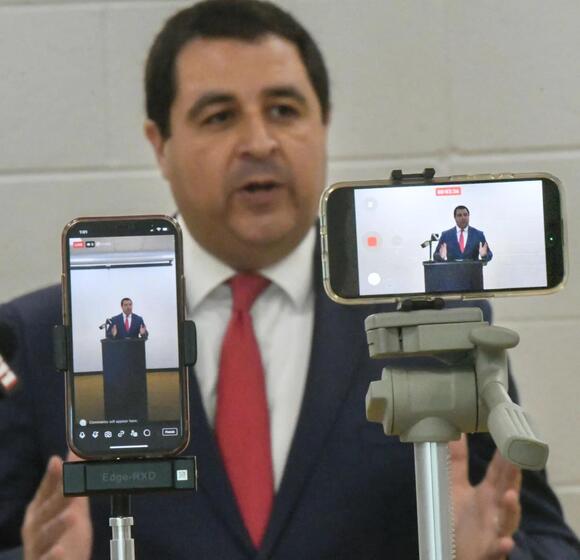
MARINETTE — Wisconsin Attorney General Josh Kaul was in Marinette Thursday where he announced what he called a historic settlement with Tyco Fire Products, saying the agreement will help clean up years of PFAS contamination and secure safer drinking water for residents in the area.
“I am here today to announce that the Wisconsin Department of Justice has reached a historic settlement with Tyco Fire Products,” Kaul said. “It is going to help remediate environmental damage and provide access to safe drinking water for Marinette area residents who have been impacted by PFAS contamination.”
PFAS — often referred to as “forever chemicals” — resist breaking down in the environment and can build up in the human body.
“They may be linked to serious health effects, including certain cancers, weakened immune response and complications during pregnancy,” Kaul said.
Kaul said he first met with Marinette-area residents about PFAS in 2019 and the state sued Tyco in 2022 alleging failures to notify the DNR of discharges and to properly remediate contamination around the company’s fire technology center.
Under the proposed consent judgement, Tyco will pay $10 million into the state’s PFAS trust fund. The agreement, filed in court, still needs a judge’s approval.
The Department of Natural Resources will recommend how to use the money, subject to review by the legislature’s joint finance committee. Kaul said he believes the funds should come back to the Marinette/Peshtigo area and urged residents to speak up.
“This money was recovered in light of the allegations in this community and I think it is essential that those funds go to this community and go to the remediation in this community,” Kaul said.
He encourages people to contact the DNR, the governor’s office and their legislators.
Kaul noted the $10 million payment is in addition to about $100 million Tyco has already spent responding to PFAS contamination in the region. He called the deal “one of the most significant settlements of an environmental enforcement action in the history of the State of Wisconsin.
Once entered by the court, the settlement becomes enforceable as a court order.
“If there is a violation of terms of the agreement, that would be a violation of a court order and the Department of Justice could go to court to seek a remedy,” Kaul said.
Tyco will also be required to continue providing clean drinking water to residents in a designated area southeast of its fire technology center. Every parcel there that does not already have a deep drinking water well will have the option to install one for the next 20 years, Kaul said.
Residents who do not choose a new well will continue to receive treatment from Tyco and bottled water will remain available to those with elevated PFAS levels in their private wells.
The company must also continue operating its groundwater extraction and treatment system and conduct ongoing monitoring and reporting of PFAS levels, with remediation goals set in consultation with DNR. Tyco will have to show regulators that the affected environment is restored to the extent to satisfy the state’s spills law requirements.
Kaul said the case underscores the importance of Wisconsin’s spills law, which has been the subject of separate legal challenges.
“To the extent there have been larger environmental resolutions in the state, there was the Fox River cleanup for example. Those were cases that were brought by the federal government in conjunction with the state,” Kaul said. “I think this is clearly the most significant state-alone enforcement action we have done as a state.”
He added that one of his priorities as attorney general has been to rebuild the Department of Justice’s environmental protection unit and strengthen the enforcement work it does to protect communities around the state.
Separate from Thursday’s settlement, Wisconsin is also participating in a broader federal multi-district lawsuit against PFAS manufactures. That case, now consolidated in South Carolina, is expected to take years.
The agreement does not include health monitoring for residents, something Kaul said is not available under the state’s spills law.
Still, Kaul said he believes Wisconsin should do more to address the human toll of PFAS exposure.
“When I spoke to folks in this community, one of the things I heard about from people was a lot of concern that folks had about the impact on their health from PFAS contamination, and there is a good reason to be concerned,” Kaul said.
As the broader PFAS litigation and state-level efforts continue — including recently enacted legislation devoting $133 million statewide to PFAS work — Kaul framed Thursday’s announcement as a major but incomplete step.
Governor Tony Evers commented on the settlement in a news release.
“Today is a historic and important milestone in our fight to make sure every Wisconsinite has access to clean and safe drinking water, whether they live in Marinette or Stella, French Island or anywhere in between. Every Wisconsinite should be able to trust the water coming from their tap.” Evers said. “While today is an important victory, we know we cannot stop. For the folks in Marinette, this day has been a long time coming, but we know that for so many families and communities across our state, dealing with PFAS pollution is still a daily reality. Here in Wisconsin, we must keep working to tackle PFAS head on, and that includes continuing to hold PFAS polluters accountable for the damage they have caused and are causing across our state.”
 Add to Preferred Sources


