undefined
Posts
undefined
Followers
14 Most Famous Dinosaur Discoveries in Utah
By Sameen David,
4 days agoUtah’s ancient rock formations have yielded some of North America’s most significant dinosaur fossils, from massive sauropods to armored herbivores that roamed the landscape millions of years ago.
Utah doesn’t just have dinosaurs—it has arguably the richest concentration of Jurassic-period fossils in the entire United States. Most people think of Montana or Wyoming when they picture dinosaur country.
But paleontologists know better. Utah’s unique geology preserved entire ecosystems in stunning detail, capturing species found nowhere else on Earth.
Here’s what the fossil record actually reveals.
#14 — Utahraptor Discovered in Eastern Utah’s Cedar Mountain Formation
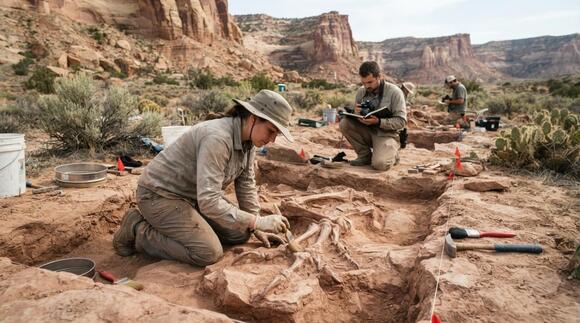
This predator rewrote the book on raptors.
Utahraptor ostrommaysorum became the largest raptor ever found when paleontologist Jim Kirkland identified it in 1991 near Moab. The discovery shocked researchers who assumed all dromaeosaurs were relatively small.
The animal stood about six feet tall at the hip and measured around 23 feet long. Its sickle-shaped claw on each foot reached nearly 10 inches in length, designed to slash rather than merely grip.
Quick Compare
- Utahraptor: 1,000+ pounds, Early Cretaceous
- Velociraptor: 30 pounds, Late Cretaceous
- Deinonychus: 150 pounds, Early Cretaceous
The original specimen came from a sandstone block that also contained at least five other Utahraptor individuals plus a large herbivore. This clustering suggests possible pack behavior, though that interpretation remains debated among specialists.
But #13 represents a find that changed how we picture an entire dinosaur family…
#13 — Falcarius utahensis Bridged Meat-Eaters and Plant-Eaters
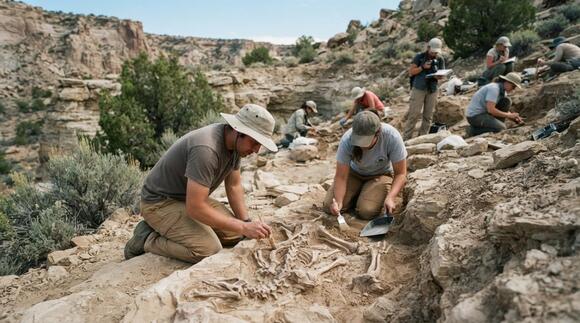
This dinosaur caught evolution in the act.
Discovered in 2005 near Green River, Falcarius represents the transitional form between carnivorous theropods and the bizarre herbivorous therizinosaurs. It possessed teeth designed for shredding plants yet retained the basic body plan of a predator.
The species lived roughly 125 million years ago during the Early Cretaceous. Its arms featured long, curved claws—not yet the exaggerated scythes of later therizinosaurs, but clearly moving in that direction.
The bone bed contained hundreds of individuals that apparently died together, possibly during a drought. Their preserved stomach contents and tooth wear patterns confirmed they ate plants despite their predatory ancestry.
Paleontologist Jim Kirkland, who also discovered Utahraptor, led the excavation team. The sheer number of specimens allowed researchers to study growth stages from juvenile to adult.
But #12 reveals an armored giant that dominates Utah’s state symbols…
#12 — Gastonia burgei Showcased Extreme Defensive Armor
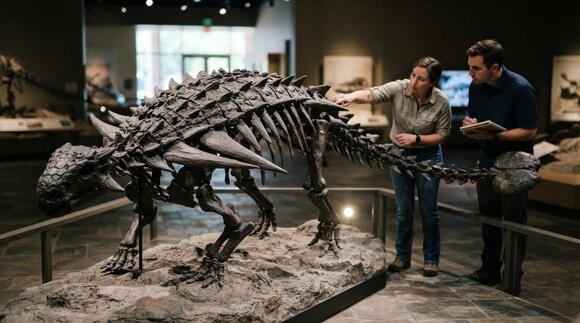
Few herbivores were this heavily defended.
Named in 1998 after fossil collector Robert Gaston, Gastonia carried armor plates, shoulder spikes, and a tail club that made it virtually unassailable by predators. The ankylosaur’s body was essentially a living fortress.
The defensive equipment wasn’t just for show. The shoulder spikes projected outward at sharp angles, preventing tyrannosaurs or large raptors from getting close to the neck or flanks.
Most armored dinosaurs relied on passive defense, but Gastonia could actively swing its tail club with enough force to shatter bone.
Multiple specimens have been recovered from the Cedar Mountain Formation, all dating to approximately 125 million years ago. The completeness of several skeletons allowed paleontologists to reconstruct the entire armor arrangement for the first time in an Early Cretaceous ankylosaur.
But #11 uncovers a predator with an unusual hunting strategy…
#11 — Stokesosaurus clevelandi Was an Early Tyrannosaur Ancestor
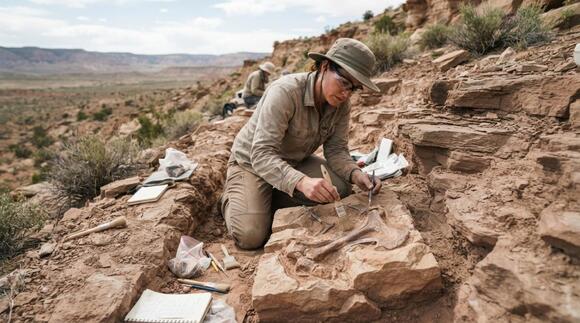
This modest hunter foreshadowed giants to come.
Discovered in the Morrison Formation near Cleveland-Lloyd Quarry, Stokesosaurus represents one of the earliest known tyrannosaurs at roughly 150 million years old. It stood only about six feet tall and measured perhaps 13 feet long.
The creature’s hip structure and leg proportions already showed the cursorial adaptations that would make later tyrannosaurs such effective pursuit predators. But its arms were proportionally longer than T. rex’s, and its skull lacked the bone-crushing power of its descendants.
Fast Facts
- Lived 150 million years ago in Late Jurassic Utah
- Weighed roughly 600 pounds as an adult
- Named after paleontologist William Stokes in 1974
- Found alongside Allosaurus and Ceratosaurus remains
The original specimen consisted primarily of hip and leg bones. Additional material discovered since has clarified its position in tyrannosaur evolution, showing that the family originated in the Jurassic rather than the Cretaceous as once believed.
But #10 brings us to a site that’s literally world-famous…
#10 — Cleveland-Lloyd Quarry Yielded Over 70 Individual Dinosaurs
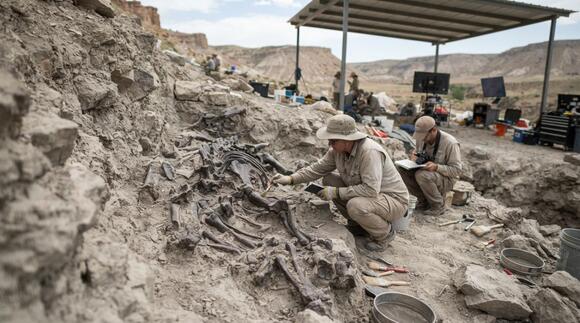
No single site has produced more Allosaurus bones.
Located in Emery County, Cleveland-Lloyd Quarry has yielded more than 12,000 bones from at least 70 individual dinosaurs, making it the densest concentration of Jurassic predator fossils on Earth. Roughly three-quarters of the bones belong to Allosaurus.
The puzzle is why so many carnivores accumulated in one spot. The leading hypothesis suggests the site was a natural trap—perhaps a spring or seep with treacherous mud that mired herbivores, then attracted predators who also became stuck.
The quarry was first excavated in the 1920s and has been worked nearly continuously since. The bone density is so high that in some areas, excavators literally cannot dig without hitting fossil material every few inches.
Allosaurus specimens from this site range from juveniles to full adults. This age diversity has allowed researchers to understand growth patterns and sexual dimorphism in a way impossible with scattered finds.
But #9 reveals a sauropod that dominated Utah’s Late Jurassic landscape…
#9 — Brachiosaurus altithorax Towered Over the Morrison Ecosystem
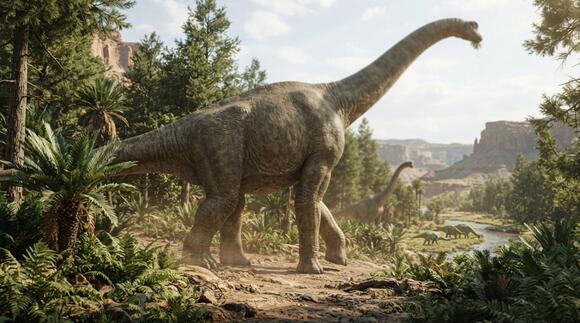
This giant’s name means “arm lizard.”
Brachiosaurus stood roughly 40 feet tall and weighed between 60 and 80 tons, making it one of the largest dinosaurs ever to walk the Earth. Its front legs were longer than its back legs, creating a giraffe-like profile unique among sauropods.
The arrangement allowed the animal to browse vegetation 30 feet or higher—foliage completely inaccessible to most herbivores. Its nostrils sat high on the skull in a distinctive dome-shaped crest rather than at the snout tip.
The first Brachiosaurus fossils came from western Colorado in 1900, but significant Utah material from the Morrison Formation has since established the state as a major source. The Dinosaur National Monument quarry alone has produced several partial Brachiosaurus specimens.
These animals required massive daily food intake, perhaps 400 pounds of vegetation. Their feeding would have shaped entire plant communities across Late Jurassic North America.
But #8 uncovers a predator that rivaled Allosaurus for top billing…
#8 — Torvosaurus tanneri Competed as the Jurassic’s Other Apex Hunter
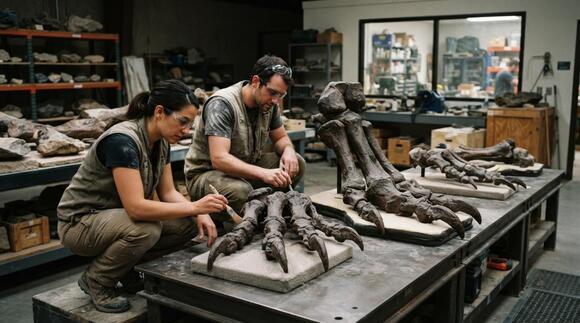
This predator may have been even larger than Allosaurus.
Described in 1979 from Morrison Formation fossils, Torvosaurus reached lengths of 33 feet or more and possessed the largest teeth of any Jurassic carnivore—some over four inches long. Its skull alone measured approximately three feet.
The animal’s teeth were blade-like rather than conical, designed for slicing rather than crushing. This suggests a different hunting strategy than tyrannosaurs would later employ, emphasizing bleeding wounds over bone-breaking bites.
Torvosaurus was stockier and more heavily built than Allosaurus, with proportionally shorter legs. This likely made it a more ambush-oriented hunter rather than a pursuit predator, perhaps targeting juvenile sauropods at water sources.
While Allosaurus bones vastly outnumber Torvosaurus remains, some paleontologists argue this reflects behavior rather than actual population—solitary hunters leave fewer fossils than pack animals.
Multiple Utah sites have yielded Torvosaurus material, though never in the concentrations seen with Allosaurus. The rarity may indicate territorial behavior and lower population density, as expected in top predators.
But #7 represents Utah’s official state dinosaur…
#7 — Allosaurus fragilis Became Utah’s Most Common Large Predator
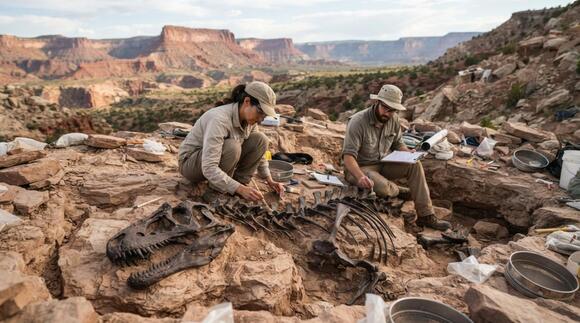
No Jurassic predator is better known from Utah.
Allosaurus dominated the Late Jurassic ecosystem between 155 and 145 million years ago, reaching lengths up to 32 feet and weights approaching two tons. The Cleveland-Lloyd Quarry alone has produced at least 46 individual Allosaurus specimens.
The skull featured sharp, serrated teeth that functioned like steak knives. But the real weapon was the muscular neck—Allosaurus likely used a hatchet-like attack, driving the upper jaw down into prey with tremendous force.
Evidence suggests these predators hunted both alone and in loose groups. Tooth marks on sauropod bones match Allosaurus dentition, and some sites show multiple Allosaurus individuals feeding on single carcasses.
Worth Knowing
- Utah designated Allosaurus the state fossil in 1988
- Bite force estimated at 2,000 pounds per square inch
- Could potentially take down prey weighing 10 tons
- Juveniles likely hunted different prey than adults
The abundance of Utah specimens means Allosaurus is one of the best-understood dinosaurs. Researchers have identified growth stages, healed injuries, and even possible evidence of parenting behavior.
But #6 brings us to a dinosaur that shouldn’t exist in Utah’s rock layers…
#6 — Marshosaurus bicentesimus Filled an Unusual Predator Niche
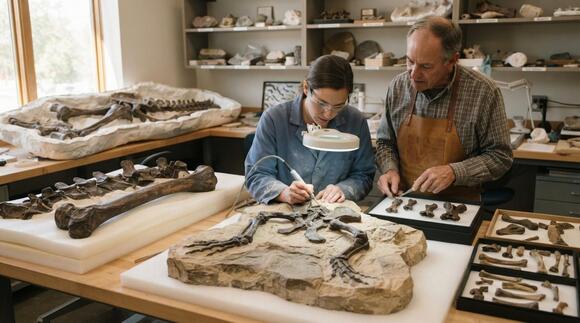
This medium predator occupied a size gap.
Named after paleontologist O.C. Marsh, Marshosaurus measured roughly 15 feet long—larger than a raptor but significantly smaller than the apex predators sharing its environment. This positioned it to hunt prey ignored by both larger and smaller carnivores.
The animal’s hip and leg structure suggests it was a fast runner. The relatively slender build implies it targeted quick, medium-sized prey like small ornithopods rather than attempting to bring down sauropods.
Marshosaurus remains are relatively rare despite being found across multiple Morrison Formation sites. This scarcity fits the ecological expectation that mid-sized predators maintain smaller populations than either top predators or small opportunistic hunters.
The original material came from the Cleveland-Lloyd Quarry in 1976. Additional specimens from Colorado and possibly Wyoming have since been tentatively assigned to the genus, though some experts argue these represent separate species.
But #5 reveals a sauropod known from extraordinary preservation…
#5 — Camarasaurus Became the Most Complete Sauropod Ever Found
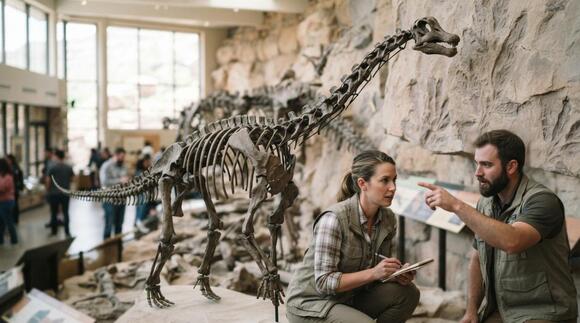
This giant gave us our first truly complete sauropod.
A juvenile Camarasaurus discovered in Utah in 1922 preserved virtually the entire skeleton, including the delicate skull bones that usually disarticulate and scatter. This specimen revolutionized understanding of sauropod anatomy.
Camarasaurus was relatively compact for a sauropod, reaching lengths of about 50 feet and weights around 20 tons. Its box-like skull featured large nasal openings and powerful jaw muscles designed for processing coarse vegetation.
The teeth were particularly robust—shaped like chisels rather than the pencil-like teeth of Diplodocus. This allowed Camarasaurus to bite through tougher plant material, including branches rather than just leaves and needles.
Camarasaurus is the most common sauropod in the Morrison Formation, suggesting its feeding strategy was highly successful in Late Jurassic ecosystems.
The completeness of juvenile specimens has allowed researchers to track growth rates. Young Camarasaurus appears to have grown rapidly, reaching adult size in perhaps 20 years—much faster than earlier estimates suggested.
But #4 uncovers a bizarre, sail-backed herbivore…
#4 — Hypsilophodon-Like Ornithopods Showed Advanced Social Behavior
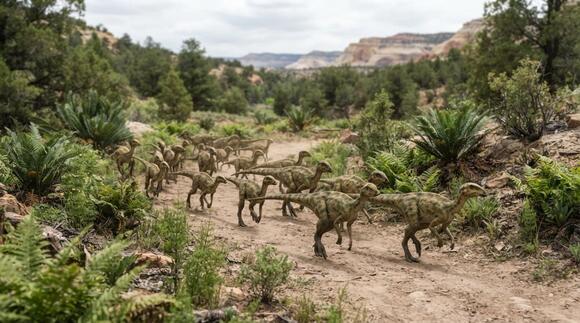
These small herbivores moved in coordinated groups.
Multiple sites in the Cedar Mountain Formation have yielded clusters of small ornithopod bones that died together, suggesting herd behavior in animals weighing only 50 to 100 pounds. These gazelle-sized dinosaurs relied on numbers for protection.
The animals possessed cheek teeth designed for grinding vegetation and long hind legs built for speed. When threatened, their primary defense was simply outrunning predators across open terrain.
Trackway evidence from several Utah sites shows groups of small ornithopods moving together, with consistent spacing between individuals. The pattern resembles modern herd animals that maintain visual contact while feeding.
These dinosaurs likely had keen eyesight and possibly color vision. Large eye sockets in the skull suggest they were active during daylight hours, unlike some contemporary mammals that were nocturnal to avoid predators.
But #3 brings us to Utah’s most surprising recent discovery…
#3 — Eolambia caroljonesa Bridged Duck-Bills and Iguanodonts
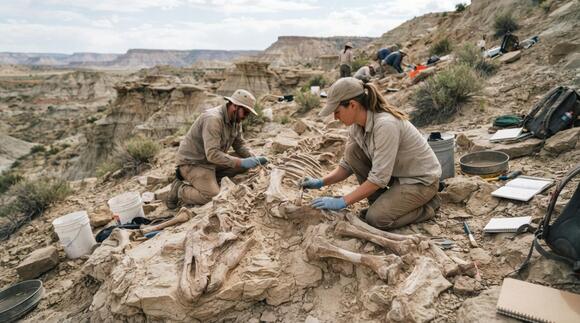
This transitional form clarified hadrosaur origins.
Described in 1998 from multiple individuals found in the Cedar Mountain Formation, Eolambia represents an evolutionary middle ground between primitive iguanodonts and the advanced duck-billed dinosaurs. It lived approximately 95 million years ago.
The skull showed the beginnings of the elaborate crest structures that would characterize later hadrosaurs. But the teeth were still relatively simple compared to the complex dental batteries that would evolve within the next 10 million years.
Eolambia measured about 30 feet long and walked primarily on its hind legs, though it could probably drop to all fours while feeding. The tail was relatively stiff, used for balance rather than as a weapon.
The discovery site preserved multiple age classes together, suggesting possible family groups. Bone histology revealed these animals grew rapidly during their first few years, then slowed considerably after reaching subadult size.
But #2 reveals a predator that terrorized Utah’s Late Cretaceous…
#2 — Teratophoneus curriei Brought Tyrannosaurs to Southern Utah
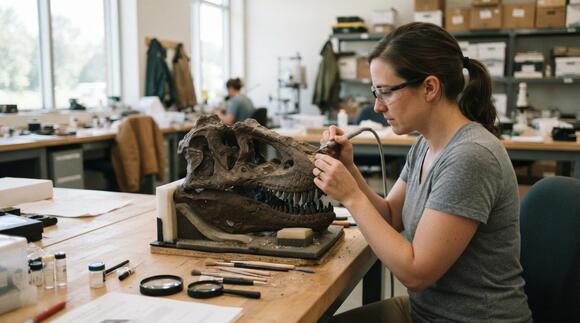
This tyrannosaur ruled an isolated island ecosystem.
Teratophoneus lived approximately 76 million years ago in what was then Laramidia, a narrow strip of land isolated by an inland sea. At 15 feet tall and weighing three tons, it was the top predator in the Kaiparowits Formation ecosystem.
The skull was proportionally shorter and broader than other tyrannosaurs of the same period. This suggests a bone-crushing bite adapted for the specific prey available in its environment, which included horned dinosaurs and duck-bills.
The name means “monstrous murderer” in Greek and honors paleontologist Philip Currie. The holotype specimen, discovered in 2000 in Grand Staircase-Escalante National Monument, included most of the skull and significant postcranial material.
Why It Stands Out
- Represents a unique southern tyrannosaur lineage
- Lived on an isolated island continent
- Shorter snout than contemporary northern species
- Found with associated prey species in same formation
The completeness of the skull allowed detailed comparisons with other tyrannosaurs. The analysis revealed that Late Cretaceous North America supported multiple tyrannosaur species simultaneously, each adapted to different regional ecosystems separated by geography.
But #1 stands as Utah’s most significant dinosaur find of all…
#1 — Dinosaur National Monument Contains the Jurassic’s Greatest Bone Bed
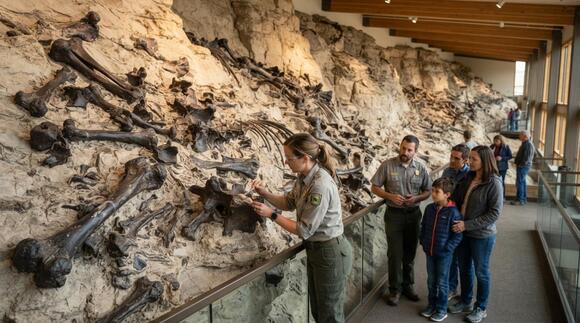
This isn’t just a site—it’s a preserved riverbank ecosystem.
The Carnegie Quarry at Dinosaur National Monument contains approximately 1,500 dinosaur bones still visible in the rock face, representing at least 11 species from 149 million years ago. The wall is literally a cross-section of a Late Jurassic river channel.
Earl Douglass discovered the site in 1909 while working for the Carnegie Museum. What he found was unprecedented: a sandbar where carcasses accumulated during seasonal flooding, creating a mass graveyard that preserved an entire ecosystem in a single geological moment.
The quarry has yielded specimens of Allosaurus, Camarasaurus, Diplodocus, Stegosaurus, and others—all in a concentrated deposit that spans less than 100 yards. The bones aren’t randomly scattered but show preferred orientations that reflect ancient water current direction.
The site became a National Monument in 1915 specifically to protect this extraordinary fossil deposit from commercial exploitation.
The visitor center was built directly over the quarry face, allowing the public to see bones exactly as they were deposited. This in-situ display preserves the scientific context while making the discovery accessible—a model that influenced museum design worldwide.
The concentration of species shows how Jurassic Utah supported remarkable biodiversity. The river system provided year-round water in an otherwise seasonal climate, drawing herbivores that in turn attracted predators in numbers found nowhere else in the formation.
The Bottom Line
Utah’s dinosaur discoveries span 80 million years of prehistory, from the Jurassic’s towering sauropods to the Cretaceous’s fearsome tyrannosaurs. The state’s geology preserved not just individual animals but entire ecosystems frozen in stone.
These finds transformed paleontology from educated guesswork into a data-rich science capable of reconstructing ancient behavior, growth patterns, and evolutionary transitions.
The Morrison Formation alone contains more Late Jurassic fossils than any comparable deposit worldwide. Meanwhile, the Cedar Mountain and Kaiparowits Formations fill crucial gaps in our understanding of Cretaceous evolution.
Which Utah dinosaur discovery surprised you most—the giant Brachiosaurus, the transitional Eolambia, or perhaps the predator-packed Cleveland-Lloyd Quarry?
 Add to Preferred Sources

