undefined
Posts
undefined
Followers
8 Things Archaeologists Found on the Pirate Ship Whydah Off Cape Cod
By Sameen David,
11 days agoStick with us to the end: one simple clue tells you whether a coin pulled from the wreck is worth cataloging or leaving in the conservation queue.
The Whydah went down in a storm off Cape Cod in 1717, and most people assume the wreck gave up its secrets decades ago. But the ship keeps yielding finds that rewrite what we thought we knew about pirate life, trade routes, and the men who sailed under the black flag.
Barry Clifford’s team has been working the site since 1984, and the artifacts still coming up tell stories the history books missed. Here’s what the sand has revealed.
#8 — A Bell with the Ship’s Name Still Legible
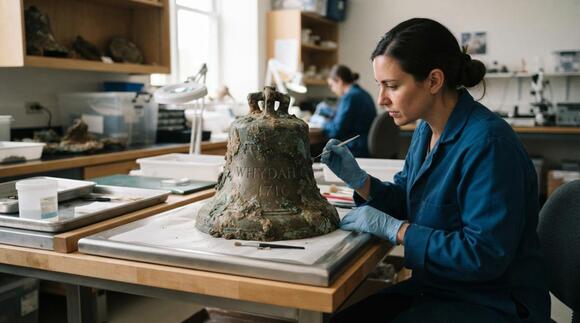
The bell came up in 1985, crusted but intact.
The bronze casting carried the inscription “THE WHYDAH GALLY 1716,” confirming the wreck’s identity after more than 250 years underwater. No other artifact in maritime archaeology has ever settled a pirate ship’s name so decisively—most wrecks are identified through cargo manifests, hull construction, or educated guesswork based on known disappearances.
The Whydah had been a slave ship before Captain Sam Bellamy seized her off the coast of Cuba. Pirates kept the original bell because replacing ship’s equipment cost money they preferred to spend on rum and prize shares.
Quick Compare
- Weight of the bell: approximately 23 pounds
- Original purpose: marking ship’s time and signaling crew
- Preservation: seawater had mineralized the surface but left the bronze core sound
- Current location: on display at the Whydah Pirate Museum in West Yarmouth, Massachusetts
The engraving style matches other ship bells cast in London shipyards during the same period, and metallurgical analysis shows the bronze alloy is consistent with early 18th-century English foundry work. Bellamy’s crew never bothered to deface it, which suggests they wore the ship’s slave-trade past without shame or saw no reason to erase a name that wouldn’t matter once they were hanged.
But #7 reveals what the pirates valued enough to lock in the captain’s quarters…
#7 — Gold Dust in Leather Pouches
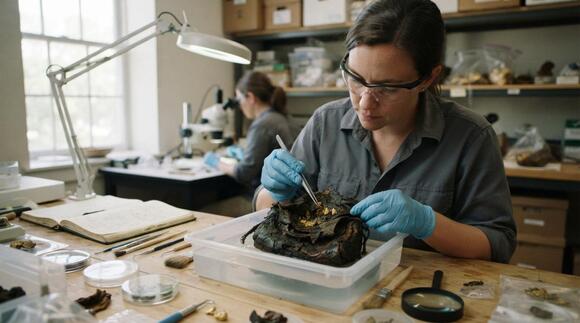
The pouches dissolved, but the contents didn’t.
Conservators found concentrated deposits of gold dust mixed with sand and shell fragments in areas corresponding to the captain’s cabin and the main hold. The dust came from West African trade—pirates operating in the Caribbean in 1717 intercepted ships carrying gold from the Gold Coast (modern Ghana) to European markets.
Gold dust was a preferred medium for small transactions because it didn’t require minting. Pirates could trade it directly in port towns where questions weren’t asked, and it was easier to divide among crew members than coins or ingots.
The leather pouches had long since decomposed, leaving only the stitching holes and the faint outline of seams in the surrounding sediment. Archaeologists mapped the distribution pattern and found the dust clustered in locations that matched eyewitness descriptions of where Bellamy stored high-value plunder.
Most pirate treasure wasn’t buried—it was spent in the nearest port or lost at sea before anyone could count it.
Chemical analysis of the dust particles shows a composition consistent with alluvial gold from the Akan goldfields, the primary source for European trade in the early 1700s. The particle size distribution suggests the gold was panned rather than hard-rock mined, which aligns with West African extraction methods of the period.
But #6 shows what the crew wore when they went ashore…
#6 — Silk Stockings and Shoe Buckles
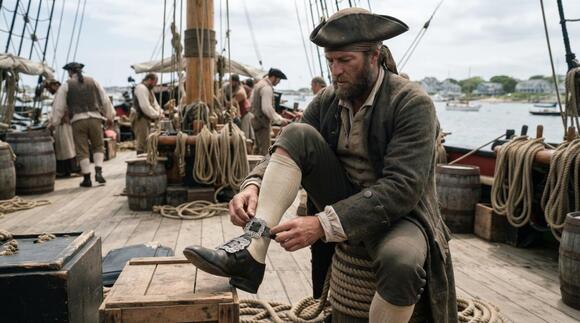
Pirates dressed better than you’d think.
Fragments of fine silk stockings and at least 30 decorative shoe buckles turned up in the debris field, challenging the popular image of barefoot cutthroats in rags. These were luxury goods—silk stockings in 1717 cost more than a laborer’s weekly wage, and silver or brass buckles were a sign of disposable income.
Pirates took clothing from captured ships and wore the finest items as a deliberate display. A well-dressed pirate could move through a port town without drawing immediate suspicion, and the clothing itself was a form of liquid wealth that could be pawned or traded.
Fast Facts
- Silk degradation in seawater: complete within 50 years under normal conditions
- What survived: mineralized impressions and a few fiber clusters protected by metal buckles
- Buckle styles: match London and Bristol fashion from 1710–1720
- Estimated crew size: 146 men aboard when the ship sank
The buckles range from plain brass to ornate silver pieces with decorative scrollwork, suggesting a mix of looted goods and items purchased outright. Some buckles show filing marks where pirates altered the fit, and a few have initials scratched into the back—possibly ownership marks or the initials of the original owners.
Clothing was listed in pirate articles—the written codes that governed crew shares—and a man’s wardrobe was considered part of his personal plunder. The Whydah’s crew had raided more than 50 ships in the months before the wreck, and they’d accumulated a wardrobe that would have looked at home in a London drawing room.
But #5 reveals the weapons they relied on when talking failed…
#5 — Over 200 Pistols in Various States of Preservation
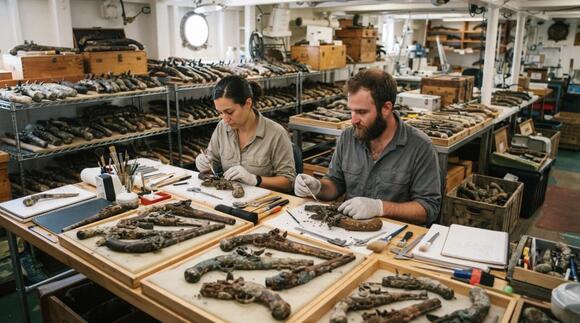
The ship was an armory.
Conservators have recovered and cataloged more than 200 pistols, most of them flintlock designs common to the early 18th century. Pirates favored pistols over muskets in close combat because they could carry multiple loaded weapons and fire in rapid succession without reloading.
The pistols came from English, French, and Dutch makers, reflecting the international nature of pirate plunder. A pirate crew didn’t buy weapons from a single supplier—they took what they captured and kept what worked.
Many of the pistols were found loaded, the powder long since dissolved but the lead balls still seated in the barrels. This suggests the crew was armed and ready when the storm hit—possibly expecting to defend the ship if they ran aground near a settlement, or simply following the pirate custom of staying armed at all times.
X-ray analysis of the corrosion patterns shows that some pistols were stored in wooden cases or wrapped in oiled cloth, while others were shoved loose into barrels or hung on pegs. The distribution pattern indicates weapons were kept near the gunwales and on the main deck, within easy reach during a fight.
But #4 uncovers the everyday tools that kept the ship running…
#4 — Navigation Instruments Including Dividers and Calipers
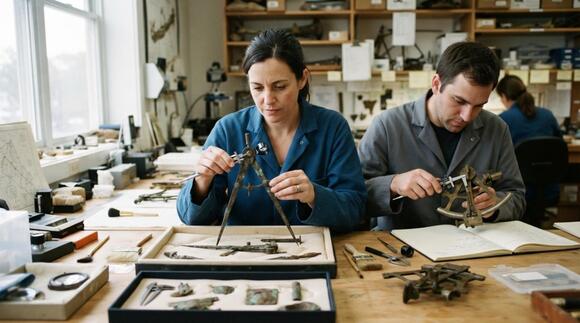
Pirates navigated like professionals because many were professionals.
The wreck yielded brass dividers, calipers, and fragments of at least one octant, tools used for chart work and celestial navigation. These weren’t crude improvised instruments—they were quality pieces that matched what Royal Navy officers carried.
Sam Bellamy’s crew included former merchant sailors and at least one man who had served as a navigator on a Royal Navy vessel. Pirates needed accurate navigation to intercept shipping routes, avoid naval patrols, and find safe harbors, and they recruited men with those skills.
The dividers show wear patterns consistent with regular use, and one set has a maker’s mark from a London instrument shop. The octant fragments include a piece of the ivory scale, which was expensive enough that only a well-funded navigator would own one.
Pirates didn’t guess their way across the Atlantic. They used the same charts, tables, and methods as legitimate sailors, and they kept their instruments in better condition than many merchant crews because their lives depended on not getting lost.
But #3 shows what they ate when supplies ran low…
#3 — Cattle Bones and Evidence of Livestock Aboard
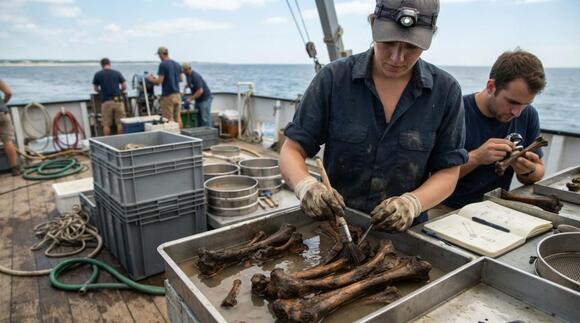
They brought dinner with them.
Cattle bones found in the galley area indicate the Whydah carried live animals for fresh meat, a practice common on long voyages but less expected on a pirate ship operating in coastal waters. The bones came from at least three animals, butchered at different times during the final weeks of the voyage.
Fresh meat was a luxury that prevented scurvy and kept morale high. Pirates operating in the Caribbean often raided coastal settlements specifically to steal livestock, which they kept penned on deck until needed.
Worth Knowing
- A live steer provided meat for 50–60 men for about a week
- Bone marrow, often ignored by wealthy passengers, was prized by sailors for its fat content
- The Whydah’s crew ate better than most merchant crews because they could take what they wanted
The butchery marks on the bones show clean cuts made with sharp blades, and the distribution of skeletal elements suggests the crew consumed the entire animal, including parts like feet and heads that would have been discarded by wealthier households. One skull fragment shows a hole drilled for brain extraction, a technique used to extract every calorie from an animal.
Pirates also kept chickens for eggs, and fragments of chicken bones turned up near what would have been the cook’s area. A ship carrying livestock smelled terrible and attracted rats, but it also meant the crew ate meat several times a week instead of surviving on salt pork and hardtack.
But #2 uncovers the coins that prove where the ship had been…
#2 — Spanish Silver Coins from Three Different Mints
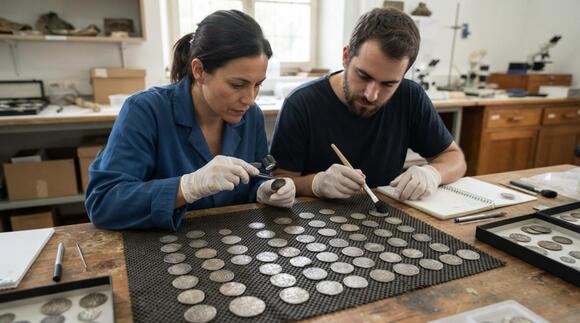
The money tells the route.
Archaeologists recovered over 400 Spanish silver coins, including pieces of eight and smaller denominations, minted in Mexico City, Lima, and Potosí. The dates range from 1684 to 1715, and the mint marks show the Whydah’s crew had raided ships carrying treasure from multiple South American sources.
Spanish silver was the international currency of the Caribbean. Pirates preferred it because it was accepted everywhere, easily divided, and held its value better than most European coinage.
The coins were found scattered throughout the wreck, not concentrated in a single strongbox, which suggests the crew had already begun dividing shares before the ship sank. Pirate articles typically called for treasure to be distributed shortly after a successful raid, with each man’s share determined by his role—the captain got two shares, skilled sailors like carpenters and navigators got one and a half, and ordinary crew got one.
A piece of eight could be physically cut into eight pieces, which is why we still say “two bits” for a quarter.
Several coins show file marks along the edges where someone tested the silver content, a common precaution against debased or counterfeit currency. One coin has a name scratched into it—”J. Brown”—possibly a crew member marking his share or a merchant who handled the coin before it was stolen.
But #1 reveals the find that changed how we understand pirate hierarchy…
#1 — A Child’s Shoe and Small Personal Items
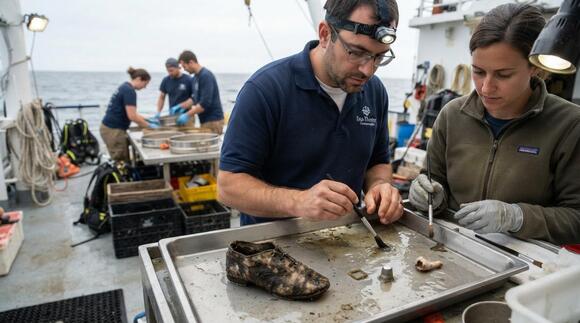
Pirates brought their families.
A small leather shoe, sized for a child between 8 and 10 years old, was found near the stern along with other items suggesting non-combatants aboard. This discovery contradicted the long-held assumption that pirate ships were exclusively male fighting crews—historical accounts mention women and children aboard pirate vessels, but physical evidence had been scarce.
The shoe was well-made, not a cheap item, and shows signs of repeated repair. It was found alongside a small wooden toy and several buttons from children’s clothing, all within a few meters of each other in what would have been below-deck quarters.
Why It Stands Out
- First physical evidence of children aboard a confirmed pirate ship
- Challenges the popular image of pirate crews as uniformly violent and transient
- Suggests some pirates maintained family units even while operating outside the law
- The shoe’s preservation indicates it was protected inside a cabin, not exposed on deck
Captain Sam Bellamy was known to have traveled with Maria Hallett, a Cape Cod woman who bore his child, though accounts differ on whether she was aboard when the ship sank. The presence of children’s items suggests either Bellamy or other crew members brought families aboard, or that the pirates had taken captives they hadn’t yet released or ransomed.
The shoe’s size and construction indicate a child old enough to walk steadily but young enough to need protective footwear—someone who lived aboard ship as part of the community, not just a temporary passenger. This adds complexity to our understanding of pirate social structures, suggesting they weren’t simply roving bands but sometimes functioned as floating alternative societies with their own domestic arrangements.
The Bottom Line
The Whydah wreck site has produced over 200,000 artifacts since its discovery, but these eight items stand out for what they reveal about daily life aboard a pirate ship in the Golden Age. The finds range from the mundane—navigational tools and livestock bones—to the unexpected, like evidence of children living among the crew.
These weren’t just thieves with boats—they were skilled sailors who built alternative communities afloat.
The artifacts challenge the Hollywood version of pirate life while confirming some of the legends. Yes, there was treasure—gold dust and Spanish silver—but there were also silk stockings, well-maintained instruments, and the small shoe of a child who went down with the ship. What surprises you most about what archaeologists found in the wreckage: the evidence of families aboard, the quality of the navigation tools, or something else entirely?
Bonus — How to Spot a Coin Worth Conservation Attention
One simple check separates the routine finds from the pieces that deserve immediate conservation.
Look for visible detail in the corrosion. Coins that retain sharp edges, readable dates, or clear mint marks under the encrustation should go to the front of the conservation queue—the detail you can see now will disappear if the piece sits in storage. Smooth, featureless lumps can wait.
Here’s what to prioritize when sorting a fresh haul:
- Any coin showing a date or partial inscription through the corrosion layer
- Pieces with intact edges or visible relief, even if the surface is degraded
- Coins clustered together—they may reveal mint dates or locations missing from isolated finds
- Items found near personal effects, which provide context for ownership and distribution patterns
Not every coin needs immediate attention, but the ones that still carry information should be documented and stabilized first. The ocean is patient, but silver isn’t—once surface detail is gone, it doesn’t come back.
 Add to Preferred Sources

