undefined
Posts
undefined
Followers
12 Things Moose Do to Get Through a Minnesota Winter
By Sameen David,
23 days agoStick with us to the end: one winter survival tactic moose use could help you spot exactly when spring thaw is coming your way.
Minnesota winters test everything that walks, flies, or breathes. Most people imagine moose simply endure the cold through brute size and thick fur, waiting for April like the rest of us.
But moose don’t wait—they adapt with strategies refined over thousands of years, and some of those strategies are so counterintuitive they upend what biologists once believed about large mammals in extreme cold. Here’s what the data actually says.
#12 — They Grow a Double-Layer Winter Coat
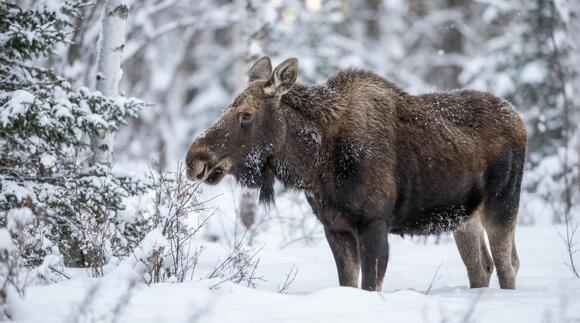
A moose doesn’t just have fur—it engineers it twice a year.
Starting in late August, moose shed their shorter summer coat and replace it with hollow guard hairs that trap air like insulation panels. Each hair shaft is structurally hollow, creating thousands of tiny air pockets across the animal’s body.
This isn’t cosmetic. The air layer works like a thermos, holding body heat close to the skin even when the outer surface of the fur drops below zero.
By October, the transformation is complete: a moose can stand in minus-twenty-degree wind and lose almost no core heat through its coat. The insulation is so effective that snow landing on a moose’s back won’t melt—there’s no heat escaping to do it.
But #11 reveals a behavior that takes this system even further…
#11 — They Let Snow Pile on Their Backs Without Shaking It Off
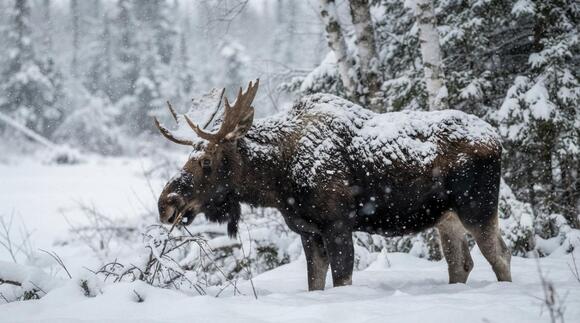
Watch a moose in a January storm and you’ll see something odd: they don’t brush off the snow.
Most mammals shake, roll, or move to clear accumulation. Moose let snow build into a thick blanket because it adds a second insulation layer over the one their fur already provides.
The principle is the same one that makes igloos work: dry snow is mostly air, and air slows heat transfer. A six-inch layer of snow on a moose’s back acts like an external quilt, trapping warmth that would otherwise radiate away on clear, cold nights.
Quick Compare
- Deer shake snow off within minutes of settling
- Elk brush against trees to clear their backs
- Moose can carry snow layers for hours without discomfort
- The behavior is most common when temperatures drop below zero
Wildlife biologists in Voyageurs National Park have measured resting moose with snow caps persisting through eight-hour rest periods. The animals only shake when they stand to move, not because the snow bothers them but because movement dislodges it naturally.
Still, staying warm is only half the problem—#10 shows what moose do when food becomes the real crisis…
#10 — They Switch to a Starvation-Mode Metabolism
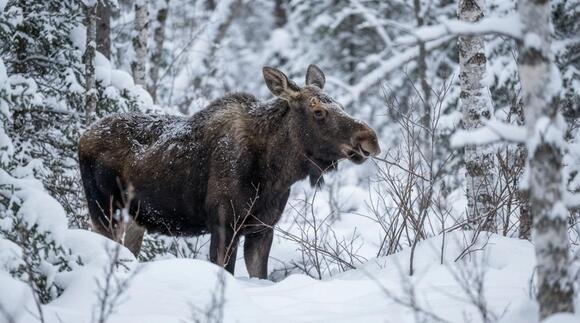
Winter food for a moose is almost a contradiction in terms.
By December, the high-calorie aquatic plants and deciduous leaves that sustained them all summer are gone. What’s left—twigs, bark, conifer needles—is so low in nutrition that a moose can eat all day and still run a caloric deficit.
So moose don’t fight it. Their metabolism downshifts into what researchers call a hypometabolic state, dropping energy expenditure by as much as thirty percent compared to summer baseline.
Heart rate slows. Digestion becomes more efficient. Movement decreases to only what’s necessary. It’s not hibernation—moose stay awake and active—but it’s a voluntary biological recession that lets them survive on twigs that would starve them in July.
Fast Facts
- A winter moose needs roughly 20 pounds of browse per day
- Summer intake can exceed 60 pounds of green vegetation daily
- Metabolic suppression can last from November through March
- The shift is triggered by photoperiod, not temperature alone
This explains why moose look gaunt by late winter even in areas with plenty of browse. They’re not starving in the acute sense—they’re running lean by design, burning stored fat while their engine idles.
Moose survive winter not by eating more, but by needing less.
And speaking of what they eat, #9 shows a food source most people would never associate with a moose…
#9 — They Strip and Eat Bark from Aspen and Willow
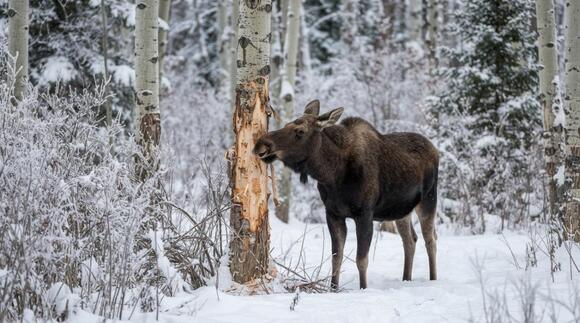
When twigs run out or ice encases them, moose turn to the trees themselves.
Aspen, willow, and sometimes birch bark become emergency rations. Moose use their lower incisors like chisels, peeling vertical strips of cambium—the living layer just under the outer bark—and consuming it directly.
Cambium contains sugars the tree stores for spring growth. It’s more calorie-dense than dead twigs, though still marginal compared to summer greens.
You can identify moose feeding sites by the tooth marks: vertical gouges running up the trunk, often as high as seven feet where the moose stretched to reach un-browsed sections. Heavily used winter ranges show entire groves of aspen with stripped lower trunks, pale scars that remain visible for years.
But even bark isn’t always enough, which is why #8 takes moose to an unexpected place…
#8 — They Bed Down in Spruce Thickets for Windbreak
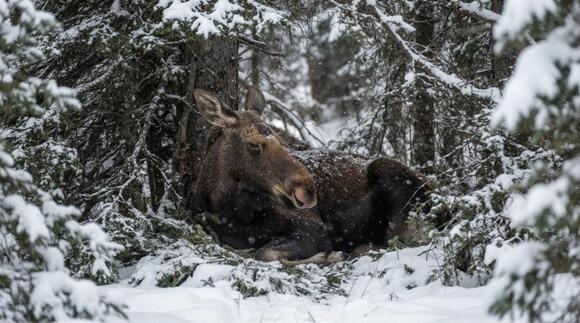
Moose don’t build shelters, but they choose their beds with the precision of an architect.
Dense spruce and balsam fir stands act as natural windbreaks. A moose bedded in a mature spruce thicket can reduce wind chill exposure by forty degrees compared to an open hillside just a hundred yards away.
Wind is the silent thief of body heat. Even a modest fifteen-mile-per-hour wind strips heat from exposed skin and fur faster than still air at the same temperature.
Moose know this. Radio-collar studies from the Superior National Forest show moose consistently selecting dense conifer cover for bedding sites during high-wind events, even when those sites are farther from browse. The thermal advantage of blocking wind outweighs the cost of a longer walk to food.
The behavior is so reliable that trackers use it in reverse: if you want to find moose in a blizzard, check the spruce thickets first.
What they do with their legs in deep snow is equally calculated, and #7 explains how…
#7 — They Walk in Their Own Packed Trails to Conserve Energy
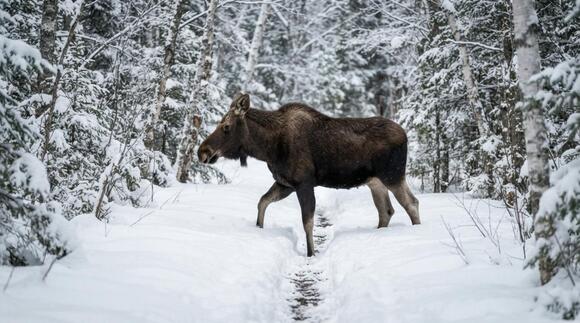
Every step a moose takes in deep snow is expensive.
Lifting a leg free of two feet of powder, then punching it down again, burns energy at several times the cost of walking on bare ground. Moose respond by walking the same paths repeatedly, packing the snow into hard trails that reduce the effort of each subsequent trip.
These trails become semi-permanent features of a moose’s winter range. They connect bedding areas to browse sites, water sources, and sometimes just loop through a territory in a circuit that lets the moose cover ground without constantly breaking new snow.
Other moose will use the same trails, especially in areas with high population density. A well-used trail can look like a narrow trench, worn down to knee height with steep walls on either side.
The energy savings are measurable: a moose walking a packed trail uses roughly sixty percent of the energy required to walk the same distance through unpacked snow. Over a winter of marginal calories, that difference is the margin of survival.
But trails only help if you’re moving—#6 reveals what moose do when they’re not…
#6 — They Reduce Daily Movement to Less Than a Mile
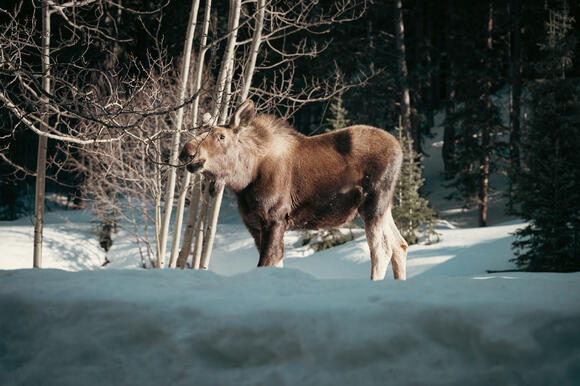
Summer moose are wanderers, covering three to five miles a day as they graze, socialize, and explore.
Winter moose barely move. GPS collar data shows winter ranges shrinking to less than one square mile, with daily travel distances dropping to under a mile on the coldest days.
This isn’t laziness—it’s arithmetic. Moving burns calories. Calories are scarce. Therefore, don’t move unless you have to.
Worth Knowing
- A moose’s winter range is typically 10–15% the size of its summer range
- Movement peaks during feeding windows, usually dawn and dusk
- Severe cold can suppress movement entirely for 24-hour periods
- Spring breakup triggers an immediate expansion back to summer patterns
Moose will sometimes bed for eighteen hours straight during deep cold snaps, rising only to feed briefly before returning to the same spot. The strategy is pure efficiency: minimize output when input is constrained.
And when they do feed, the choices they make are surprisingly selective—#5 shows what they’re really looking for…
#5 — They Target High-Tannin Twigs That Other Deer Avoid
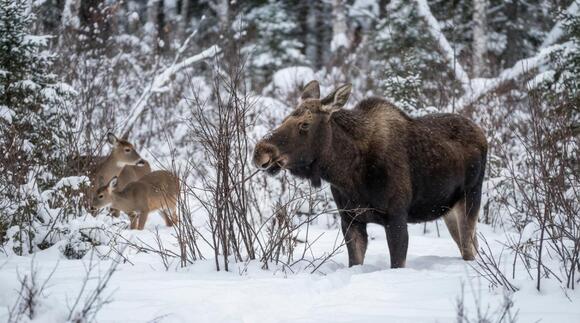
Not all twigs are equal, and moose know it.
While white-tailed deer avoid high-tannin browse—compounds that interfere with digestion and taste bitter—moose have gut bacteria and liver enzymes adapted to break down tannins efficiently, turning a deterrent into a competitive advantage.
Willow, red-osier dogwood, and certain species of birch twigs contain tannin levels that would cause digestive upset in deer. Moose process them without issue.
This adaptation matters most in winter, when browse competition intensifies. By exploiting a food source other ungulates avoid, moose access calories that would otherwise go unused. It’s ecological niche separation written in stomach chemistry.
Researchers have documented moose selectively browsing high-tannin species even when lower-tannin options are nearby, suggesting they may actively prefer the taste or derive some secondary benefit from the compounds.
But digestion is only half the equation—#4 reveals a water behavior that defies the season…
#4 — They Break Through Ice to Drink from Streams and Lakes
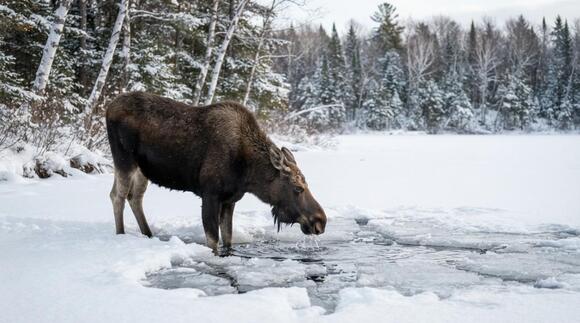
You’d think moose could get all their water from eating snow.
They can’t. Snow is thermally expensive to melt—it costs body heat to convert ice into liquid—and the water content of woody browse is negligible.
So moose seek out liquid water even in the dead of winter. They’ll break through ice at the edges of lakes and rivers, using their weight and hooves to crack open access points where current or springs keep water flowing beneath a frozen surface.
This behavior is most common in January and February, when snow is deep but temperatures occasionally rise enough to thin ice at shorelines and stream margins. A moose will sometimes return to the same access point daily, maintaining a hole by breaking through refrozen layers each morning.
It’s a small detail that surprises people: even in minus-twenty weather, moose still need to drink, and they’ll work to get it.
The next behavior, though, is what really keeps them alive when food runs short—#3 explains the strategy…
#3 — They Chew Cud for Hours to Extract Maximum Nutrition
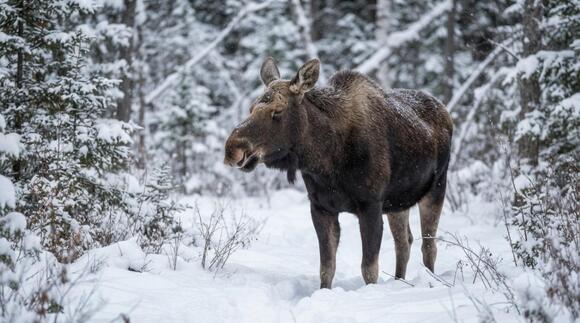
Moose are ruminants, and winter is when that matters most.
After browsing, a moose will bed down and begin chewing cud—regurgitated food brought back up from the rumen to be chewed again. This second-pass chewing breaks down woody fibers that were too tough to digest the first time, unlocking calories that would otherwise pass through unused.
A moose can spend six to eight hours a day chewing cud during winter, far more than in summer. The behavior is pure efficiency: when food is low-quality, you process it harder.
The rumen itself is a fermentation chamber, packed with bacteria that break down cellulose. But fermentation takes time, and the tougher the material, the longer the process. By chewing cud, moose mechanically assist the bacteria, speeding digestion and improving nutrient extraction.
In winter, a moose’s survival depends less on what it eats than on how thoroughly it digests it.
It’s a slow, patient system—and #2 shows another way moose turn time into an advantage…
#2 — They Time Calving to Sync with Spring Green-Up
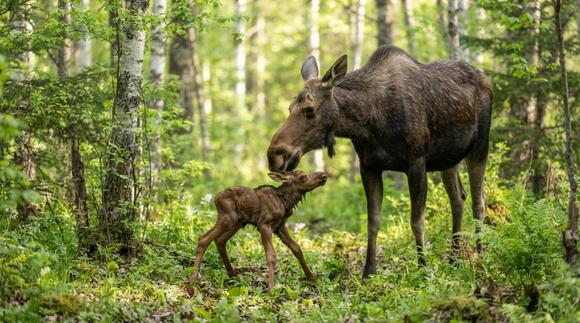
Moose don’t give birth in winter. They time it so calves arrive in late May or early June, exactly when fresh greens return.
This synchronization is precise. Gestation lasts about 240 days, meaning moose breed in late September so calves are born into abundance, not scarcity.
A newborn moose calf weighs around thirty pounds and needs to gain weight rapidly to survive its first winter. The only way that happens is if the mother has access to high-calorie forage immediately after birth, allowing her to produce rich milk while the calf begins browsing on its own.
Why It Stands Out
- Calves double their birth weight in the first two weeks
- Timing is controlled by photoperiod, not temperature
- A two-week shift in green-up can reduce calf survival by 30%
- Climate change is beginning to disrupt this synchronization in some regions
Spring green-up in northern Minnesota typically peaks in mid-to-late May. Moose have been locking into that window for millennia. When green-up arrives early or late due to weather anomalies, calf survival rates shift accordingly—proof that the timing isn’t accidental.
But the single most important winter behavior is one most people never see, and #1 is where it all comes together…
#1 — They Drop Their Antlers to Reduce Energy Costs
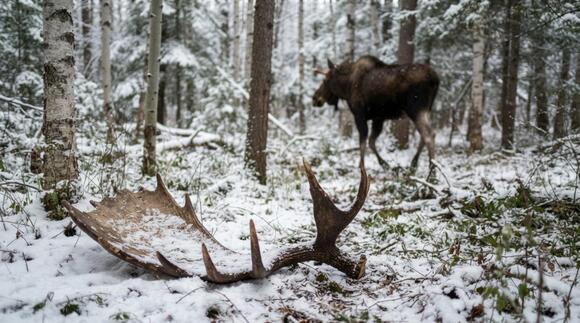
Every November and December, bull moose shed their antlers.
It looks like a loss—antlers are iconic, intimidating, a symbol of dominance. But carrying them through winter is a metabolic burden that serves no purpose once the rut is over, and moose are ruthlessly practical.
Antlers can weigh sixty pounds or more on a large bull. That’s sixty pounds of bone the animal must carry, support, and keep supplied with blood flow, all for zero functional benefit during the months when calories are scarcest.
Dropping them is pure efficiency. The antlers fall off when the bone connection at the skull weakens, a hormonally controlled process tied to declining testosterone after breeding season ends. Within days of shedding, the wounds seal and the bull is lighter, more mobile, and less encumbered.
Come spring, they’ll grow a new set, larger than the last. But through the lean months, bulls and cows alike are stripped to essentials—no wasted weight, no wasted energy, just survival math carried out in bone and tissue.
The Bottom Line
Moose survive Minnesota winters not through toughness alone, but through a layered system of biological and behavioral adaptations that reduce energy expenditure at every level.
From hollow fur and snow blankets to metabolic suppression and antler shedding, each strategy solves a specific problem in the winter survival equation. The animals don’t endure cold—they engineer around it, using tools refined over thousands of generations.
The moose you see standing in a February blizzard isn’t suffering. It’s operating exactly as designed.
What surprises you most about how moose handle winter—the antler drop, the snow blanket, or the fact they still break ice to drink?
Bonus — One Simple Sign That Moose Know Spring Is Coming Before You Do
Moose begin changing their behavior weeks before green-up becomes visible to humans. If you know what to watch for, they’ll tell you spring is on the way before the thermometer does.
The earliest signal is movement. Bulls and cows that spent months in tight winter ranges begin expanding their daily circuits in late March or early April, sometimes before snowmelt even starts. They’re not finding new food yet—they’re anticipating it, moving toward areas where green-up happens first.
Here’s what to watch for if you live in or visit moose country:
- Moose shifting from dense conifer cover to more open mixed forests
- Increased sightings near wetland edges and lakeshores, even while frozen
- Bulls beginning to show aggression again as testosterone rises pre-antler growth
- Tracks showing longer daily distances and less reliance on packed trails
One final sign: watch for moose feeding behavior to shift from woody browse to include more probing and digging at the snow base, where early shoots sometimes emerge under the insulating layer. It’s subtle, but it’s happening before anything green is visible from the road. When you see it, spring is closer than the calendar admits.
 Add to Preferred Sources

