undefined
Posts
undefined
Followers
14 Things Scientists Quietly Changed Their Minds About T. Rex
By Sameen David,
2026-10-09Stick with us to the end: one surprising fossil find completely rewrote what we thought we knew about how T. rex actually hunted.
For decades, Tyrannosaurus rex has been cast as the ultimate killing machine—a lone hunter with bone-crushing jaws and tiny, useless arms. That mental image shaped everything from museum displays to blockbuster movies.
But paleontologists have spent the last twenty years quietly walking back many of those claims. New fossil evidence, better imaging technology, and field discoveries have forced scientists to admit they got some big things wrong.
Here’s what the data actually says.
#14 — Those “useless” arms were anything but weak
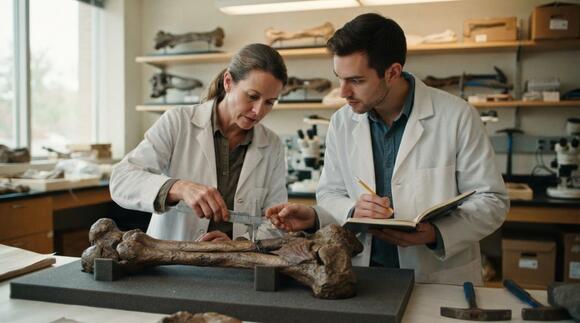
Scientists used to joke that T. rex arms were evolutionary leftovers.
The humerus bone in each arm could support over 400 pounds of flexing force, according to biomechanical studies published in the early 2000s. That’s roughly the lifting capacity of an adult human’s entire body, concentrated in one dinosaur forearm.
The muscle attachment points show these arms weren’t vestigial decorations. They were built for gripping and pulling with serious strength.
Paleontologists now think T. rex used its arms to grip struggling prey at close range, or possibly to push itself upright after resting. The two-fingered claws show heavy wear patterns consistent with regular use, not disuse.
But #13 corrects an even older assumption about speed…
#13 — It couldn’t outrun a human in a straight sprint

Every chase scene you’ve seen is biomechanically impossible.
Computer models based on leg bone density show T. rex topped out around 12 to 15 miles per hour—about the pace of a casual human jog. Running any faster would have generated enough impact force to shatter its own leg bones on landing.
The femur and tibia weren’t built for sustained speed. They were optimized for power and stability, not agility.
A full-grown T. rex weighed six to nine tons. That mass, combined with a high center of gravity, made high-speed chases a structural impossibility. It hunted through ambush and endurance, not sprinting.
And #12 reveals what replaced speed in its hunting strategy…
#12 — It likely hunted in coordinated groups
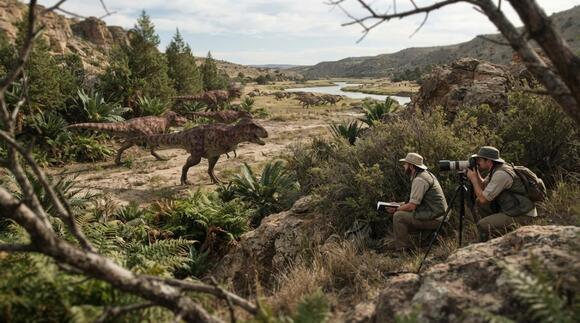
The “solitary apex predator” image came from incomplete evidence.
Quick Compare
- Modern Komodo dragons hunt solo but scavenge in groups
- Crocodiles are solitary but tolerate each other at kills
- T. rex fossil sites show multiple adults in close proximity
Trackway fossils from British Columbia show three adult-sized tyrannosaurs moving in the same direction at the same time, preserved in stone dating to roughly 66 million years ago. The spacing and gait suggest coordination, not coincidence.
Pack hunting would explain how T. rex brought down much larger prey like Triceratops and Edmontosaurus. A single tyrannosaur risked serious injury from a horn strike or tail blow; a group could attack from multiple angles.
Bite marks on hadrosaur bones show attack patterns consistent with multiple T. rex individuals feeding on the same carcass while the animal was still alive. That’s predation, not scavenging.
Still, #11 dismantles the idea that it was only a predator…
#11 — It absolutely scavenged when it could
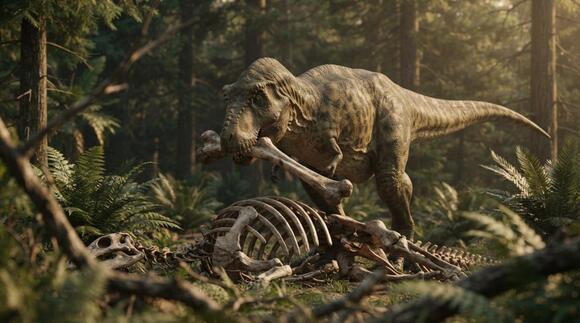
For years, suggesting T. rex scavenged was considered heresy.
Every modern apex predator scavenges opportunistically, and there’s no evolutionary reason T. rex would have been pickier. Its sense of smell was highly developed—olfactory bulb imprints in skull fossils show a brain region larger than that of modern vultures.
Scavenging is energetically cheaper than hunting. A six-ton animal needs roughly 40,000 calories per day. Passing up a free meal would have been a fatal waste of energy in a Cretaceous ecosystem.
Most apex predators today take the easy meal when they find it.
Tooth wear patterns show T. rex bit into bone with enough force to crack open marrow—a feeding behavior seen in scavengers, not just active hunters. It likely did both, depending on opportunity.
And #10 overturns what we thought about its vision…
#10 — Its vision was sharper than an eagle’s
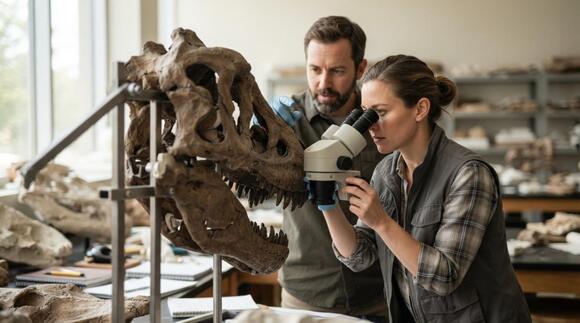
The “motion-based vision” trope has no basis in anatomy.
Eye socket size and orientation suggest T. rex had binocular vision with an acuity roughly 13 times sharper than human eyesight. That’s better depth perception and detail resolution than modern birds of prey.
The large orbit size allowed for large eyeballs, which in turn permitted more photoreceptor cells. More cells mean better image resolution, especially at distance.
This wasn’t an animal that struggled to see stationary objects. It could spot a human-sized target over three miles away in good light. The “stand still and it won’t see you” scene was Hollywood fiction, not paleontology.
But #9 changes the timeline of when it ruled…
#9 — T. rex existed for only 2 million years
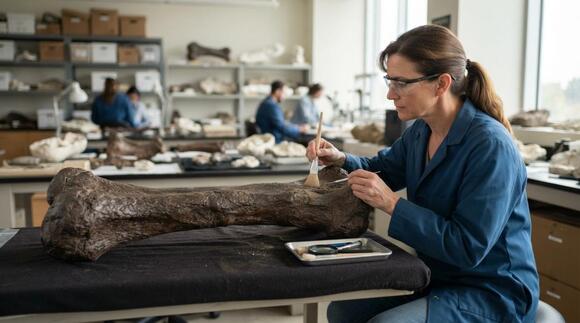
That’s a geological eyeblink.
Fast Facts
- Stegosaurus went extinct 80 million years before T. rex appeared
- T. rex lived closer in time to humans than to Allosaurus
- The entire species lifespan fits within the Maastrichtian stage
Tyrannosaurus rex appears in the fossil record around 68 million years ago and vanishes at the K-Pg extinction event 66 million years ago. The entire reign of the “king of dinosaurs” lasted roughly two million years—shorter than many Ice Age mammal species.
For comparison, Homo sapiens has existed for over 300,000 years and we’re still here. T. rex dominated its ecosystem brilliantly, then disappeared completely when an asteroid reset the planet.
Its brief existence makes every fossil find statistically improbable. We’ve likely discovered less than one percent of all T. rex individuals that ever lived.
And #8 corrects a major assumption about its skin…
#8 — It had patches of primitive feathers
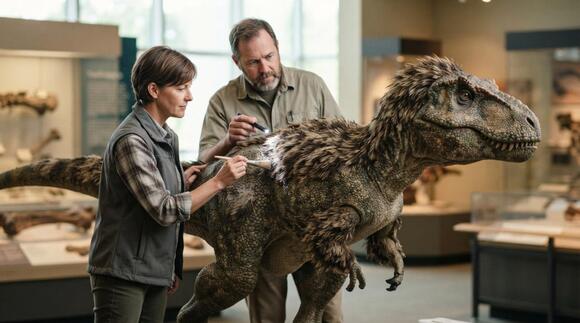
Scaly, lizard-like skin was the default reconstruction for decades.
Skin impressions from close tyrannosaur relatives like Yutyrannus show filamentous proto-feathers, especially on younger individuals. While no direct T. rex skin has been found with feathers intact, phylogenetic bracketing suggests at least some body coverage.
Feathers likely served as insulation for juveniles and display structures for adults. The metabolic cost of maintaining a six-ton body temperature in a temperate climate would have been enormous without some insulating layer.
Adult T. rex may have lost most feathering as they aged, similar to how elephants lose hair. But hatchlings and subadults almost certainly had a fuzzy or downy covering on parts of the body, particularly the back and tail base.
Still, #7 reveals it grew faster than anyone expected…
#7 — Juveniles gained five pounds per day during growth spurts
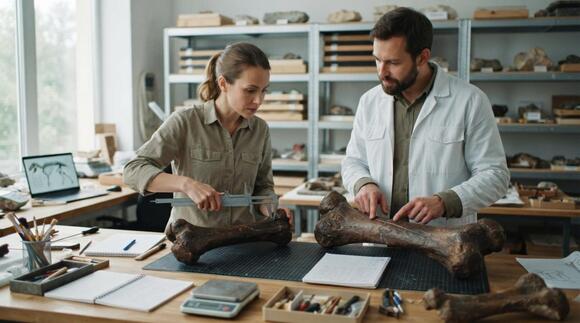
That’s faster than any living land animal.
Bone histology studies show T. rex hit a teenage growth phase where it added roughly 1,700 pounds per year—nearly five pounds every single day for four to five years straight. Growth rings in femur cross-sections reveal this explosive adolescent phase.
This rapid growth required massive caloric intake. A teenage T. rex likely spent most of its waking hours hunting or scavenging to fuel bone and muscle development.
By age 20, growth slowed dramatically. Most T. rex individuals didn’t live past 30 years old, based on the oldest bone samples ever recovered. They grew fast, hunted hard, and died relatively young by mammalian standards.
And #6 overturns what museums still show about posture…
#6 — The tail stayed off the ground at all times
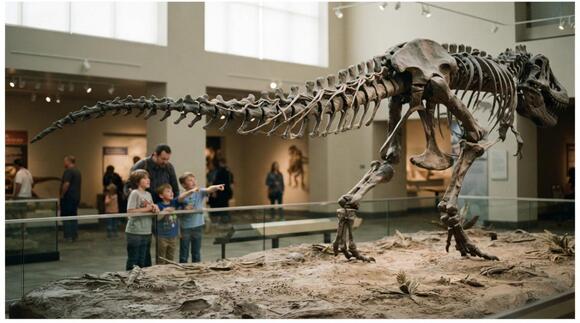
Older museum mounts dragged the tail like a third leg.
The tail contained over 40 vertebrae reinforced by ossified tendons that locked it into a horizontal cantilever position. Letting it sag would have snapped those tendons and made walking biomechanically impossible.
The tail wasn’t a stabilizer touching the ground. It was a dynamic counterbalance that shifted constantly to offset the weight of the massive head and torso during movement.
Dragging a tail would have left continuous furrows in mud and soft sediment. No such drag marks appear in any tyrannosaur trackway fossil. The tail was always elevated, functioning as an active part of the locomotion system.
But #5 dismantles the “king” imagery itself…
#5 — Most specimens are female, not male
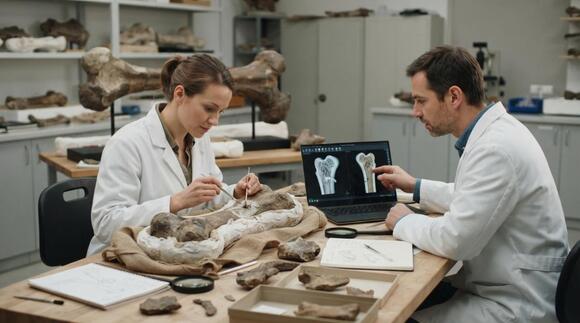
Sexual dimorphism in dinosaurs is notoriously hard to prove, but the data leans one way.
Specimens with wider hips and thicker femurs—traits associated with egg-laying—make up roughly 70% of all well-preserved T. rex fossils. If the sample is representative, females either outnumbered males or survived longer in the fossil record.
Medullary bone, a calcium-rich tissue found only in egg-laying females, has been identified in at least one T. rex specimen. This tissue forms temporarily during egg production, proving that individual was female.
The “Tyrant Lizard King” was more often a queen.
The largest and most complete skeletons, including the famous “Sue” specimen, show pelvic and limb features consistent with female morphology. Males may have been smaller or less robust, making them less likely to fossilize.
And #4 changes what we thought it ate most often…
#4 — Hadrosaurs were the primary prey, not Triceratops
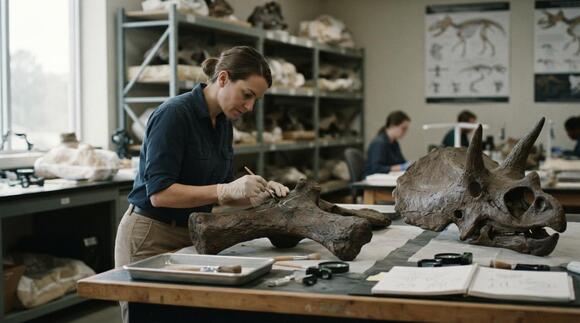
Ceratopsians make for dramatic reconstructions, but the evidence points elsewhere.
Worth Knowing
- Hadrosaur fossils outnumber ceratopsians 3-to-1 in Hell Creek Formation
- Bite marks on hadrosaur bones match T. rex tooth spacing exactly
- Triceratops horns posed serious injury risk during frontal attacks
Coprolites—fossilized T. rex dung—contain crushed hadrosaur bone fragments far more often than any other prey type. Hadrosaurs were abundant, relatively defenseless, and moved in herds, making them ideal targets.
Triceratops was dangerous. A well-placed horn strike could puncture a T. rex’s abdomen or shatter a leg. Hadrosaurs could only run, and T. rex was built to chase down runners over distance.
The fossil record shows T. rex pursued the lowest-risk, highest-reward prey available. Dramatic fights happened, but calculated hunting fed the species.
Still, #3 reveals a gap in the fossil record that surprised everyone…
#3 — No juvenile T. rex fossils exist between ages 2 and 13
It’s called the “juvenile gap,” and it’s still unexplained.
Paleontologists have found hatchling-sized specimens and subadults over 13 years old, but almost nothing in between. Either juveniles lived in environments that didn’t preserve fossils, or something about that age range made them less likely to die in fossil-forming conditions.
One hypothesis suggests juveniles occupied different ecological niches than adults—possibly hunting smaller prey in dense forests where fossilization rarely occurred. Another suggests juvenile mortality was so low during that phase that few died and were preserved.
The gap makes it nearly impossible to track ontogenetic changes during T. rex’s most formative years. We’re missing a huge developmental window that would explain how a 50-pound hatchling became a six-ton apex predator.
And #2 corrects the single most repeated “fact” about its bite…
#2 — The bite force was half what pop science claims
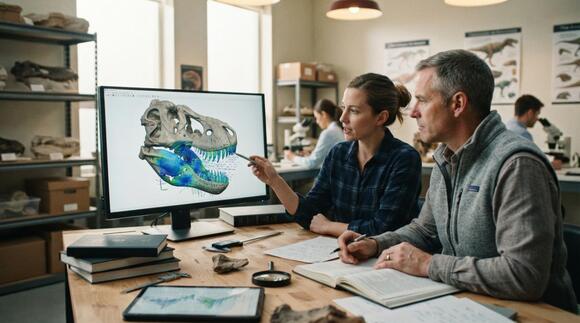
The “strongest bite in history” claim has been quietly downgraded.
Rigorous biomechanical modeling published in 2012 estimated T. rex bite force at roughly 8,000 pounds per square inch—not the 12,000+ figure still circulating online. That’s still three times stronger than a modern saltwater crocodile, but far below the exaggerated numbers.
The confusion came from early studies that didn’t account for jaw muscle fatigue or realistic feeding angles. Maximum theoretical force and sustainable biting force are very different measurements.
Even at 8,000 PSI, T. rex could crush bone and puncture thick hide with ease. The correction doesn’t diminish its predatory capability—it just makes the claims defensible.
But #1 reveals the discovery that changed everything…
#1 — A fossil proved they cared for their injured
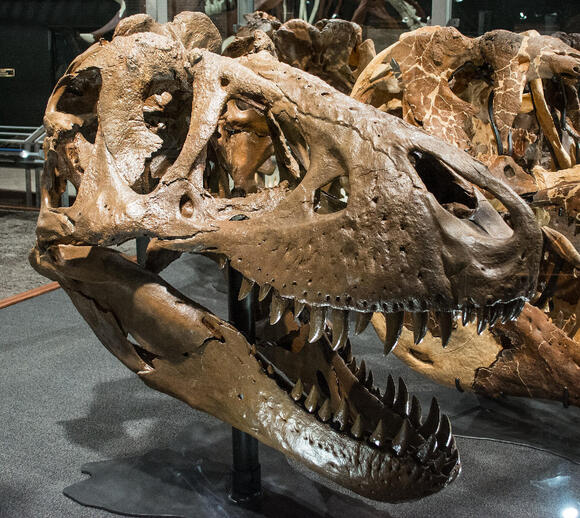
This one specimen rewrote behavior assumptions across the entire species.
Why It Stands Out
- Healed fractures require weeks of immobility
- Infection evidence shows the wound was treated or cleaned
- Survival past injury implies group support or food-sharing
A T. rex femur found in Montana shows a catastrophic break that healed completely over several months. The individual survived long enough for new bone to calcify and fuse, despite being unable to hunt during recovery.
A solitary predator with a broken leg dies within days. This one lived for weeks or months while immobilized, which means other tyrannosaurs either brought it food or tolerated it scavenging from their kills.
The specimen also shows signs of infection that cleared—something almost impossible without a clean environment or removal of necrotic tissue. Whether that happened through grooming behavior or environmental luck is unknown, but the survival itself is evidence of social structure.
This single fossil turned T. rex from a ruthless loner into something more complex: a social animal that invested in the survival of its group members, even when they couldn’t contribute to the hunt.
The Bottom Line
The Tyrannosaurus rex that emerges from modern paleontology barely resembles the monster of 1990s pop culture. It was slower, fuzzier, more social, and far more strategic than the brute-force killer we imagined.
The evidence points to an intelligent pack hunter with acute senses, strong family bonds, and flexible survival strategies. It scavenged and hunted. It cared for injured members. It dominated an ecosystem for two million years and then vanished entirely.
The real T. rex is more interesting than the movie version ever was.
What surprised you most—the feathers, the pack behavior, or the evidence of compassion? And if you could ask paleontologists to solve one remaining T. rex mystery, what would it be?
Bonus — The one fossil detail that separates real finds from fakes
Museums and private collections are flooded with composite skeletons and replicas. One structural feature separates authentic T. rex fossils from reconstructions every time.
Real T. rex bones show Haversian canals—microscopic vascular channels visible under magnification that form during life. No casting process replicates these internal structures accurately.
Here’s what to check when evaluating any fossil specimen:
- Request a thin-section microscopy image showing internal bone structure
- Look for evidence of bone remodeling and growth rings in the cortex
- Verify the presence of medullary cavity space within long bones
- Confirm that surface texture matches natural weathering, not molding artifacts
A composite skeleton may be 95% plaster with one real tooth. Asking for Haversian canal evidence forces sellers to prove the bone grew inside a living animal.
True fossils also show diagenetic changes—mineral replacement that happens over millions of years and creates crystalline patterns impossible to fake. If a seller refuses microscopy or cross-section analysis, you’re looking at a replica, not a relic.
READER QUIZ
[How Well Do You Know the Real T. Rex?]
According to biomechanical studies, what was T. rex’s maximum running speed?
- 5 to 8 miles per hour
- 12 to 15 miles per hour
- 25 to 30 miles per hour
- 35 to 40 miles per hour
What prey animal did T. rex hunt most often based on coprolite evidence?
- Triceratops
- Ankylosaurus
- Hadrosaurs
- Smaller tyrannosaurs
How long did T. rex exist as a species before going extinct?
- 2 million years
- 10 million years
- 50 million years
- 150 million years
What was the estimated bite force of T. rex in modern studies?
- 3,000 PSI
- 8,000 PSI
- 12,000 PSI
- 20,000 PSI
What age range is missing from the T. rex fossil record?
- Ages 0 to 2 years
- Ages 2 to 13 years
- Ages 13 to 20 years
- Ages 20 to 30 years
Have you changed your mental image of T. rex after learning these facts?
- Completely—it’s a different animal now
- Somewhat—a few details shifted my view
- Not really—I still picture the classic version
 Add to Preferred Sources
