undefined
Posts
undefined
Followers
Their kids were placed in self-contained classrooms. Then the problems began.
By Theo Peck-Suzuki,
5 hours ago
American special education, by law, is supposed to strive for inclusion — providing students with as much time with their nondisabled peers as possible, even if it takes extra support.
The reality for some children doesn’t measure up.
In New Haven, two families are speaking out after they say their children were pushed into restrictive special education classrooms without proper evaluation, where they received woefully inadequate services.
Both families have children with autism. The parents said New Haven didn’t conduct key assessments before placing their children in self-contained classrooms, and they said the experiences made the children’s behaviors worse at home. According to one parent, her child’s classroom was lacking a certified special education teacher for part of the year.
Attorneys with the Center for Children’s Advocacy who represent the parents said these experiences are not uncommon in New Haven and elsewhere in the state. They described understaffed systems that don’t take basic steps to assess children’s needs and struggle to meet their legal obligations under federal special education law.
Under these circumstances, the attorneys said, some kids are pushed into restrictive classrooms where they end up learning very little.
CCA attorney Sarah Mervine likened it to a daycare.
“I’m gonna take all these kids, smush them together, so three [paraeducators] can deal with 10 people, instead of saying, ‘Wait a minute, where is the best way I could integrate these children?’” she said.
Her colleague Kathryn Meyer called it “a failure to invest in inclusion.”
State lawmakers are expected to take up the issue in earnest during next year’s legislative session, which starts in January. And New Haven Mayor Justin Elicker has been an outspoken critic of Connecticut’s school funding system, which has increasingly left cities like his on the hook for ballooning education costs; special education is one of the main pressure points.
Connecticut also has an acute shortage of special education professionals, making it almost impossible for schools to hire the staff they need — especially if they don’t have the money to offer competitive salaries. New Haven, which lacks taxable property wealth relative to the size and needs of its student body, is a case in point.
New Haven Public Schools could not comment directly on any individual cases because of student confidentiality rules. The executive director of student services, Typhanie Jackson, provided The Connecticut Mirror with a written statement.
“We understand and respect that some parents will feel frustrated as we work to provide appropriate support to students who may have complex learning needs,” Jackson said. “Our goal will always be to provide the right support for each child as an individual.”
She added, “The challenges facing school districts in providing special education services are well known. We are working with our legislators in the hope that they may be able to help us augment state funding for public education, and particularly special education, this year.”
But parents say they can’t just wait for the state or the district to catch up. They worry about their kids falling behind and failing to learn essential skills they’ll need as they age out of the school system. Special education is where they build those skills, and its shortcomings have far-reaching implications.
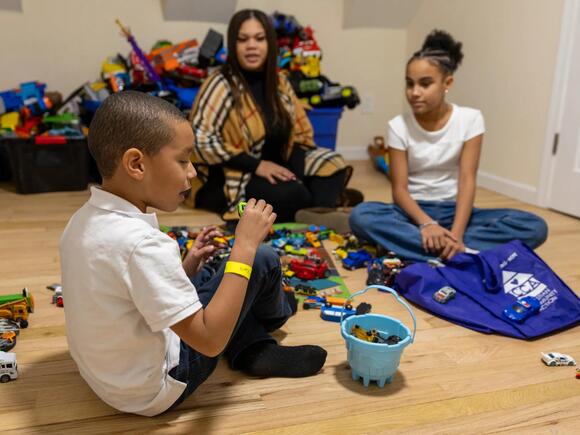
Pushed toward self-contained classrooms
Ziomary Vazquez didn’t know at first that her son Jaysiel had been moved to a self-contained classroom.
Jaysiel has autism and sometimes struggles with his behavior. He can speak, but it can be hard to understand him — though when he’s talking about, say, the BMW M4, “He’ll tell you the whole entire specs of the car, just like that, without hesitation,” Vazquez said.
In the 2023-24 school year, Jaysiel attended two different part-time preschool programs: one at LULAC Head Start and one at the Reginald Mayo Early Learning Center, which is run by New Haven Public Schools. At LULAC, he was in the same space as all the other kids, and Vazquez said he was doing well there. But the situation was different at Reginald Mayo.
One day, Vazquez arrived to pick Jaysiel up from school and found him in a classroom with just one other student. A staff member told Vazquez her son was in a self-contained classroom after throwing a tantrum.
Because of that, Vazquez said, Reginald Mayo had decided the general education classroom wasn’t a good fit for her son. None of that sat well with Vazquez. As far as she knew, Jaysiel had been doing well in a general education setting at LULAC. There, he was learning with other kids and could eat and use the bathroom on his own.
(The Connecticut Mirror emailed LULAC for comment and did not receive a response.)
At the end of the school year, Vazquez decided not to send Jaysiel back to Reginald Mayo. He still had another year of preschool, and he spent it exclusively at LULAC — where, she said, his behavior improved markedly.
The following year, Jaysiel returned to New Haven Public Schools to start kindergarten at Hill Central Music Academy. For a few months, Vazquez said, everything was fine, but then she began receiving reports of problems, some highly distressing. In one case, Vazquez said, the school lost track of her son for two hours — eventually discovering him hiding in his locker.
It was becoming clear Jaysiel needed some kind of additional support. What exactly that looked like, however, became a source of tension between Vazquez and the school. The school argued Jaysiel couldn’t function in general education and needed to go back into a self-contained classroom.
Vazquez maintained her son could stay in general education with a one-to-one paraeducator.
In her corner was Jennifer Wheeler of the Center for Children’s Advocacy. Wheeler said she was convinced Jaysiel was suited for a general education classroom the first time she met him.
“[Vazquez] had given me a list of names, and he sat over my shoulder and he started reading them, including Everleigh, E-V-E-R-L-E-I-G-H,” Wheeler said. “OK, this is a kid who can read and function and learn really well.” He seemed to Wheeler like the perfect example of a kid who could thrive if he just had a dedicated paraeducator to help manage his behavior.
When a child exhibits problematic behavior, a school is supposed to conduct a functional behavior assessment, or FBA. It’s how everyone figures out what is causing those behaviors and how to address them. A one-to-one paraeducator, a self-contained classroom — those interventions stem in theory from the FBA.
But Jaysiel had never had an FBA.
In early March, Wheeler joined Vazquez and school officials at a Planning and Placement Team meeting about Jaysiel. Wheeler said when she asked about the FBA, there were “blank stares.”
Wheeler said the school agreed to provide a part-time, one-to-one paraeducator. Two weeks later, Jaysiel was still struggling, and a supervisor again recommended the self-contained classroom.
“I said, ‘Well, let’s get the para full time before we make that decision,’” Wheeler recalled. To Wheeler’s surprise, the supervisor told her the paraeducator hadn’t even started yet.
The paraeducator started two days later, and Jaysiel’s behavior improved almost immediately, Wheeler said. “In April, when I checked in, I was told that ‘this is a kid who absolutely does not belong in a self-contained classroom,’” Wheeler said.
‘The failure to invest in inclusion’
CCA attorney Kathryn Meyer said her organization has deep concerns about how kids like Jaysiel are ending up in self-contained classrooms.
Per the Individuals with Disabilities Education Act — known as the IDEA — every student is entitled to a free appropriate public education in what is known as the least restrictive environment. That standard means kids should go into the most inclusive setting they can manage.
In other words, if children can learn in the same classroom as their neurotypical peers, that’s probably where they should be. If they need extra support — like a one-to-one paraeducator who works with them to manage disruptive behaviors — so be it.
For other kids, the least restrictive environment may look different. It may be a separate room where they go to build certain skills or learn concepts at a different pace. It may include time in a resource room where they can cool off if they’re having a bad day. Whatever it is, the IDEA mandates it should be as inclusive as the child can manage.
Over the past several years, Meyer said, she’s seen growing resistance from some schools toward investing in more inclusive services — especially hiring one-to-one paraeducators. She said some districts, New Haven included, have told her they just “don’t do” that anymore.
“To say that we have a blanket policy is the opposite of making an individualized determination,” Meyer said.
It’s no secret schools are in a very difficult position when it comes to special education. Legally, they have to provide whatever is in a child’s Individualized Education Program, or IEP, no matter the cost. If they agree to a one-to-one paraeducator for a kid, they just have to find the money.
[RELATED: These Meriden moms want CT to do better on special education]
Except many districts can’t — at least, not easily. Years of rising costs have taken chunks out of strained school budgets. Those costs have increasingly fallen on individual towns because the state’s share of public education funding does not rise with inflation. For cities like New Haven, where property wealth doesn’t fill the gap, the end result is cuts and shortages throughout the district.
Justin Harmon, a spokesperson for New Haven Public Schools, said Meyer’s claim that New Haven doesn’t do one-to-one paras is untrue.
“There is no such policy. We use 1:1 paras when programmatically appropriate and in alignment with IDEA requirements,” Harmon wrote in an email.
Jackson, the special education director, said in her written statement that the district is working on increasing “the number and range of specialized programs for students with complex learning needs in order to successfully maintain more such students within our district community.”
And, she said, the district is “augmenting training opportunities for educators regarding best practices for co-teaching, with an eye to improving opportunities for special education students in the general education classroom.”
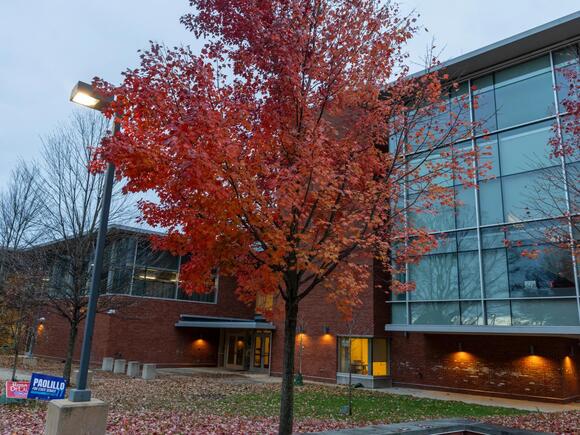
‘They’ve ruined a lot of things’
CeeCee Crooks thought she knew who her son Carter’s special education teacher was. The woman worked in Carter’s self-contained classroom at East Rock Elementary in New Haven, and she had the air of someone in charge.
But while visiting the school one day, Crooks began to feel unsure.
“I’m like … ‘She’s the teacher, right?’ And they’re like, ‘No, no,’” Crooks recalled. “I’m like, ‘Who’s the teacher?’ And they kind of all muted.”
It turned out the classroom had no teacher. The woman Crooks had been watching was a paraeducator — support staff for a leader who didn’t exist. Confused, Crooks contacted CCA attorney Sarah Mervine.
“It’s like we put these kids in self-contained classrooms so we don’t see them,” Mervine said.
Crooks’ son Carter has autism and was identified as nonverbal. The self-contained classroom he attended was supposed to be a space to learn important academic and life skills in a manageable environment. In reality, Crooks said, “he wasn’t learning anything.”
“They had a big projector screen. They would watch Cocomelon and spin in their chairs and go to recess and go to gym and go to music. That was it,” she said.
The school finally hired a new special education teacher, but Crooks said Carter was still left to spin in a chair and stare at his phone for hours at a time. Carter has diabetes and the phone is there to monitor his blood sugar, but he’s not supposed to use it. His FBA — which, like Jaysiel’s, was delayed — found phone use to be a major trigger for his negative behaviors.
Crooks said Carter’s behavior at home also changed for the worse. He started flipping furniture, which Crooks suspected he learned from a classmate. He also got “a little rough” with his siblings.
She said they were understanding. Her 3-year-old daughter would “rub his back and say, ‘It’s OK, Carter. We have to breathe. We have to calm down.’”
Mervine said what she and Crooks really wanted for Carter was to have a proper one-to-one paraeducator assigned to him. She couldn’t say whether Carter would have done well in a general education setting, but she expressed doubt that the school had properly assessed him in the first place.
“A lot of times they don’t even know what the child in front of them is capable of,” Mervine said.
Mervine said there was also a pervasive lack of documentation. In one instance, Mervine said, Carter’s blood sugar dropped to 40. He was with a paraeducator at the time, and the school nurse thought he had gone home; no one told her he was actually still in the building. There was no incident report.
Not knowing what was happening was a source of significant concern for Crooks. Part of the problem — well-known to parents of nonverbal children — was that Carter himself couldn’t tell her. It’s one reason some parents, Crooks included, believe self-contained classrooms should be equipped with cameras.
(A bill mandating such cameras cleared the Education Committee with unanimous support in the 2026 legislative session but died without a vote in the House. The Connecticut Education Association, one of the state’s two teachers unions, submitted testimony in opposition to the bill, raising concerns about student privacy and suggesting the perceived lack of trust might dissuade people from becoming special education teachers. CT Mirror reached out to New Haven’s teachers union for comment but did not receive a response.)
By June, Crooks was fed up.
“It’s been a nightmare. They’re a nightmare,” Crooks said. “They’ve ruined a lot of things and set my son back in so many ways.”
The problem of funding
There is growing interest among state leaders in reforming how Connecticut approaches special education.
In April, Gov. Ned Lamont convened a Blue Ribbon Commission on K-12 Education Funding and Accountability to, as its website states, “deliver a top-to-bottom overhaul of how the state funds its public schools.” The commission has met regularly since June and will issue a final set of recommendations on Jan. 15.
One popular idea the commission has discussed is boosting the state’s main school funding mechanism, the Education Cost Sharing or ECS grant, and then tying it to inflation. That would alleviate a large and growing source of strain for towns, as health care, transportation and other costs have risen faster than state aid. More money could mean more staff and better training for schools.
In a similar vein, the commission has looked at expanding the SEED grant, a relatively new pot of money the state set aside in 2025 to begin paying for in-district special education programming. Previously, the state covered only the costliest out-of-district placements for children with the most severe needs. The grant was designed to provide around $180 million in funding, but the General Assembly ultimately allocated only $30 million.
But even a relatively modest ECS increase could amount to an additional $400 million in one year, and that’s before factoring in the $150 million or more for a fully funded SEED grant. Finding that money will be difficult, especially given Connecticut’s stringent budget caps. Some advocates have argued that legislators could raise the state’s income tax to foot the bill, but there, they would likely run into another roadblock: Lamont.
At a press conference the day after the election, Lamont told reporters he doesn’t want to raise the income tax unless “absolutely necessary.” Asked whether school funding qualified, he replied, “I don’t want more money for the status quo.” And he pointed out that Connecticut has already put millions more into school funding in the past few years — though that only brought ECS up to a funding level set in 2013.
There is another idea Lamont seems to prefer: bolstering regional services schools can access for, among other things, special education.
“Talk about regional back-office savings, there’s a place where the state can take a real lead,” Lamont said at the post-election press conference.
That might involve staffing up Connecticut’s Regional Educational Service Centers to provide special education services or training at scale, rather than making each town build its own programming from the ground up. The Blue Ribbon Commission is looking at that idea, too, and its members seem enthusiastic so far.
A more ambitious proposal around special education came from the Connecticut Citizens’ Assembly on Property Taxes in late October. The 98-member group of everyday citizens was convened in July to develop a comprehensive plan for local property tax relief. Among the solutions it put forward: shifting all special education costs fully onto the state. That would amount to $3.3 billion a year out of the state budget.
The question of design
Beyond the money, there’s a pedagogical question about what special education should look like in the first place — particularly whether the model of a self-contained classroom makes sense.
The CCA’s Kathryn Meyer isn’t sure.
“What we do not think is appropriate or lawful is for students with disabilities to be isolated from their peers. … That means it’s not any less restrictive than an outplacement would be,” Meyer explained.
Meyer said districts should instead work to create a “spectrum of services” for kids.
Ideally, she said, schools would create a separate hub — a kind of “home base” — for kids with special needs. The home base would be in a neighborhood school and would include an environment appropriate for children’s needs, as well as related service providers from the community. The staff-to-student ratio would be kept as low as possible.
Crucially, Meyer said, the point is not to suppress behaviors but to develop skills. Kids should also have plenty of chances to spend time outside the hub with their general education peers. “I would say that’s the underlying principle to it all,” Meyer said.
Although every student’s needs and development will look different, Meyer said that over time, a program like this should enable a growing number of students to enter progressively less restrictive environments. That’s another general goal of special education, though critics say it is often unrealized.
Meyer acknowledged implementing this kind of system isn’t always easy.
“In order to build these programs successfully, you need to have the expertise, and most school districts don’t have that expertise,” she said.
That brings up another challenge in special education: There just aren’t enough people in the workforce.
As of Nov. 12, there were 330 unfilled special educator teacher positions and 1,264 unfilled special education paraeducator positions in Connecticut, according to the state’s education data portal EdSight. Those are roles districts are actively hiring for — not roles they’d create if their budgets were bigger.
The state is trying to close that gap.
Earlier this year, the State Department of Education announced a new training program for aspiring paraeducators, with the aim of training 250 in the first year. The state also has scholarship programs for aspiring teachers and recently won a federal grant to expand its Teacher Registered Apprenticeship Program, which pays student teachers to work in the classroom. The program puts an emphasis on training new special education and early intervention teachers.
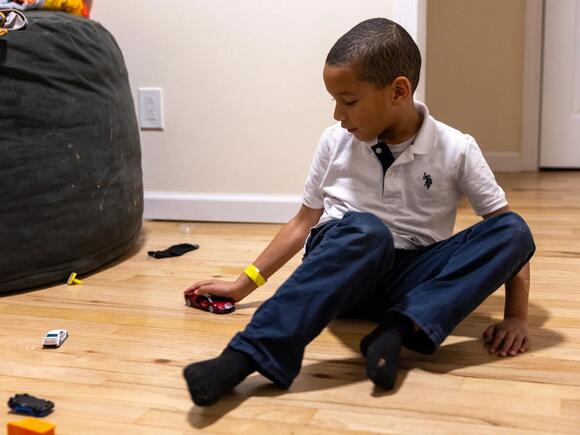
A new school year begins on better footing
Jaysiel transferred to Fair Haven this year, and so far, he seems to be doing much better — though Wheeler cautioned that kids often have a honeymoon period of a few months in a new setting.
He still has a part-time one-to-one paraeducator in his IEP; had the district denied the transfer, Wheeler said, she would have kept pushing for a full-time paraeducator instead.
Vazquez said Jaysiel was doing well academically in his new school.
“He can read and write just fine,” she said. He reads age-appropriate books for a first grader and is particularly fond of those about cars and police. She added that he has one of the highest scores in his class.
As for Carter, the district agreed to send him to an outplacement after the delayed FBA found no lessons were taking place in the classroom, according to Mervine.
“We were ready to file due process to get it, but they gave it to us because they know they failed him,” said Mervine.
Over the summer, it also became clear that Carter could both read and speak, raising further questions about whether a self-contained classroom was really his “least restrictive” learning environment.
The outplacement, she said, gives Carter more freedom of movement than he had at his previous school. Kids can walk down the hall and go up the stairs on their own — further evidence, Mervine suggested, that the self-contained classroom model should be reimagined.
“Not every self-contained teacher is terrible. A lot of them are wonderful,” Mervine said. “But the system is not a good system. We could imagine a better system.”
 Add to Preferred Sources
