undefined
Posts
undefined
Followers
10 fighter jets ranked by how intimidating they look
By Rob Glenn,
7 days ago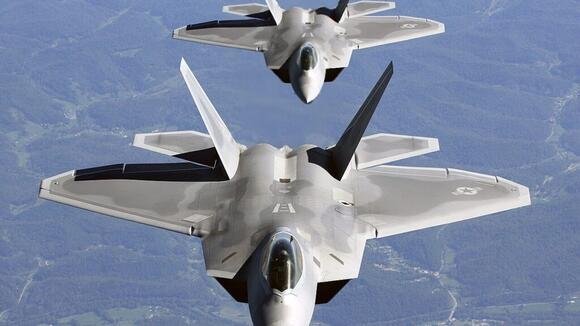
At the 1989 Paris Air Show, Soviet test pilot Viktor Pugachev flew his famous “cobra” in a Su-27, and Western crowds got their first good look at the Flanker. For sheer menace on the ramp, though, many enthusiasts now point to a quieter shape, the F-22 Raptor.
Looks never shot anything down, of course. Still, a fighter’s outline tells you what its designers feared and what they wanted. Huge radar noses, swing wings, canards and blended stealth panels all send a message before the engines start.
These are Combat Rated’s picks for ten fighter jets ranked by how intimidating they look, counting down from number 10 to number 1. The order is our opinion and nothing more. The supporting facts, from first flights to production numbers, come from official and museum sources.
10. Eurofighter Typhoon
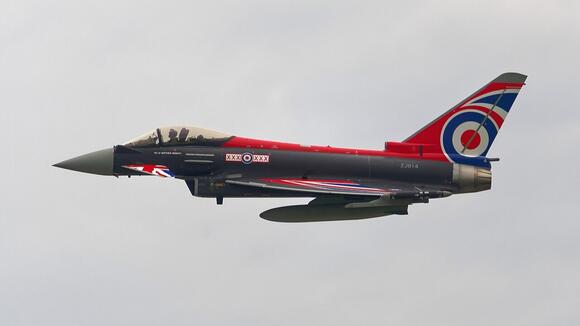
The Typhoon is a canard-delta fighter with a wide chin intake, and from head-on it looks like it is baring its teeth. The latest version is the FGR Mk4. It was designed for air superiority. Over time, however, it took on air policing, combat missions and Quick Reaction Alert duty, the scramble role that sends fighters up to meet unknown aircraft.
The type entered service in 2003, and more than 600 have been built. Nine nations fly it, with Turkey set to become the tenth. Early in 2026, the fleet passed one million flying hours, according to Forces News. The RAF alone runs six frontline Typhoon squadrons, four at Lossiemouth and two at Coningsby.
Typhoons first saw combat over Libya in 2011, and they still stand QRA in the UK and the Falkland Islands. So why only tenth? In our view, its lines are clean and purposeful rather than threatening; it looks fast and agile, but it lacks the hard, angular edges or bulk that make other jets on this list look dangerous. Seen from below, with its canards and wing tanks, it still makes an impression.
9. Lockheed Martin F-35 Lightning II
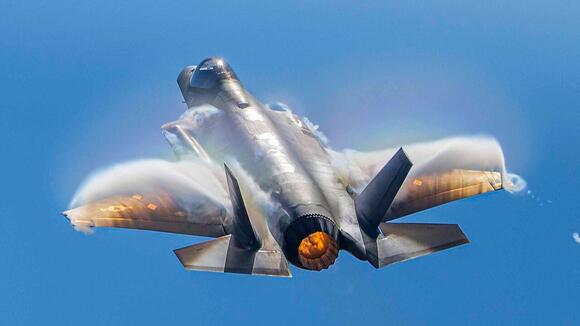
The F-35 is stocky for a fighter, with a broad body built around one very large engine. That engine produces 43,000 lb of thrust in the F-35A. The Air Force describes the jet as the cornerstone of its fighter fleet. It is also meant to replace a long list of older aircraft, from the A-10 and F-16 to the AV-8B Harrier.
Its real menace is hidden in the sensors. The Distributed Aperture System gives the pilot a spherical view for missile warning, aircraft warning and night vision. Meanwhile, an internal targeting system handles long-range detection and precision ground attack. All of it feeds a helmet-mounted display, so the pilot sees targeting data on the visor.
More than 371 F-35As had reached the U.S. Air Force by the time of its fact sheet. The jet also flies with eight partner countries and 12 foreign military sales customers at 49 locations. We rank it ninth because its shape looks more efficient than aggressive, yet the smooth, featureless panels carry their own quiet threat. The program first received the Lightning II name on July 7, 2006.
8. Panavia Tornado F3
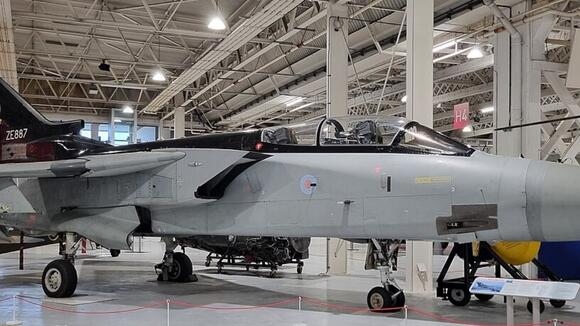
The Tornado F3 was the long-nosed air defence version of the Tornado, built to guard British airspace. Its swing wings and stretched fuselage gave it a lean, predatory profile, especially with missiles tucked under the belly. The first production aircraft flew in November 1985, and squadron service began in July 1987.
Britain ordered 152 F3 and F3(T) aircraft, which equipped eight air defence squadrons. During the 1991 Gulf War, Tornado F3s flew combat air patrols from Dhahran, Saudi Arabia, and later over Bosnia in 1994. The Gulf detachment, nicknamed the “Desert Eagles,” included 18 Tornado F3s, with ZE887 among them. The final RAF units, with No. 111 Squadron at Leuchars, disbanded on March 22, 2011, according to the RAF Museum’s history of ZE887.
In our view, the F3 looks most intimidating with its wings swept fully back, when it resembles a dart. Spread wide for landing, it looks far less sinister. That split personality keeps it at number eight. ZE887 itself flew its final flight on March 4, 2010, and the museum completed its reassembly at Hendon on October 21, 2010.
7. Mikoyan MiG-31 Foxhound
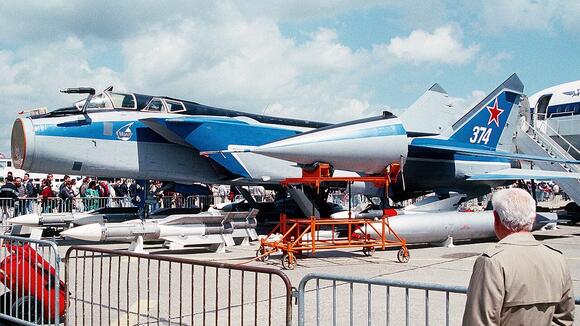
The MiG-31 is a giant two-seat interceptor, and it looks built for one job, chasing down intruders fast. It is 21.5 meters long and has a maximum takeoff weight of 46,200 kg. Its first flight came in September 1975. By 1982, it was fully operational with the Soviet air defence forces.
Its radar is what made it famous, and Airforce Technology describes the N007 Zaslon as the world’s first electronically scanned phased array radar on a fighter. A weapon system officer in the back seat runs it while the pilot flies. It can scan up to 200 km, track 10 targets and engage four at once. The jet carries four long-range R-33 missiles and can reach 3,000 km/h at high altitude, with a service ceiling of 20,600 meters and a ferry range of 3,300 km.
More than 500 have been built, including 370 for the Russian Air Force. In our view, its slab-sided intakes and twin tails give it the look of a brick that learned to fly at Mach 2-plus. It is not pretty. Then again, it was never meant to be, and that bluntness lands it at number seven.
6. McDonnell Douglas F-4 Phantom II
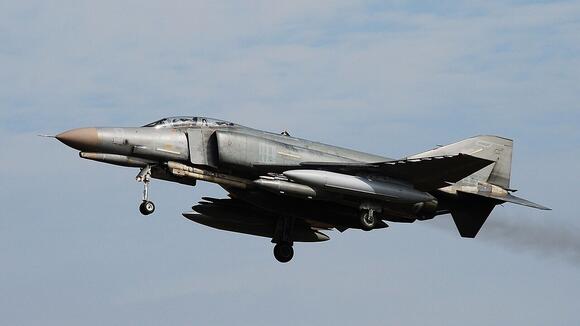
The Phantom earned its menace honestly. Its drooping tailplanes, upturned wingtips and smoky engines gave it a brutal, muscular look. The Navy version first flew in May 1958. Two General Electric J79 engines, each rated at 17,000 lb of thrust with afterburner, pushed it to about 1,400 mph at 40,000 feet, with a pilot and a weapons systems officer aboard.
Production ended in 1979 after more than 5,000 aircraft. It became the first multiservice aircraft, flying with the Navy, Air Force and Marine Corps at the same time. It was also the only aircraft flown by both the Thunderbirds and the Blue Angels. According to the Holloman Air Force Base fact sheet, Phantom variants scored more than 100 MiG kills in Southeast Asia.
It could carry up to 16,000 lb of external ordnance, and a loaded Phantom looked heavy and angry. We rank it sixth because few jets look this aggressive without any stealth shaping at all. Its working life was long, too. The USAF retired it in 1996 after Desert Storm, and QF-4 drones later served as targets for missile tests.
5. Chengdu J-20
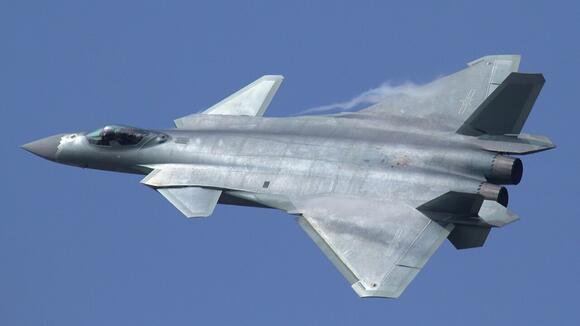
China’s J-20 is long, dark and sharply angled, with canards mounted behind the intakes. It first flew on January 11, 2011, at Chengdu’s factory airfield. That flight lasted about 18 minutes, according to AIN’s report at the time, with a J-10 chase plane alongside. The public got its first real look at the 2016 Zhuhai air show.
Its size alone stands out: reported figures give a length of about 20.4 meters, making it a big fighter by any standard. The canards have pronounced dihedral and work with a delta wing, while the weapons ride in a main bay and two side bays. It reportedly carries no internal cannon and can reach Mach 2 or more. Chinese officials confirmed its entry into service on March 9, 2017.
Many details remain unverified, so we treat its performance claims with caution. Its looks, though, need no confirmation. In our view, the J-20 has the most menacing side profile of any stealth jet outside Russia and the U.S. A first combat unit formed in February 2018, and a thrust-vectoring J-20B variant was announced in July 2020.
4. Sukhoi Su-27 Flanker
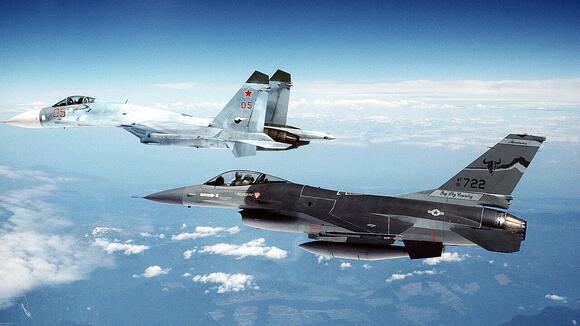
The Su-27 looks like a predator in mid-crouch. Its drooping nose, widely spaced engines and long tail boom give it a hunched, coiled stance on the ground. Sukhoi began the design in 1969, and the first prototype flew in May 1977. However, the early T-10 had serious problems, so Sukhoi redesigned it as the T-10S-1 in 1981.
Series production began in 1982, and the two-seat Su-27UB followed in 1984. It was designed from the start with fly-by-wire controls, which allowed the dramatic maneuvers Pugachev later showed off in Paris. The jet also carries ten external hardpoints, including stations on each wingtip and two in tandem on the centerline. Its self-protection suite includes a radar warning receiver, electronic countermeasures pods and chaff and flare dispensers.
By the end of the Cold War, just over 400 Su-27s had been produced. China received about 80 Russian-built aircraft and then made 95 licensed J-11s. In our view, the Flanker’s long, curving lines make it one of the most beautiful fighters ever built. It is also among the most threatening, and that combination puts it at number four.
3. Grumman F-14 Tomcat
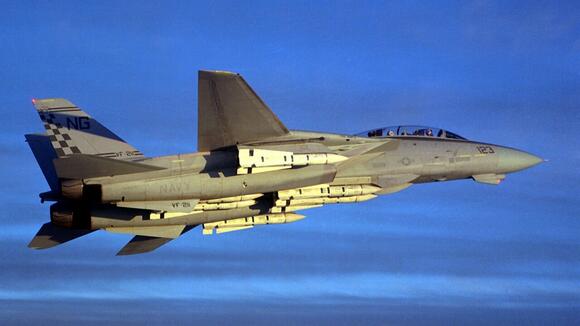
The F-14 had swing wings, twin tails and a long weapons tunnel under its belly. With its wings swept back, it looked like a fighter ready to pounce off a carrier deck. The Tomcat first flew on December 21, 1970, at Calverton, New York, and its wingspan changed from 64 feet spread to 38 feet swept. Two Pratt & Whitney TF30 engines sat in widely spaced nacelles, which only broadened its stance.
It carried real teeth to match the look. The AWG-9 radar could detect hostile aircraft beyond 100 miles and launch missiles at six targets at once. It could carry up to six AIM-54 Phoenix long-range missiles, plus Sparrows, Sidewinders and an M61A1 cannon. Its top speed was about 1,544 mph, according to the Cradle of Aviation Museum.
Grumman built 712 Tomcats, 632 for the U.S. Navy and 80 for Iran. In our view, a Tomcat sitting on a catapult with full Phoenix load is one of the most aggressive sights in naval aviation. It narrowly misses the top two. The museum’s own example, the third pre-production aircraft, made the trip from Calverton by road in one piece.
2. Sukhoi Su-57 Felon
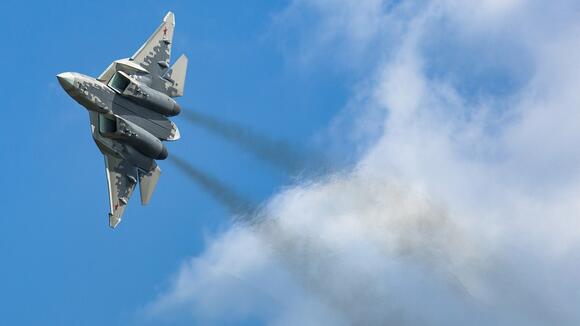
The Su-57 is Russia’s stealth fighter, and it looks like a Flanker reshaped by a sharper blade. It first flew on January 29, 2010, as the T-50-1 prototype. Its blended body, wide engine spacing and all-moving tail surfaces give it a flat, menacing silhouette. Its vertical fins even toe inward to act as airbrakes.
Several features are unusual, starting with movable leading-edge root surfaces, called LEVCONs, which help control airflow at high angles of attack. Composites reportedly make up about a quarter of its structural weight and nearly 70 percent of its outer surface. Weapons ride in internal bays, and its AL-41F1 engines use thrust vectoring. According to the Russian Defense Ministry, the first serial aircraft entered regimental service on December 25, 2020.
Russia had signed a contract for 76 production aircraft in June 2019. We rank it second because its shape looks more aggressive than almost anything flying, and the shortage of clean photos only adds to the mystery. Russia also claimed combat trials in Syria in 2018, though those claims are hard to verify independently. Its Defense Ministry later said the Su-57s flew 10 sorties during that deployment.
1. Lockheed Martin F-22 Raptor
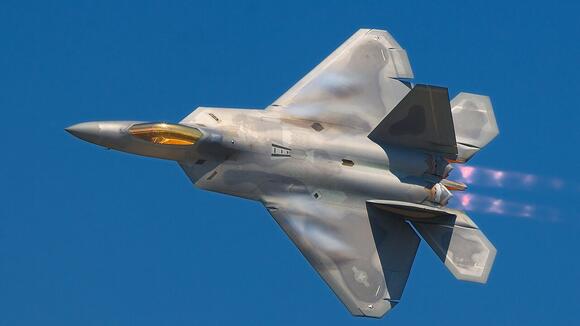
The F-22 Raptor takes the top spot because every line on it looks deliberate. Its sharp chines, angled intakes and diamond-shaped wings combine into one hard-edged wedge. The Air Force built it to project air dominance at long range. Its prototype, the YF-22, first flew in late 1990, against the YF-23.
The jet backs up the look with performance: it can supercruise above Mach 1.5 without afterburner, and its engines produce more thrust than any current fighter engine. Thrust vectoring adds to its agility. For air combat, it carries six AIM-120 AMRAAMs and two AIM-9 Sidewinders internally, according to Air Combat Command. Against ground targets, it can carry two 1,000-lb GBU-32 JDAMs or eight 250-lb small-diameter bombs internally, while keeping missiles for self-defense.
In our view, the Raptor manages to look both elegant and ruthless, which no other jet here quite achieves. Nothing hangs off it, and nothing looks accidental. That is why we rank it number one. Initial operational testing finished in 2004, full-rate production was approved in 2005, and the Air Force renamed it the F-22A in December 2005.
 Add to Preferred Sources
