undefined
Posts
undefined
Followers
Crooked River Bicentennial Trail offers an interactive look back at local history
By Jason Chaney,
10 days ago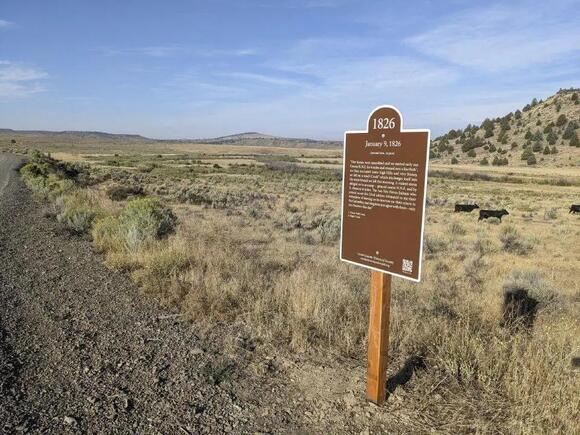
The Crook County Historical Society is now offering a chance to learn about early local history while exploring the locations in which it took place.
“Ever wonder what Central Oregon looked like 200 years ago? What wildlife roamed the land? Where did Native Americans live or gather to harvest salmon or other food? What were conditions like, and how did folks deal with them?” the organization asks. “Now you can find out.”
The Historical Society recently announced the installation of 42 roadside signs, from Prineville to Paulina, that feature the first written description of the county’s watershed. Journal entries of Peter Skene Ogden, an expedition leader for the Hudson’s Bay Company, tell a story of the people, plants, animals and conditions found here 200 years ago.
“Even better, they are placed where they were written so that you, the viewer, can read them, view the surrounding landscape, and let your imagination take hold,” the Historical Society stated.
Adventure, politics and beaver
In 1826, the Crooked River was “ground zero” in an extraordinary international affair, the organization explains, with beaver trapped in Oregon being auctioned in London to the finest hat-makers in Europe and the world.
At the time, the Oregon Country was jointly occupied by the United Kingdom and U.S., with a final border determination left to the future. The Hudson’s Bay Company, an entity with close ties to British imperial interests, devised a strategy of trapping out beaver from all of the Oregon Country to deter American advancement and allow Britain to strengthen its territorial claims.
On four passes, from Prineville to Paulina, Ogden’s brigades trapped nearly 2,000 beaver. Ogden was clearly impressed with what he encountered, writing about the Crooked that: “I doubt if we should find another equal to it in any part of this country.”
“Ogden’s journals are surprisingly entertaining and personal,” the Historical Society notes. “He describes weather, wildlife, vegetation, Native American encounters, his men and the condition of their horses and the challenges of the journey. He also shares his thoughts, motivations and concerns, making his 200-year-old observations remarkably relatable.”
Prepare for surprise
The Historical Society boasts that the journal entries reveal a landscape that may be hard to imagine today.
• A substantial Native American encampment and salmon fishing weir near Paulina — perhaps our own little Celilo?
• Bighorn sheep in present-day Prineville.
• A significant Native American presence near Ochoco West and elsewhere along the river.
• Thousands of beaver, yet scarce large game and nearly non-existent juniper.
• More erratic and extreme winter weather.
“These are just a few of the discoveries waiting along the trail,” the organization stated. “Each sign offers another glimpse into a world that existed here long before the first settler set foot in Crook County.
The irony and the arc
The Hudson’s Bay Company’s campaign to eliminate beaver ultimately failed to stop American advancement, the Historical Society points out, “as the lure of verdant farmland proved too strong. But the removal of thousands of beaver and their extensive dam systems fundamentally changed the watershed. The consequences— including incised streams, reduced water storage and disconnected floodplains—are still with us today.”
The group follows with the good news that a new chapter is unfolding. Local ranching families and community organizations are working to increase water abundance and improve water quality through a technique known as “process-based restoration.” The vision is greater upstream water retention, healthier streams and maybe even the return of swimming holes, fishing spots and picnic areas.
The trail awaits
The Historical Society stresses that whether you’re a history buff, a longtime resident, a curious traveler or simply looking for a new reason to get out and explore Central Oregon, the Crooked River Bicentennial Trail offers something special.
“You might be surprised by what you discover—and you’ll never look at the Crooked River quite the same way again,” the organization concluded.
 Add to Preferred Sources


