undefined
Posts
undefined
Followers
Opinion: Gridlock won’t fill Iowa’s environmental trust fund
By Todd DormanThe,
7 days ago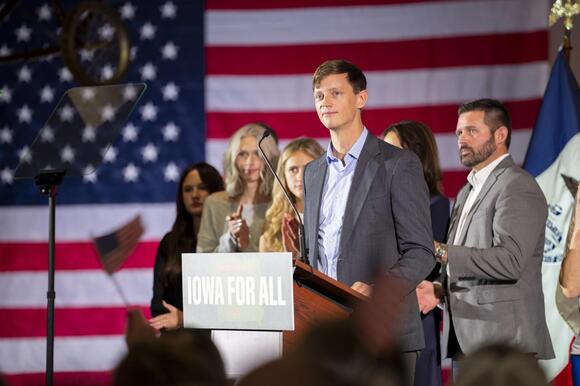
Iowa voters created a trust fund in 2010. But lawmakers couldn’t be trusted to actually fill it. Now, a new leader says he’ll do the job. Trust him.
But can the Golden Dome of Wisdom, now purple as elderberry wine, be trusted to avoid the poison of partisanship?
Both the victorious and the vanquished candidates in Iowa’s race for governor declared their support for filling the Iowa Natural Resources and Outdoor recreation trust fund.
In recent days, Gov. elect-Rob Sand has said he still wants to fill the fund, which would require at least a three-eighths-cent increase in the state sales tax. That would generate roughly $180 million or more annually for efforts to protect Iowa’s water and expand recreation offerings for Iowans and visitors.
On last weekend’s “Iowa Press” program on Iowa PBS, Sand talked about several proposals that could be part of his first state budget.
“And then I should add, we’ve got to fund IWILL,” Sand said.
Iowa Water and Land Legacy is another name for the trust fund.
“This is important. This is something that Zach Lahn talked about in the campaign. It's something that people in both parties want. We know that because 63% of us voted for it in 2010. Time to do it,” Sand said.
The 2010 election
Let’s take the wayback machine to 2010.
That year saw a red wave. Republicans gained 63 seats in the U.S. House and barely missed taking over the Senate. In Iowa, more than 592,000 voters welcomed Terry Brantsad back to Terrace Hill, along with his running mate Kim Reynolds. Whatever happened to her?
Iowa voters took cues from the righteous right and removed three Iowa Supreme Court justices from the bench who joined a unanimous ruling legalizing same-sex marriages.
But on that same Election Day, more than 629,000 Iowa voters, or about 63%, approved a measure adding the Iowa Natural Resources and Outdoor Recreation Trust Fund to the Iowa Constitution. It was the capstone achievement for a group of state officials and representatives of 13 outdoor conservation and recreation groups — including the Iowa Environmental Council, the Sierra Club, Ducks Unlimited and others — that spent the better part of four years putting the proposal together. It received 90% support in the Iowa Legislature.
The Iowa Farm Bureau was also part of the effort. But in the end, it opposed passage of the amendment. The group believes every square mile of available Iowa land should be plowed up for farming. When it comes to expanding outdoor recreation, the Farm Bureau is a real buzzkill.
The panel forged a formula for spending trust fund bucks.
A 23% share would go toward natural resources with a 20% share for soil conservation and water protection and 14% for protecting watersheds.
A 13% slice would go toward the Resource Enhancement and Protection program, or REAP, another 13% would be spent on local conservation partnerships, 10% for trails and 7% for lake restoration. The spending plan was approved by lawmakers and it became part of the sales pitch to voters.
After it was approved, all lawmakers had to do was pass a three-eighths-cent sales tax increase to fill the fund and realize its goals. Instead, they did nothing for 16 years and counting.
In 2018, while running for his first full term as secretary of agriculture, Mike Naig opposed filling the fund. He told me voters wanted the fund but not the tax increase. So, we created a fund hoping it would not be filled. Makes perfect sense.
During his 2026 campaign, Naig said he would support a tax increase so long as the increase was offset by other tax reductions.
Reynolds’ plan
In 2020, Gov. Reynolds floated the Invest in Iowa Act. It would have filled the trust fund, but it also came with more red flags, roadblocks and warning signs than a washed-out bridge.
A big chunk of the trust fund would have replaced existing environmental funding. The trust fund was supposed to provide new dollars for conservation and recreation, not replace current spending.
Reynolds tossed out the original spending plan. Nearly all the water quality spending would have gone to beef up ineffective, strictly voluntary conservation efforts, with no monitoring to measure success. Reynolds also steered outdoor recreation funds to the Iowa Economic Development Authority, which would score grant applications. Preference would be given to recreational purposes that enhance existing natural areas instead of creating new ones. And the funds for trails were slashed.
Why? See Iowa Farm Bureau, above.
It was ridiculously prescriptive, deferential to big agricultural interests and pulled a bait and switch on voters. But in March 2020, the pandemic hit. The Legislature skedaddled and Reynolds’ plan was scrapped and never seen again.
In 2023, state Sen. Dan Dawson, R-Council Bluffs, floated a plan that would have authorized a one-cent sales tax increase with three-eighths flowing into the trust fund. To offset the increase, Dawson would have eliminated the local option sales tax, instead giving the other five-eighths back to local governments. City officials all over Iowa fainted dead away.
But it didn’t happen. Instead, lawmakers passed multibillion-dollar income tax cuts.
Can they hammer out deal?
So, here we are in 2026, wondering if a new Democratic governor can convince a Republican-controlled Legislature to fill the fund. Republican lawmakers I communicated with this past week were unsure how the debate would play out and whether Republicans would be willing to work with Sand to make it happen.
"Senate Republicans don’t like to come in and raise taxes," Senate Majority Leader Mike Klimesh told the Des Moines Register. "That’s not something we do. We just don’t do that. So the proposal would have to make sure that it was actually a net decrease to Iowans as far as the tax obligation goes."
By all means, with a $1 billion budget shortfall, let’s cut more taxes.
My own views on the trust fund have evolved. I was once gung ho about filling it ASAP.
But once you learn where water pollution comes from, it’s tougher to support increasing the sales tax on every Iowan to clean up a mess caused mainly by rural landowners who won’t adopt conservation measures. The sales tax is a burden on low-income Iowans, who pay a larger share of their income to cover it.
And if the money is just going to be funneled into the same approaches that have yet to make a dent in nitrate levels, it’s even harder to support. Changing the trust fund spending formula to please powerful interests is a deal-breaker.
But ignoring voters who approved the fund isn’t how this democracy thing should work. If done right, the fund could deliver more outdoor recreation, which is an economic engine for rural areas. It might also fund some worthwhile water quality efforts if Big Ag doesn’t call the shots. And with studies tying cancer to nitrate exposure, a sense of urgency has intensified.
Will Republican leaders cooperate? And is Sand fully committed to water quality?
Word on the creek is Sand is contemplating keeping Kayla Lyon at the head of the Department of Natural Resources. This is the same director who pushed for the removal of seven river segments that routinely hit high nitrate levels from the impaired waters list, including the perpetually polluted Raccoon River, which provides drinking water to the Des Moines area.
If Sand wants us to believe clean water is his priority, reappointing Lyon would not be a step in that direction. Sand and Lyon went to high school together in Decorah, but Viking pride shouldn't play a role in environmental protection.
Still, in the end, doesn’t everyone want clean water? You’ll probably be disappointed by the honest answer. Trust me.
 Add to Preferred Sources
