undefined
Posts
undefined
Followers
Cedar Rapids residents press police on surveillance tech
By Grace NielandThe,
9 days ago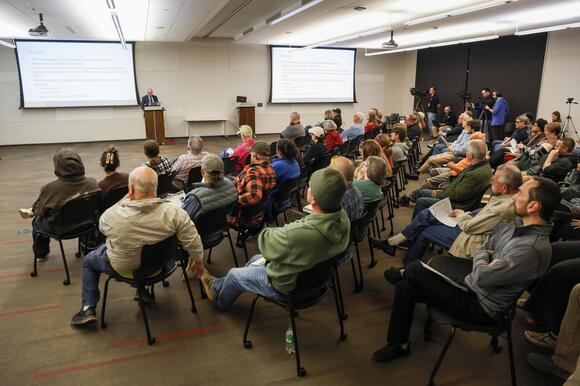
CEDAR RAPIDS — What’s in a name? For residents opposed to the Cedar Rapids Police Department’s use of automated license plate readers, the answer is “not much.”
That was the frequent refrain from residents who attended a Tuesday information session about the department’s use of automated license plate reading cameras, or ALPR, and other advanced technologies. Attendance hovered around 70 people at the 90-minute event, where audience outcry was repeated and fervent.
Throughout the evening, department staff and city leaders did their best to explain — and at times defend — the $14.5 million contract with Axon Enterprise to support the department’s acquisition of new body cameras, tasers, automated license plate readers and other technology.
“At the end of the day, the officers, supervisors and everybody else is just trying to do the best we can for the victims of crime,” Capt. Cody Estling said. “Technology is an important piece of that, and we want to do what we can to provide transparency … that we’re using (that) technology the right way.”
Staff presentations covered multiple aspects of the 10-year, $14.5 million Axon contract approved this summer by the Cedar Rapids City Council, but the bulk of the evening was spent discussing automated license plate readers.
Currently, the city contracts with Flock Safety for operation of 70 pole-mounted ALPR cameras that automatically scan the license plates and color, make and model of every vehicle that passes within view.
Officers are pinged if the plates match those associated with certain warrants or a missing persons case, and all Flock data is stored for 30 days in case officers need to access it later as part of an investigation.
But the city is terminating the contract and replacing its services with Axon.
Flock Safety has come under scrutiny over the past year following nationwide reports of system errors, privacy violations and officer misconduct at certain agencies, and city staff this fall determined they would not renew the city’s contract with the Atlanta-based company.
Staff present at Tuesday’s meeting did not comment on reports of misused Flock data specifically, although they did state a transition to Axon for future ALPR service would provide greater “local control” of collected data.
The plan is to install new cameras in the existing Flock locations after the current contract runs out in early February. The city will own those cameras but contract with Axon for operational needs and secure data storage.
“With Axon, we control the data. It’s not out there just flying around,” stressed interim Police Chief Tom Jonker.
Jonker said the department will also “start from ground zero” on its data sharing and decide when and how to share ALPR data with other departments on an “as needed, as requested and as allowed” basis.
That’s in comparison to the current policy with its Flock data where dozens of state and local agencies nationwide presently have access. Federal agencies are not included.
Residents respond
That argument didn’t seem to change things for some of those in the audience, however. Attendees’ interjections ranged from brief jeers like “Liar!” or “Answer us!” to more lengthy expositions on residents’ inability to present their questions publicly rather than through the provided online form.
The meeting was broken into three segments starting with staff presentations and a 30-minute Q&A to address resident concerns. During that time, questions were only taken through the online form.
Attendees afterward could meet individually with elected representatives or city staff to ask additional questions but those responses were not part of the public presentation in what became a point of contention in an already tense discussion.
At one point, City Council member Dale Todd told attendees that the format was selected to ensure as many questions were answered as possible but if they didn’t like it they “probably should leave,” prompting several people to exit.
Hank Welter, of Cedar Rapids, told The Gazette after the meeting that the information session answered some of his questions about the use of automated license plate readers and other technology but that there was still more that he wanted to know.
“One of my biggest things would be the data usage, by Axon or anyone,” he said. “What happens to people’s personal information (once it’s recorded)? How is it retained? Is it used for training, and is it depersonalized? I just don’t feel there was an adequate response.”
He questioned the city’s decision to hold an information session now instead of before adopting the Axon contract. Several attendees made similar comments but declined to provide their names, at times citing the personal privacy concerns that prompted their attendance at Tuesday’s meeting.
 Add to Preferred Sources

