undefined
Posts
undefined
Followers
Lee County officials hear from residents on proposed steel mill project
By Gretchen TeskeThe,
1 days ago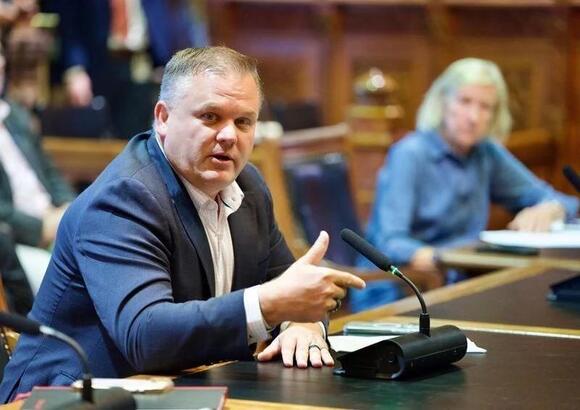
FORT MADISON — Kelly Jameson has lived in the Green Bay Bottoms all her life. As a third generation resident, raising the fourth, she’s passionate about her community.
And, she’s passionately against a proposed steel mill that is planned for the area. If Mesabi Metallics builds the largest steel mill in the United States just three miles from her house, she said, it defeats the whole reason she has stayed in her hometown.
“This is currently a nice, rural community … when the reason we choose to live here is gone, why would we stay?” she asked at a public information meeting held in Fort Madison Wednesday evening.
Lee County supervisors and officials from Mesabi Metallics held an informational meeting at the Quality Inn & Suites in Fort Madison, allowing area residents and business leaders to express their views on the potential for a steel mill.
Roughly 200 people packed the hotel conference room, leaving standing room only. Jameson was one of about two dozen speakers Wednesday night, although her dissenting comments were in the minority.
City administrators, economic development workers, supervisors and mayors of neighboring communities spoke in favor of the project and the opportunities it would bring. Local business owners, also, were excited about the new plant, and believe it will bring needed economic development to the area.
A plant comes to Iowa
In September, the White House announced the largest-ever steel plant would be coming to southeast Iowa. Minnesota-based and Indian-owned Mesabi Metallics officials said they planned to build a roughly $15 billion integrated “mega” steel plant, the first of its kind built in the U.S. since the 1960s.
The exact location of the mill has yet to be announced, but Mesabi CEO Joe Broking said the company is getting close. Speculation is the plant will be located near the small, unincorporated town of Wever, in an area known as the Green Bay Bottoms.
Once operational, the Mesabi Metallics plant is expected to create at least 1,750 new, permanent jobs paying an average of $48 an hour. The first steel production is expected by 2030, and the plant will produce 10 million tons of steel annually.
The first phase of the project will support 5,000 to 6,000 construction jobs, officials said at the time. Wednesday night, Broking said construction could start as early as late next year.
Mesabi is currently in the process of developing a site in northern Minnesota. The iron ore mine in Nashwauk, a small town about 200 miles northeast of Minneapolis, was shuttered before the company bought it.
At the public information meeting Wednesday, Broking said the goal is to mine in Minnesota and rail the product to Iowa. The Lee County plant will do the melting and pouring, he said.
The Minnesota project has had its fair share of ups and downs, Broking admitted. The project went through a Chapter 11 bankruptcy, but ownership did not give up, he said.
Instead, investment continued, and Mesabi was able to obtain the necessary permits to continue construction with no problems. That is due in part to Mesabi’s commitment to the community and to the product.
“It’s not just about building relationships,” Broking said. “It’s about what we’re doing.”
Steel producing is a massive culprit when it comes to carbon emissions. Mesabi uses both natural gas powered and electric furnaces to reduce the carbon emissions by 60%-70%, Broking said.
“(At) this operation, we can make this product in America the cleanest, most environmentally friendly steel in the world at the lowest cost, and we can do that right here in the U.S., right here in Iowa.”
But, it’ll come at a cost. The facility will need ample access to water and expects to draw it from the Mississippi River for the process.
“Then we will build water treatment facilities to treat that water, because we're required to do that in order to build a facility like this in the U.S.,” Broking explained.
Permits have already been filed with the the Iowa Department of Natural Resources for air permits. Mesabi has to control the amount of dust emissions, but Broking said the facility uses technology that will make it the cleanest steel plant developed in the world.
However, there are other resources the plant will need.
Broking said the plant will use about 1.3 gigawatts of power but does not expect that to impact folks in the area.
For perspective, Alliant Energy’s 200-megawatt solar field in Linn County powers about 40,000 homes. That means Mesabi will roughly use the equivalent to powering 260,000 homes.
The plant will require a colossal 200,000 BMTU of natural gas — or 200 million BTU, per day. Broking said leadership is currently in talks with natural gas companies to discuss getting resources to the site.
On the flip side, Broking said, Mesabi expects to see more than $95 billion in economic impact throughout the life of the project. With 1,750 jobs expected and high wages, the impact will be transformational for the community, he said.
Not all community members are sold
But, not all community members agree the tradeoff is worth it. Jameson, the Green Bay Bottoms resident, told the crowd Wednesday night the focus was on jobs and money, but county leadership was not taking into consideration what this means for the land.
The area proposed for the project is on a major flood plain and flooded severely about 30 years ago, she said
“Why build in a flood plain without the necessary utility or transportation infrastructure? Will you use eminent domain for the infrastructure? Will routine independent testing on wastewater and air emissions be completed and published in an easily accessible location for residents to verify that standards are being met?” she asked.
Jameson said unlike solar panels and wind turbines, the effects of the plant will not be limited to the ground its on, adding she had major concerns about air quality with the dust particles the plant is expected to emit.
“This is an unnecessarily large project that this area can't support. Between this and the data center, county leadership is making questionable choices, and I would avoid moving to Lee County completely if I was making the choice now,” she said.
Roslyn Garcia, a former city council member in nearby Keokuk, also voiced major concerns about the project. She supported the opportunity for the county, she said, but warned the supervisors this is not something they could fall behind on, especially if construction is supposed to begin next year.
“To sustain a workforce of this size, it requires coordinating infrastructure expansion, addressing lack of transportation, finding space in schools that are already understaffed, expanding access to childcare, building quality, affordable housing, and maintaining and potentially growing public safety services long before the anticipated revenue ever starts rolling in,” she said.
The project will expose the issues Lee County is already facing, she said, and needs a solid long-term plan to move forward.
“An hour commute these days isn't a deal breaker. Seventeen-hundred jobs sounds great, but not if they don't live, shop, and pay taxes in Lee County,” she said.
One resident spoke up in favor of the new amenities Lee County could benefit from if the deal goes through. Tierra Griffith recently moved from Colorado to Montrose with her husband about five years ago, she said.
While the construction process will certainly have its growing pains, the long-term gains are worth it.
“Our population is declining, and people who have been here a long time, they've seen services go down, they've seen things change,” she said. “There will be things we don't care for as much as we would like. There'll be more traffic, there'll be more of everything, but that also brings good stuff. There'll be more services. There'll be more revenue. There'll be opportunities that we didn't have, and so I think that's very important to just think about.”
Griffith said in order to have growth, change is necessary. And if it comes with more revenue for more resources, the short-term pain for long-term growth is worth it.
Big project, big incentives
With Mesabi’s commitment to pour into Lee County economically, the county is stepping up, too.
Emily Benjamin, president and CEO of the Lee County Economic Group, said the county is not unique in its challenges for recruiting new residents. It watched the population decline by 6.4% from 2010-2020.
“This project won't reverse decades of population loss, but it's a really good start and strong growth and stability (with) 1,750 permanent, full-time, family-sustaining jobs that have a meaningful impact to our local economy and the 7,000 construction jobs during construction that will also support many families and many ancillary businesses throughout the construction period,” she said. “A $15 billion investment is the type of project that we've always wanted to attract.”
The project will build a stronger tax base, improve existing training for local workers and give young people a reason to stay, she said. A strong, anchor employer will encourage local spending and benefit everyone who lives in the area.
It will, however, come with its own challenges, she said.
Roads will see heavy traffic with construction trucks traveling to the site and with a bigger population, there will be a need more more law enforcement, EMS, fire, staff in the engineering, conservation and public health departments, more housing, bigger schools and strain on existing employers.
“This presents a real opportunity for us to come together as a community and put thought and intention into the types of housing that we want to build, and the types of of job training and additional amenities that we're going to need to add to our community for the construction process, the commissioning process, and beyond,” she said.
Benjamin said the investment in Lee County would be for a long-term benefit. Big principles for the project included that the county would not incur any debt but benefit from new revenue and growth and that the county would not pay for infrastructure.
“To that end, we also learned throughout the fertilizer plant construction process that the demand on county services was particularly high during the construction period,” she said. “In talking with the Mesabi team, we all agreed that it's necessary for the company to provide additional funds to the county throughout the construction period in order for the county to adequately service the needs of the construction period.”
A host community agreement plan has been drawn up, that would require Mesabi to pay $250,000 upon execution, and an additional $100,000 per quarter until construction begins. Mesabi will pay an additional $365,000 per quarter though the construction process, up to $10.5 million, to help offset the county’s costs.
The first $112 million in improvements will count for the county as new growth, giving the county a guaranteed floor and minimum assessment agreement, Benjamin said. That will require property improvements to be assessed at a minimum of $112 million before any rebate to the company occurs.
Anything above that $112 million will be paid via a pilot program in lieu of taxes, she said. Lee County will rebate Mesabi’s tax increments, and Mesabi will pay $50 million over the course of 20 years.
“Those payments are lower during the construction phase and increased over time. But again, the host community payments throughout the construction period will help offset that for the county,” Benjamin said. “The pilot does not reduce or offset taxes, TIF (tax increment financing) terms, or host community payments.”
As a term of the agreement, Lee County is tied into the state’s incentive package, meaning Mesabi must meet, qualify for, and stay in compliance with its agreement with IEDA and any conditions set by the state.
Additionally, Lee County will work with Mesabi and the state to determine road needs and pursue potential grants at no cost to the county.
“The county will pay nothing to remove, relocate, or repair or add roads for the project, and access will be preserved for existing residents and businesses in the area,” she said.
Mesabi also will sign a road use agreement, stating it agrees to survey road conditions before and after construction, and use haul routes approved by the county. Mesabi also will control the dust and repair any and all damage to county roads and bridges.
The Lee County Board of Supervisors is expected to vote on this plan next week.
 Add to Preferred Sources
