undefined
Posts
undefined
Followers
CCSO gun range, public safety training center now open
By Carl Hamilton,
2 days ago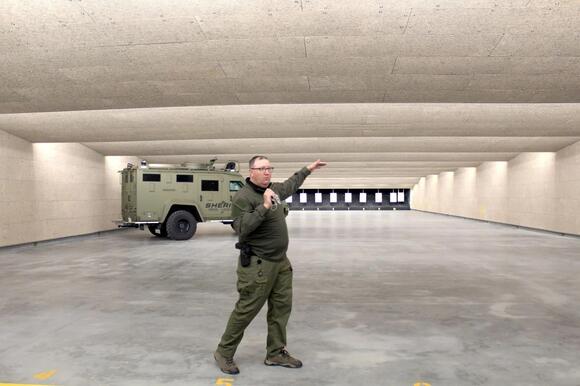
NORTH EAST — Law enforcement officers are required by the Maryland Police Training & Standards Commission to go to a shooting range twice a year and fire at stationary targets with their agency-issued guns to qualify as marksmen.
That requirement, albeit an infrequent one, still posed problems for Cecil County Sheriff’s Office deputies because the agency did not have its own shooting range.
Deputies had to travel to shooting ranges in other parts of the state to comply. CCSO also had to pay for the use of those shooting ranges owned and operated by other police agencies and private entities. In addition, as for scheduling at those shooting ranges, CCSO was at the mercy of the owners and operators.
Now CCSO not only will be able to easily meet that twice-annual firearm qualification requirement, it will be capable of well exceeding it because the agency’s $7.3 million indoor shooting range at the Cecil County Public Safety Training Center near the entrance of the Charlestown Crossing community along Route 40 near North East has opened.
The majority of the funding came from federal American Rescue Plan Act (ARPA) grants that the county had been awarded, with an additional $1 million grant issued by the State of Maryland.
“For decades, our deputies trained wherever they could find space,” said County Executive Adam Streight, who served 25 years as a CCSO deputy before he was elected to his current position in November 2024 and retired at the rank of sergeant. “This gives them the dedicated place to train year round, on their own schedules, with simulated daylight or darkness, on any shift.”
Streight was among those in attendance Friday when Sheriff Scott Adams, his command staff and other deputies hosted an open house at the indoor shooting range. Representatives of several police agencies in and outside of Cecil County attended the event, including members of the Queen Anne’s Sheriff’s Office.
The 13-month-long construction project yielded a state-of-the-art, open 50-yard-long shooting range with a long line of 10 targets that can remain stationary, similar to traditional ranges — except this one has no fixed stalls or partitions, allowing for more extensive training in which deputies can maneuver throughout the spacious room while training in an array of simulated real-life situations.
Numerous vehicles can fit inside the shooting range and they can be used in training drills. On Friday, a $406,000 armored rescue vehicle known as the Lenco BearCat G3 was parked in the shooting range and it was dwarfed by its surroundings. CCSO’s Special Response Team, which handles high-risk situations, including hostage and barricade, uses the BearCat G3.
There are lines on the range floor to mark off the number of yards to the targets. The distance for the twice-annual firearms qualification is 25 yards, with deputies shooting at stationary targets from a standing position. It is 50 yards for rifle qualification. The range can accommodate weapons up to .50 caliber, well beyond the calibers used by law enforcement officers.
There also are two “running man” tracks that allow targets to move side to side across the width of the target row. The speed of those targets can be set at “walk, jog or run,” enabling deputies to practice shooting targets at variable speeds, once again replicating real-life situations.
Targets allow for “shoot/don’t shoot” scenarios. Those targets suddenly shift from front to back, revealing an image that poses a threat or one that poses no threat, and deputies must decide in a matter of a few seconds to shoot or not to shoot before the target turns back to its original position. Target shifts can be set to different times, all within a range of seconds.
In addition, the indoor shooting range allows deputies to practice maneuvers in which they move from spot to spot, taking cover and providing cover for each other. Lighting can be adjusted to replicate night, day and anything in between.
Streight emphasized that, while deputies are required to qualify at a shooting range twice a year, they need to train with firearms much more often — in a variety of simulated real-life situations — to increase their proficiency with their weapons and to sharpen their split-second decision-marking skills.
Training more often under those simulated real-life situations also will decrease deputies’ chances of suffering gunshot wounds and other harm during incidents. Also, on the public safety side of the coin, it will lessen the odds of deputies accidentally shooting an unarmed suspect or an innocent bystander.
“Shooting is a perishable skill. They need the space and the time to train in real-life scenarios. The days of shooting at stationary targets are over. They need to train like they would operate on the streets. How you react in real-life situations reflects how you train. There are no second chances in real life, so we want to get it right every single time,” Streight said. “A lack of frequent training in simulated real-life scenarios gets people killed. In this litigious age, we need to be properly trained.”
Adams concurred.
Noting that deputies work rotating shifts around the clock, Adams said the agency’s indoor shooting range “gives us much more flexibility” because deputies working nightshift can train in the day and deputies working dayshift can train at night.
The design and engineering of the shooting range, which include a bullet trap system and a led abatement ventilation system, also placed an emphasis on ensuring that the sound of gunfire did not escape the building, particularly because it is located near the entrance of a residential area.
“It is in a residential community, which is kind of unheard of,” Adams told attendees during Friday’s open house, before commenting, “You would have no idea that shooting is going on inside the building if you were standing outside.”
In addition to the shooting range, the building houses a large training room that can be separated into two smaller training rooms with a partition, two offices, a gun-cleaning room, storage rooms, an entrance area to the shooting range, restrooms and other spaces. A specially-designed sticky mat at the shooting range door prevents deputies from carrying out led particles on the soles of their shoes as they are exiting.
Because of the new shooting range, CCSO deputies will be able to conduct firearms training and drills much more frequently. So will the deputies assigned to the Special Response Team, which currently trains twice monthly.
At some point, once CCSO establishes its own qualification and training schedule, it’s possible that the agency could charge other police departments to use the shooting range.
 Add to Preferred Sources
