undefined
Posts
undefined
Followers
Alachua County Commissioners request budget modifications for their priorities
By Jennifer Cabrera,
2026-08-11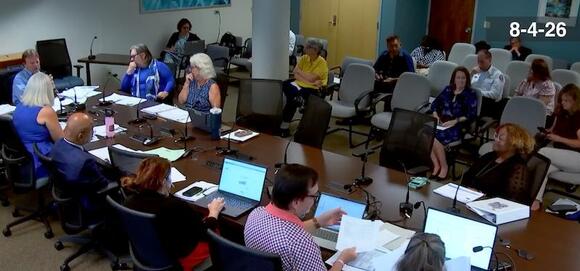
BY JENNIFER CABRERA
GAINESVILLE, Fla. – At an August 4 budget meeting, Alachua County Commissioners requested changes to the proposed FY2027 budget in their areas of interest and brought up ideas for future initiatives, including renewing CHOICES, addressing food waste, renewing the infrastructure surtax two years early, and employing jail inmates and recently incarcerated individuals in Public Works.
Make the “story easier to tell”
During the overall review of the budget, Chair Ken Cornell asked Assistant County Manager Tommy Crosby to make the “story easier to tell” by separating out the budget that comes directly from property tax revenue from other revenue sources like rolled-over ARPA funds, money transferred from other funds, and grant funding. Cornell pointed out that although the County’s FY2027 overall budget is close to a billion dollars, the General Fund budget from property taxes is about $184 million, and Crosby said he would bring a presentation to a future meeting that shows how much the budget has grown, “just operational revenues versus operational expenditures, year over year.”
Cornell said that as he talks to voters, “it’s become clear to me that the misinformation at the state level, with regards to our top-line budget, has confused a lot of people.”
The future of CHOICES
During a discussion about the Community Support Services budget, Commissioner Anna Prizzia said the CHOICES program is winding down, “and we have a number of indigent care and support care services that we provide through that fund right now, and with the cuts in Medicare and the changes to Medicare coverage, I just wanted to — it’s not necessarily for now, but… we have five or six years left… [This is] our frontline support for medical support for people who are uninsured and underinsured, especially in our rural areas,… and I just want to flag those as future needs.”
Director of Community Support Services Claudia Tuck said staff has been “trying to shore it up,” and they will bring forward some ideas next spring.
Commissioner Anna Prizzia: “It is that root-causes investment,… thinking about how we shift away from probation into… prevention, right? How do we shift money from having to constantly renovate an aging jail because we have less people in that jail, and we’re instead stemming the tide of crime in our community by providing economic opportunity?”
When Cornell said they would need to cut somewhere else if they added funding for medical support, Prizzia brought up Baltimore’s “investment in youth support services… It is that root-causes investment,… thinking about how we shift away from probation into… prevention, right? How do we shift money from having to constantly renovate an aging jail because we have less people in that jail, and we’re instead stemming the tide of crime in our community by providing economic opportunity?… It’s hard to quantify… I think Medicare, Medicaid, and SNAP… are dwindling, and I don’t see our state stepping up to do anything about it, necessarily. So I think it’s going to be on our local governments.”
School zone cameras
During a discussion about the budget for the school zone cameras, Assistant County Manager Missy Daniels said the County will soon begin having the magistrate hearings for people who challenge the citations.
Prizzia said, “I’ve not been in favor of surveillance or cameras… If this gets to the point where we start having to add [positions], I would much rather add… a patrol person on the ground who can also support our community in other ways,… than hire code enforcement to review camera footage.”
Cornell said he voted for the program because it’s targeted on school zones and run by the Sheriff’s Office, and the Sheriff will provide feedback on whether it’s cost-effective.
Daniels said the Sheriff’s Office reviews the footage, and Codes Enforcement only processes the agendas for the hearings with the magistrate; she said any costs should be recaptured through fees.
Juvenile Detention Center and literacy
During a discussion about the Juvenile Detention Center (JDC), Prizzia said she’s been trying to “connect the dots” between PEAK Literacy and the new principal at the JDC “so that we can get more supports for literacy in the [JDC], as well as at our jail, for our youth that are incarcerated there.”
Future landfill and food waste initiatives
During a discussion about the solid waste budget, Prizzia said she wanted to “flag” the future conversation about a landfill, given “the long-term viability of New River’s capacity if they don’t build new cells… [Solid waste] is something that we need to be thinking about, in terms of funding for outreach and communication in the community, and doing engagement, and thinking about those conversations, as well as our Circular Economy plan.”
Prizzia said the County needs to begin to “engage our community [about] our goals for waste reduction, because we’re seeing a decrease in recycling… We need to increase… what we’re doing for our Zero Waste and Waste Reduction and Circular Economy initiatives to get out community more engaged.” She said she is watching the City of Gainesville’s initiatives regarding food waste and composting, and “if it works well,” she wants to consider expanding that into the unincorporated areas of the county, inside the urban services boundary.
Public Works and pothole repair crews
During a discussion about the Public Works budget, Prizzia noted that the road and bridge budget was reduced by $3 million, and Cornell said he had also wanted to ask about that. Crosby said that recent road repair work has “squeezed the gas tax dry,” so more of the road work is being funded from the Infrastructure Sales Surtax, which shows up in a different part of the budget.
Public Works is now running four pothole repair crews, and Cornell said, “I think we need six,… We gave direction at our last meeting to… find additional money” for responding to service requests. He said this area is the primary one where he would want to make an adjustment to the proposed budget. Crosby said the board will have that discussion on August 13.
Commissioner Prizzia: “Some of our roads are completely failing, regardless [of the County’s investment], right? And they don’t happen to be the ones on the list [in the 10-year plan]. And at the end of the day, we’re still responsible for those roads, so what do we do? I just don’t know.”
Prizzia agreed with Cornell and said, “Some of our roads are completely failing, regardless [of the County’s investment], right? And they don’t happen to be the ones on the list [in the 10-year plan]. And at the end of the day, we’re still responsible for those roads, so what do we do? I just don’t know… If we have six teams and they’re constantly patching the roads, maybe they’ll get us through until we have the funding to actually pave them, but in some of these instances,… they’re too far gone.”
Public Works Director Ramon Gavarrete on adding pothole crews: “That means that other things are not being done, and I’m telling the board right now: expect phone calls of other things, maintenance-wise, that are probably going to go a little bit backwards.”
Public Works Director Ramon Gavarrete said three of the pothole crews are rotating through the “problematic” roads, and the fourth is filling potholes on roads that are otherwise in decent shape. He added, “That means that other things are not being done, and I’m telling the board right now: expect phone calls of other things, maintenance-wise, that are probably going to go a little bit backwards.” He said he has moved 16 employees from other units to the new Asphalt Unit.
County Manager Michele Lieberman said it’s not just a matter of not having enough budgeted positions to do the work: “It’s also a function of lack of ability to hire staff to fill the positions.”
Employing recently incarcerated individuals in Public Works
Prizzia said the County’s re-entry program (for people recently released from prison/jail) has “a lot of people moving through that, that need jobs, and so maybe there’s a chance to work with our new re-entry program on a training program that could get people ready.” Gavarrete said he would “leave the HR discussions to HR.” He said the mowing crew only has 11 positions right now, and some of them are vacant, so it’s “probably only nine.”
Cornell said he loved the idea of employing people from the re-entry program, and Commissioner Marihelen Wheeler added, “Even if they’re temp jobs.”
Cornell said he wants the high-priority potholes “addressed.” Prizzia agreed but said it shouldn’t result in reducing maintenance activities, “because then we start getting the calls about ‘My right-of-way is not mowed’ and ‘My trees aren’t trimmed’ and ‘This tree branch fell down on my car because it hadn’t been trimmed.'”
Surtax is not enough to fix all of the road problems
Crosby told Commissioners that the business tax change “impacted both halves of the penny [surtax] by about $2.8 million, $1.4 million [on the infrastructure side]… Also, remember that when we requested the public to consider the surtax, we were aware that it was not going to be enough to fix all of the capital road problems, right?”
Assistant County Manager Tommy Crosby: “So what we’re coming to now, three to four years in, is… the reality that there’s not going to be enough resources to fix every road, long-term, because of the backlog and because of the condition the roads got in before we implemented [the surtax].”
Crosby continued, “So what we’re coming to now, three to four years in, is… the reality that there’s not going to be enough resources to fix every road, long-term, because of the backlog and because of the condition the roads got in before we implemented [the surtax].” He said the board could opt to “pre-fund” the surtax with a bond, but they need to be “diligent with the resources we’ve currently been provided, doing as much as we can, as fast as we can,” to persuade voters to renew the surtax at the end of its 10-year term.
Prioritizing repairs could bump paving projects off the end of the list
Crosby also told the board that if they redirect resources to “patching or segments or whatever the case may be,” that will bump projects off the end of the list; he said residents have been assured that the list will be completed, but changing priorities could lead to a lack of revenue at the end of the 10-year plan.
Prizzia agreed, saying she didn’t want to divert surtax funds that were previously allocated to other priorities: “We have a lot of urgency in a lot of areas, right? Especially around housing, social services supports, as well as our crumbling infrastructure. And I just don’t want to rob from Peter to pay Paul.”
Chair Ken Cornell: “What I would say is, we’re not going to fix four decades of neglect in four years… However, I have also been saying that, if I happen to win my fourth term, I intend to try to bring forward the renewal of this tax in 2030, two years early, and so… I want to make sure that we have shown real progress in the first eight years of this, and if hat means pulling from the tail end of this tax to get this done… I think we need to do that, and I think we need to do that now.”
Cornell said, “I don’t, either. What I would say is, we’re not going to fix four decades of neglect in four years… However, I have also been saying that, if I happen to win my fourth term, I intend to try to bring forward the renewal of this tax in 2030, two years early, and so… I want to make sure that we have shown real progress in the first eight years of this, and if that means pulling from the tail end of this tax to get this done… I think we need to do that, and I think we need to do that now… I want [staff] to hear that, from my perspective, this is a big priority, and I want to find more resources for that department.”
Chair Cornell: “I want [staff] to hear that, from my perspective, this is a big priority, and I want to find more resources for [roads].”
Allowing jail inmates to work in Public Works
During a discussion about how long it takes to fill County vacancies, Wheeler said, “If we are having a hard time filling applications [in Public Works], and you’re talking about re-entry needs [for people released from incarceration], at some point, we could also look again at giving the opportunity to inmates to be able to work, as long as we’re paying them properly.”
Prrizia said, “I am a fan of fair pay for fair work… We weren’t paying them.”
Wheeler said, “If we wanted a new program where we’re paying people so that they have an account when they leave, or they can pay their child support and that sort of thing,” and Cornell interjected, “I’m happy to open that up again.”
Hiring individuals with criminal convictions
Prizzia said that reminded her that she’d been meaning to ask how the County is doing “on our ‘Ban the Box,’ like, how are we doing at hiring people that have backgrounds,… and how are we making sure that we’re both recruiting and hiring people… that have a background, like even just hiring people that already are out of jail, and giving them the chance, to be a fair chance employer?”
Prizzia said she is “100% in favor of [giving] people who are currently being held at our jail… or waiting for a trial, to have the opportunity to continue with the job that they already have, or to work in employment where they’re actually earning the income that they should be earning, and that it’s going into an account for them to determine how they use it. What I didn’t like was — and I wasn’t a part of that decision that you guys made — but people being forced to work and their wages being garnished.”
Wheeler said there were a lot of “complaints from the community” about inmates working for Public Works, “but I think if we set it up so that we’re paying people a fair wage,” and Prizzia added, “and they had the choice.”
Assistant County Manager Heather Akpan said, “I think that you all would be surprised at the people amongst you. The vast majority of people who have something on their background are hired if they’re qualified… There’s very few things that are completely disqualifying.”
Court Services: Shifting “the needle from probation to prevention”
During a discussion about a reorganization of Court Services, Prizzia said she wants to continue to look at ways to “sort of shift the needle from probation to prevention… If that means that some of our probation officers become street outreach people or whatever that might look like — … I don’t have the answers today,… and I hope that the director that comes in is someone who… has sort of a vision for how this department can help us empty our jail.”
Commissioner Prizzia: “I hope that the [Court Services] director that comes in is someone who… has sort of a vision for how this department can help us empty our jail.”
Court Services rebranding to Justice Support Services
Akpan said she hoped the rebranding of Court Services to “Justice Support Services” would “have a little razzmatazz” when it happens later this month. She also said the County has a Request For Proposals out for new GPS monitors, and Commissioner Mary Alford said, “I still don’t understand why we have ankle monitors when everybody has a cell phone and cell phones have tracking devices and cameras.”
Commissioner Mary Alford: “I still don’t understand why we have ankle monitors when everybody has a cell phone and cell phones have tracking devices and cameras.”
Increasing pay at the animal shelter
During a discussion about Animal Resources, Wheeler advocated for raising the pay of shelter workers: “If it’s going to take us three years to get a shelter in place, there’s money out there that we need to invest in the people who are working in it. That means giving those people raises, putting them up to a living wage — not just a fair wage, but a living wage.”
Town hall meetings for Commissioners
While discussing General Government, Prizzia said she’d like for Commissioners to be able to have town hall meetings “with our [Public Information Officer], in our individual districts,… if there’s things that are coming up.” Cornell said he thought it was “less about districts and more about issues.” He said he would like Prizzia to “do the one on food,” and Prizzia agreed, “I would really like to do one on local food systems.” Alford said a “road summit in the southwest part of the county” could be helpful, and Prizzia said she would like to have “a small budget” for each Commissioner to have a town hall meeting “at least once a year.”
The post Alachua County Commissioners request budget modifications for their priorities appeared first on Alachua Chronicle.
 Add to Preferred Sources

